
REVIEW · JEWISH QUARTER TOURS
Private Tour: Warsaw’s Jewish Heritage by Retro Fiat
Warsaw’s past rides in a vintage Fiat. This private four-hour tour makes difficult history easier to follow by linking surviving walls, memorials, the Jewish Cemetery, and Nożyk Synagogue with a personal guide in a retro Fiat 125p. I especially like the hotel pickup and the chance to shape the conversation around your interests. The main catch is timing: a late afternoon start can miss entry to both the synagogue and cemetery.
The tour is strongest with a guide such as Karol, Marcin, Martin, Conrad, or Alex, all praised for clear English, careful driving, and serious attention to the subject. The Fiat adds charm, but the real value is having someone explain what is no longer visible. At $108.28 per person, it is not a bargain for a solo visitor, though private transport and four hours of focused guiding make the price more reasonable for a small group.
In This Review
- Key points at a glance
- Why this tour matters in modern Warsaw
- Riding through the former Jewish Ghetto
- The ghetto wall fragment and Chłodna Street
- Muranów and the Ghetto Heroes Monument
- POLIN Museum and the value of adding more time
- Nożyk Synagogue, an active place of worship
- The Jewish Cemetery and the people behind the dates
- How good is the private guiding?
- What the $108.28 price delivers
- Timing, clothing, and practical planning
- Who should book this Warsaw tour?
- FAQ
- How long does the Warsaw Jewish Heritage by Retro Fiat tour last?
- Where does the tour start?
- Does the tour return to the starting point?
- Is the tour private?
- What vehicle is used?
- Is hotel pickup included?
- Is admission to Nożyk Synagogue included?
- Is the Jewish Cemetery open every day?
- Can I visit POLIN Museum during the tour?
- Should I cover my head during the tour?
Key points at a glance
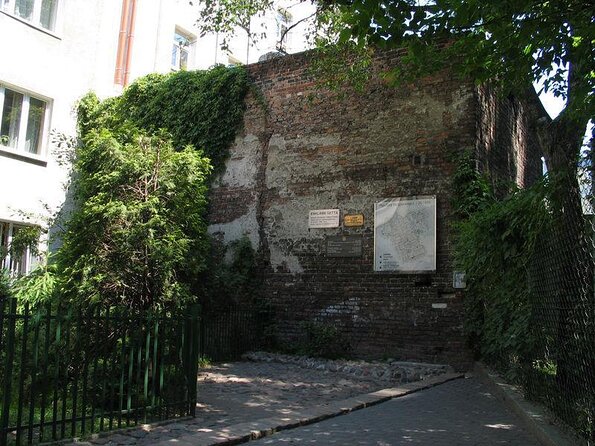
- The 1940 ghetto wall remains are easy to miss: Your guide helps you find the surviving fragments and explains their place in the former Jewish Ghetto.
- Nożyk Synagogue is Warsaw’s only surviving prewar Jewish house of prayer: Entry is meaningful, but it is closed from Friday evening through Saturday.
- The Jewish Cemetery adds a quiet, human dimension: Graves of community leaders, cultural figures, and many unnamed victims cover a long span of Jewish life in Warsaw.
- Muranów looks modern because so much was destroyed: New buildings and street art now occupy the former Large Ghetto, making a guide essential for reading the area.
- The Fiat 125p is fun but not the main event: Groups of four or more use a vintage minivan instead, so the classic-car element is strongest for smaller parties.
- The tour can follow your interests: Ask about family history, The Pianist film locations, the Warsaw Ghetto Uprising, or particular memorials.
Why this tour matters in modern Warsaw
Warsaw’s Jewish heritage cannot be understood from a single museum room or monument. The former ghetto covered a large part of the city, yet much of what you see today was built after the war. A road may look ordinary until your guide points out a wall fragment, a former boundary, or a building connected with the wartime Jewish administration.
That contrast gives this tour its purpose. You move through present-day Warsaw in a small vintage car while learning how Jewish life developed over many centuries, how the Nazi occupation changed the city, and how the community is remembered today.
I like that this is a private activity rather than a fixed group walk. You can ask questions without holding back a larger crowd, and you can tell the guide if your interest is family research, wartime history, religious sites, or cinema. Several guides have been praised for going beyond a basic script, bringing old photographs and explaining how streets looked before the war.
The subject is painful. The best guides handle it with care rather than turning the tour into a dramatic show. Reports about Karol, Marcin, Martin, Conrad, and Alex describe guides who were friendly and serious, answered detailed questions, and helped put the sites into a clear timeline.
More History Tours in Warsaw
- Warsaw: POLIN Museum of the History of Polish Jews Ticket
★ 4.7 · 1,142 reviews - Warsaw: Chopin Concert at Historical Venue in Old Town
★ 4.7 · 445 reviews - Small-Group Historical Guided Tour of Warsaw with pick up/drop off. Public Tour.
★ 4.5 · 343 reviews
Riding through the former Jewish Ghetto
Your guide picks you up from your hotel lobby if it is in the central pickup area, or meets you at the Palace of Culture and Science at pl. Defilad 1. The tour ends where it began unless another arrangement is made with the provider.
The Fiat 125p gives the outing a distinct Warsaw character. This was a familiar Polish car during the Communist period, so it adds a small piece of twentieth-century local life to a tour focused mainly on the war years. It also attracts attention on the street, and one guide even supplied snacks during the drive.
Do not expect the car itself to provide comfort on the level of a modern vehicle. One dissatisfied customer found the car poorly kept, so vehicle condition may vary. For four or more people, the company uses a vintage minivan instead. That is more practical for a larger party, but you will lose some of the tiny-car novelty.
The driving is useful because the sites are spread out. You save energy and time compared with trying to connect the ghetto wall, Chłodna Street, Muranów, the cemetery, and Nożyk Synagogue on foot. The tradeoff is that some stops are short, so listen closely and ask for a pause if you need more time.
The ghetto wall fragment and Chłodna Street
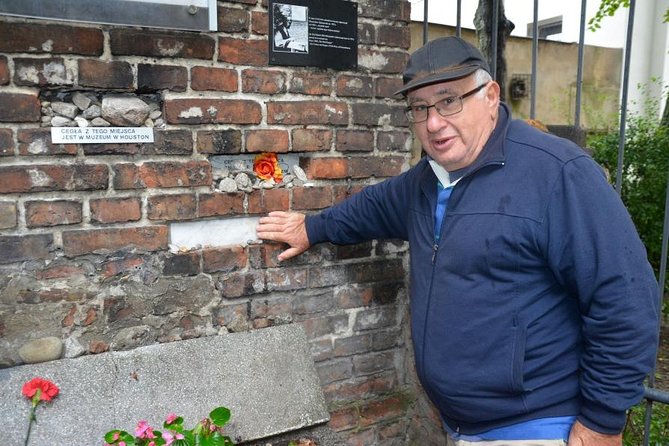
The first stop is a surviving fragment of the wall built in 1940 around the Jewish Ghetto. More than 400,000 Jews were imprisoned inside the ghetto, and the remaining section is marked with commemorative plaques.
The physical fragment is modest. That is precisely why a guide helps. Without explanation, you might walk past it and see only a small piece of brickwork. With context, it becomes a marker of a huge forced enclosure that was later largely erased from the city.
You spend about 15 minutes here, with no admission charge. It is enough for an introduction, photographs, and questions, but not a long stop. If you want a detailed family-history discussion, tell your guide early so the schedule can be adjusted where possible.
Chłodna Street follows, with about 10 minutes to see the Footbridge of Memory. The bridge once connected two parts of the ghetto over a street that remained open to the rest of Warsaw. The tour also points out the building where Adam Czerniakow, head of the Jewish Community and chairman of the Judenrat, lived.
This is one of the more effective locations because the street arrangement helps you picture the separation. Your guide may also point out a street that survived from both sides of the former ghetto area. Modern traffic and buildings make the scene look normal, so old photographs are especially useful here.
Muranów and the Ghetto Heroes Monument
The drive continues into Muranów, the former Large Ghetto. Today, modern apartment buildings and street art cover much of the area. The change can be disorienting, and it is tempting to assume little happened here because so little remains above ground.
Your guide fills in the missing parts. The half-hour visit is not a museum tour. It is a moving lesson in how a city can be rebuilt over a destroyed neighborhood while memorials and fragments preserve selected points of memory.
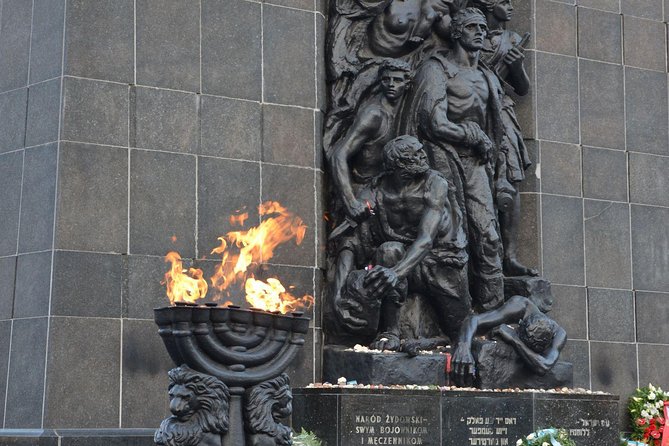
Next comes the Ghetto Heroes Monument, which commemorates the Warsaw Ghetto Uprising of 1943. The monument is one of the tour’s central stops, and its setting rewards a slower explanation. This is a place to ask about the uprising, the conditions inside the ghetto, and the difference between remembering a community and remembering a single military event.
The route also includes a memorial for people who committed a group suicide during the uprising and the departure point for transports to the Treblinka extermination camp. These are brief points along the route rather than full standalone visits, but they add important context to the area.
The guide’s skill matters most in Muranów. Some guides have used photographs to show the contrast between wartime streets and the rebuilt district. That simple visual comparison can make the history much clearer than a list of dates.
More Jewish heritage tours in Warsaw:
- Warsaw: Warsaw Ghetto Private Walking Tour with Hotel Pickup
★ 4.9 · 369 reviews - Warsaw: Ghetto, Jewish Cemetery & POLIN Museum Private Tour
★ 4.8 · 132 reviews - Tour of the Warsaw Ghetto
★ 5.0 · 119 reviews - Warsaw: Jewish Heritage & Holocaust Walking Tour
★ 4.7 · 119 reviews
POLIN Museum and the value of adding more time
The tour stops outside POLIN Museum of the History of Polish Jews. The building is not included as an interior visit during the scheduled route, and museum admission costs extra.
You can choose to visit the museum after the drive, with the guide leaving you there rather than returning you to the original meeting point. This is a sensible option if you want a full day focused on Jewish Warsaw. The tour gives you place-based orientation first, while the museum offers a much broader account of more than 1,000 years of Polish Jewish history.
I would not treat the exterior stop as a substitute for the museum. Fifteen minutes is enough to see the building and discuss its role, but not enough to explore its exhibitions. If you plan to go inside, check how much time you have available and confirm the arrangement with the guide.
The museum can also help balance the wartime focus of the tour. The route deals heavily with destruction, the ghetto, and the uprising, while POLIN presents Jewish life in Poland across a far longer period. That wider frame is important.
Nożyk Synagogue, an active place of worship
Nożyk Synagogue is described as the only surviving prewar Jewish house of prayer in Warsaw. Unlike a memorial that exists only to mark the past, it remains an active place of worship.
The visit lasts about 30 minutes, and admission is not included. You may be asked to cover your head at Jewish sites, so carry a suitable covering or be prepared to follow the site’s instructions.
The synagogue is closed from Friday evening throughout Saturday for the Sabbath. This is the single most important scheduling warning. A tour beginning at 5 p.m. may still have daylight for the outdoor stops, but it cannot include entry to the synagogue if access has ended.
That timing problem has caused real disappointment for visitors who wanted the interior. Book a morning or earlier afternoon departure if the synagogue is a priority. Do not assume that a late summer sunset means indoor sites remain open.
The Jewish Cemetery and the people behind the dates
The Jewish Cemetery is another 30-minute stop, with admission extra. It is closed from Friday evening through Saturday, like the synagogue.
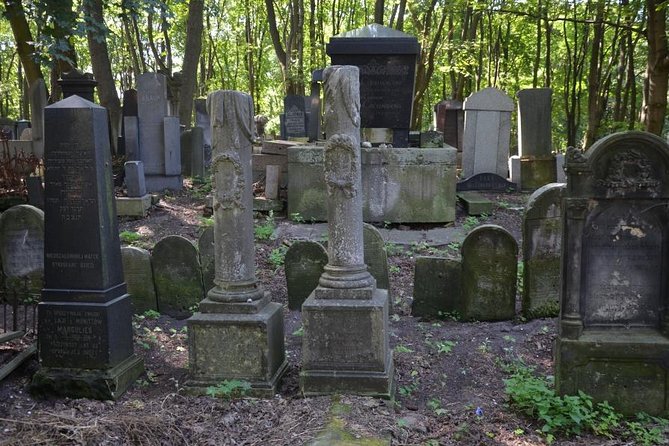
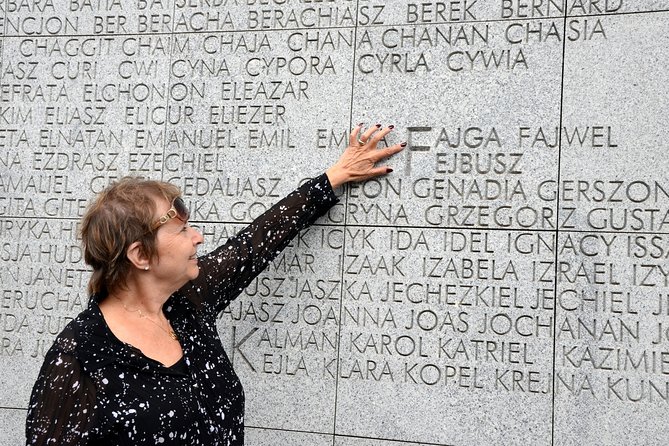
The cemetery contains graves associated with more than 200,000 people, including spiritual and political leaders, creators of Jewish culture, and many unnamed victims of the ghetto. It also represents generations of Jewish Varsovians, not only those who died during the Nazi occupation.
This is often the most affecting part of the route because it brings the story back to individuals and families. Gravestones, names, and worn inscriptions create a different experience from the large public monuments. I would pay the extra admission if you have an interest in Jewish genealogy, religious history, or the human scale of Warsaw’s past.
The half-hour visit is useful but limited. You will not see every corner of such a large cemetery. Ask your guide to focus on the people or themes that matter most to you, especially if you have a family connection to Warsaw.
Comfortable shoes are sensible, though the provided information does not specify the condition of every path. More important is allowing enough time. A rushed cemetery stop can feel like a checklist, while a careful one gives the whole tour greater meaning.
How good is the private guiding?
The strongest part of this experience is the guide, not the car. Karol was praised for his historical training, detailed explanations, and flexibility. Marcin was described as warm and passionate, with excellent English. Martin received particular praise for making an 800-year story understandable, including personal reflections on life in Poland before and after the Cold War.
Other guides named in the feedback include Alex, Alec, Conrad, Konrad, and Max. The exact guide is not guaranteed, but the repeated strengths are clear: punctual pickup, safe driving, strong English, patience with questions, and the ability to connect places with events.
A private format gives you room to ask about family names, wartime decisions, Communist-era Warsaw, modern Jewish life, or film locations from The Pianist. One guide patiently allowed a stop at Mi Polin, a shop near a synagogue selling mezuzot made from molds of original doorposts from Jewish homes in Polish towns.
That flexibility is valuable, but you should use it actively. Tell the company about special interests when booking, then remind the guide at the start. One weaker experience involved a mismatch between the customer’s stated interests and what the guide covered. Clear communication cannot guarantee a particular guide, but it improves your chances of getting the tour you want.
What the $108.28 price delivers
At $108.28 per person, this tour costs more than joining a standard walking tour. You are paying for a private vehicle, hotel pickup and drop-off in central Warsaw, an English-speaking driver-guide, and a route that links sites spread across the city.
For one person, the price may feel high. For a couple or small private group, it buys convenience and personal attention. You do not need to navigate public transport between scattered locations, and you can ask questions throughout the four hours.
Group discounts are available, though the supplied details do not give the discount amount. Groups of four or more use a vintage minivan, so confirm the vehicle if the Fiat is central to your plans.
The cemetery and synagogue charge separate admission, and the POLIN Museum is also extra. Build those costs into your budget. The outdoor memorials and wall fragment do not require admission.
The value is best for someone who wants a guided introduction rather than a quick photo tour. If you already know Warsaw’s Jewish history well and mainly want transportation, you may find the four hours more than you need. If you want context, questions answered, and a route tailored to your interests, the price is easier to justify.
Timing, clothing, and practical planning
The tour lasts about four hours. Hotel pickup is offered only in the city center, although the provider may find another meeting solution if your hotel lies outside the normal area.
The official meeting point is the Palace of Culture and Science. If you are not being collected at your hotel, confirm the exact meeting arrangement before the day of the tour.
Choose your start time with care. A morning or early afternoon departure gives you the best chance of entering both Nożyk Synagogue and the Jewish Cemetery. Friday evening and Saturday are poor choices for those two stops because both are closed for the Sabbath.
Bring a head covering for visits to Jewish religious sites. Museum admission is optional, and you can be left at POLIN after the driving portion if you decide to continue there.
The tour is offered in English, and most people can participate. It is near public transportation, but the main advantage is avoiding the need to connect the distant stops yourself.
Free cancellation is available up to 24 hours before the start time. Changes or cancellations inside that window are not accepted for a refund.
Who should book this Warsaw tour?
I would choose this tour if you have four hours, want a private guide, and care about understanding the places rather than merely seeing them. It suits people with Jewish family connections, anyone studying World War II, and first-time visitors who want a focused introduction to Warsaw’s Jewish past.
It is also a good choice if you have already taken a general city tour and found the Jewish history too briefly covered. The private setting lets you go further, ask direct questions, and request film locations or family-history connections.
I would hesitate if you mainly want to ride in a classic car. The Fiat is a pleasant bonus, but the vehicle may be replaced by a vintage minivan for larger groups, and one poor account raised concerns about car condition. I would also hesitate for a late tour if entering the synagogue and cemetery matters to you.
For the best experience, book before your visit, choose a time that allows indoor access, and tell the company exactly what you hope to learn. The repeated praise for guides such as Karol, Marcin, Martin, and Conrad suggests that the human side of the tour is its real strength.
FAQ
How long does the Warsaw Jewish Heritage by Retro Fiat tour last?
The tour lasts approximately four hours.
Where does the tour start?
The listed meeting point is the Palace of Culture and Science at pl. Defilad 1, 00-901 Warsaw. Hotel pickup is also offered in the city center.
Does the tour return to the starting point?
Yes. The activity ends back at the original meeting point unless the guide leaves you at POLIN Museum by prior arrangement.
Is the tour private?
Yes. Only your group participates in the private activity.
What vehicle is used?
The standard vehicle is a private retro Fiat 125p. Groups of four or more are driven in a vintage minivan instead.
Is hotel pickup included?
Yes, hotel pickup and drop-off are included for hotels in the city center. If your hotel is outside the pickup area, contact the provider to discuss another meeting solution.
Is admission to Nożyk Synagogue included?
No. Admission to Nożyk Synagogue is not included. The synagogue is closed from Friday evening through Saturday for the Sabbath.
Is the Jewish Cemetery open every day?
No. The Jewish Cemetery is closed from Friday evening through Saturday. Admission is not included.
Can I visit POLIN Museum during the tour?
The tour includes an exterior stop at POLIN Museum. Museum entry costs extra, and the guide can leave you there after the tour if you choose to visit inside.
Should I cover my head during the tour?
You may be required to cover your head when visiting some Jewish sites. Plan to follow the instructions at the synagogue and other religious locations.
Just added in Warsaw
- Historical Walking Tour of Jewish Warsaw★ 5.0 · 68 reviews
- Deluxe Polish Food Tour Experience in Warsaw★ 5.0 · 19 reviews
- CO2-Offset Arrival Transfer from Warsaw Airport to Warsaw City★ 5.0 · 1 review
- Amazing photo walk through the Old town of Warsaw★ 5.0 · 32 reviews
- 8-day tour around Poland by private car★ 5.0 · 2 reviews
- 2 Hour Super Segway City Tour of Warsaw★ 5.0 · 5 reviews
- Electric Scooter Tour: Full Tour – 3-Hours of Magic!★ 5.0 · 3 reviews
- 2h Rental of Motorboat for 10 in Warsaw no License Needed★ 5.0 · 1 review