
REVIEW · JEWISH QUARTER TOURS
Tour of the Warsaw Ghetto
Warsaw’s past is written into its streets. This three-hour tour connects surviving buildings, wall fragments, memorials, and former ghetto sites with a clear account of Jewish life, Nazi persecution, and the 1943 uprising. I like the way the tour uses old photographs and maps to show what has vanished, and I like that it combines walking with about 30 minutes on public transport. The main drawback is the heavy subject matter, along with a lot of walking on a tour that is not suited to children.
The tour costs $102.78 per person and includes hotel pickup in central Warsaw, a licensed city guide, and private participation for your group. You will pay an additional €5 to enter Nożyk Synagogue, and the main POLIN Museum exhibition is not part of the tour, so plan extra time if you want to visit it properly.
In This Review
- Key points to know before booking
- Why this tour adds meaning to Warsaw
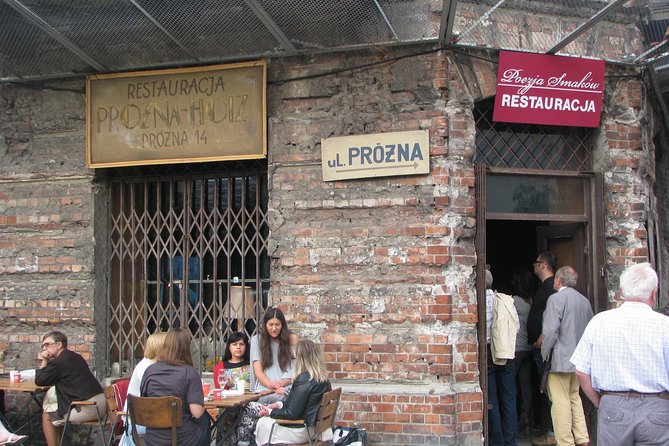
- Starting at Próżna and Nożyk Synagogue
- Próżna and Waliców: fragments of a destroyed district
- Chłodna Street and the vanished bridge
- Umschlagplatz and the machinery of deportation
- POLIN, the ghetto uprising, and Willy Brandt
- Miła 18 and the last chapter of the uprising
- Pawiak Prison and the wider occupation
- Walking, public transport, and the pace
- Is $102.78 good value?
- Who should book this Warsaw tour?
- Should you book it?
- FAQ
- How long does the Warsaw Ghetto tour last?
- How much does the tour cost?
- Is hotel pickup available?
- What sign will the guide carry?
- Is Nożyk Synagogue admission included?
- Is the POLIN Museum’s main exhibition included?
- Does the tour operate on public transport?
- Can I cancel for a full refund?
Key points to know before booking
- Old photographs make vanished streets visible: Guides use maps and large historical photos to explain how the ghetto looked before wartime destruction.
- The route covers major sites: You visit Nożyk Synagogue, Próżna, Waliców, Chłodna Street, Umschlagplatz, POLIN, the Willy Brandt memorial, Miła 18, and Pawiak Prison.
- Expect plenty of walking: About 2.5 hours are spent on foot, with roughly 30 minutes using buses, trams, or the underground.
- Marzena receives especially strong praise: She is known for careful storytelling, clear English, thoughtful answers, and a sensitive approach to painful material.
- The tour gives Warsaw’s ghetto story a physical setting: You do not just hear dates and names. You visit the places where key events happened.
- The synagogue schedule matters: On Friday afternoons from 1 p.m., Saturdays, and Jewish holidays, the synagogue visit is omitted.
Why this tour adds meaning to Warsaw
Warsaw was almost completely destroyed during the Second World War, and the former ghetto is not preserved as one enclosed historic district. Modern roads and buildings now cross the area. That can make the story difficult to follow on your own.
This tour solves that problem by linking scattered traces into one route. A wall fragment at Waliców, a surviving street at Próżna, and the empty space around Umschlagplatz may look modest at first. With a guide, maps, photographs, and a timeline, each place gains a clear role.
I like this approach because it avoids treating the ghetto as a single museum display. You see the city as it exists now while learning how the German occupation changed it. The contrast between present-day Warsaw and old images is part of the lesson.
The guide also explains daily life, not only the most famous events. You learn how the ghetto was formed, how people lived under forced confinement, how the two sections were connected, and why armed resistance eventually took place. The story moves toward the deportations, the destruction of the ghetto, and the uprising in 1943.
This is a serious tour. It includes starvation, persecution, deportation, murder, and the deliberate destruction of a community. The tone is respectful rather than theatrical. A skilled guide can make the material understandable without turning suffering into a spectacle.
More Jewish heritage tours in Warsaw:
- Warsaw: Warsaw Ghetto Private Walking Tour with Hotel Pickup
★ 4.9 · 369 reviews - Private Tour: Warsaw’s Jewish Heritage by Retro Fiat
★ 5.0 · 208 reviews - Warsaw: Ghetto, Jewish Cemetery & POLIN Museum Private Tour
★ 4.8 · 132 reviews
Starting at Próżna and Nożyk Synagogue
The published meeting point is Próżna 11, in central Warsaw. If your hotel is in the city center, the guide can collect you from reception with a PolinTours sign. If you are staying in an apartment, you are asked to wait outside.
The order of stops may change depending on your hotel location. That is practical, since the tour uses public transport as well as walking. You should not expect a rigid loop that begins and ends in the same place.
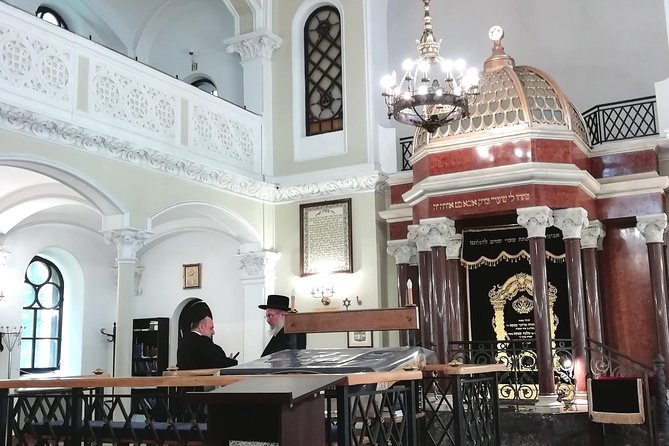
Nożyk Synagogue is the only synagogue in Warsaw that survived the Second World War and remains in operation. The visit lasts about 15 minutes, which is enough for a focused introduction rather than a long architectural tour.
Admission is not included. The extra charge is €5 per person. The synagogue is also subject to religious scheduling, so the tour does not enter on Friday afternoons from 1 p.m., Saturdays, or Jewish holidays.
That limitation is worth checking before you book. The synagogue is an important part of the route, but the tour still covers the main ghetto sites when it is closed.
Próżna and Waliców: fragments of a destroyed district
Próżna is one of the last surviving streets connected with the former ghetto area. You spend about 20 minutes here, learning how the neighborhood looked and what happened to its Jewish residents.
This is where the guide’s photographs matter. Modern Warsaw does not always reveal the former street plan, so an old image can show a building frontage, a street corner, or a line of people that is no longer visible. You begin to understand that the ghetto was not an abstract wartime zone. It was a dense urban community with homes, shops, schools, religious life, and families.
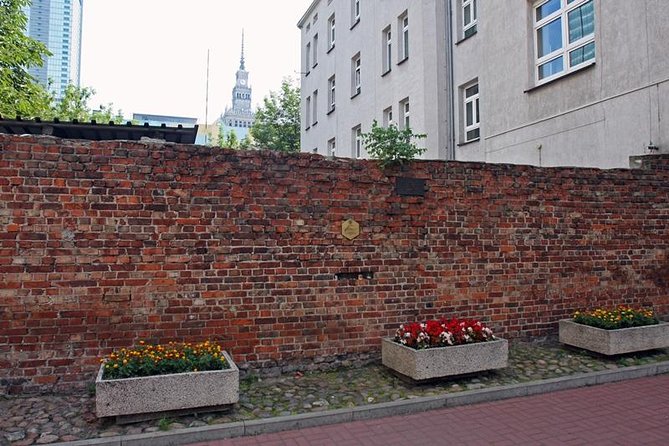
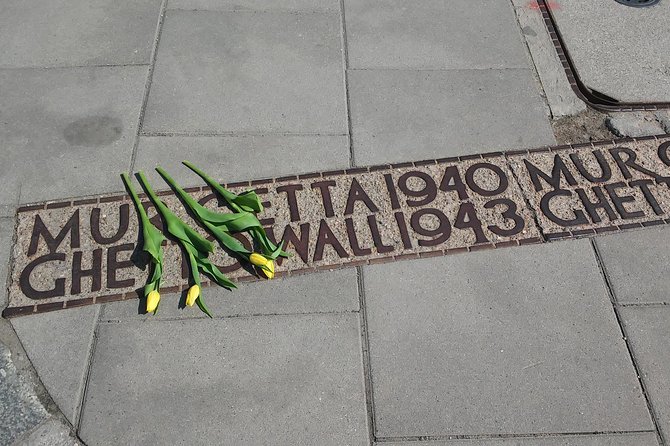
At Waliców, you see fragments of the ghetto wall. The stop takes about 15 minutes, but the physical remains carry unusual weight. Even a partial wall can help you grasp the system of forced separation created by the German occupation.
The guide covers the origins of the ghetto, everyday conditions, and the 1943 uprising. You also hear how the district was altered and destroyed. Bullet holes and surviving sections of old buildings may be visible along the route, although the precise remains you see can depend on the walking path and current city conditions.
I find these stops valuable because they prevent the ghetto from becoming only a sequence of dates. You are standing in the former district, looking at pieces of the built city that survived when so much else did not.
Chłodna Street and the vanished bridge
Chłodna Street marks the former location of the bridge connecting the Small Ghetto and the Big Ghetto. The bridge became one of the best-known symbols of the Warsaw Ghetto because it physically separated and connected sections of the district above the street.
The bridge itself is gone. That is precisely why the stop benefits from a guide with photographs and maps. You can stand at the location and compare the ordinary modern street with the wartime image of the elevated wooden passage.
The tour also brings in the story of Władysław Szpilman, the musician whose life was later portrayed in Roman Polański’s film The Pianist. His connection helps place the street within a personal wartime account, though this is not a film-location tour.
You spend about 20 minutes here. The stop works best if you pay attention to the geography. The guide explains why the bridge was needed, how the two areas functioned, and what the division meant for people trying to move through the ghetto.
A few more in Warsaw
- Warsaw: Chopin Concert in the Old Town
★ 4.8 · 2,287 reviews - Warsaw: Traditional Galar Cruise on The Vistula River
★ 4.6 · 1,640 reviews - Warsaw: Old Town Highlights Walking Tour in English
★ 4.7 · 1,516 reviews - Warsaw Concert: Chopin – Painted by Candlelights with Wine
★ 4.8 · 1,442 reviews
Umschlagplatz and the machinery of deportation
Umschlagplatz is one of the most difficult places on the route. This was the assembly and departure point used for deportations as the Germans carried out their plan to murder Europe’s Jews.
The stop lasts about 15 minutes. The guide explains the site’s symbolic meaning and how the deportation process worked. You are not simply shown a memorial and given a date. You learn how bureaucracy, deception, confinement, and transport worked together.
This part of the tour can feel stark because the present-day surroundings do not always match the scale of what happened there. That contrast is hard to avoid in Warsaw. The guide’s role is to connect the quiet street and memorial with the vast human cost.
You may want a short pause after this stop. The itinerary moves on, but the subject does not become lighter. The experience is most useful when you give yourself permission to listen quietly rather than rush from one location to the next.
POLIN, the ghetto uprising, and Willy Brandt
The route continues toward the POLIN Museum of the History of Polish Jews. The tour introduces Jewish life in the ghetto, the reasons people took up arms, and the people who offered help.
The emphasis here is on the uprising and its setting. You learn about the fighters, the desperate circumstances behind the resistance, and the wider destruction of Warsaw’s Jewish community. One useful feature is the guide’s attention to the difference between armed resistance and the many other ways people tried to survive or help under occupation.
The tour does not include the main POLIN exhibition. That is important. POLIN is a major museum, and the permanent exhibition requires about 2.5 hours if you want to see it properly. Audio guides are available in German, and the museum is closed on Tuesdays.
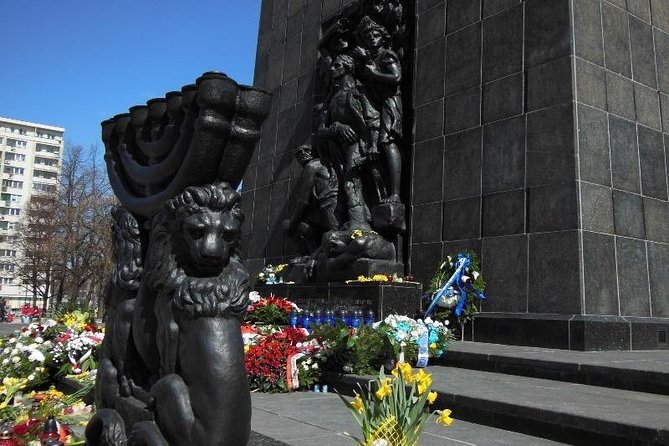
The tour passes the Ghetto Heroes Memorial and the nearby Willy Brandt memorial. At this location, Willy Brandt made his famous gesture of kneeling during a 1970 visit to Warsaw. The guide explains its meaning and its place in postwar memory.
You spend about 15 minutes at POLIN and another 10 minutes at the Brandt memorial. These short stops are introductions, not substitutes for a museum visit. I would schedule POLIN separately if you have the time, especially if Jewish history in Poland is a major reason for your trip.
Miła 18 and the last chapter of the uprising
At Miła 18, you see the former location of the bunker used by Jewish resistance fighters. The stop lasts about 10 minutes and focuses on the final phase of the uprising.
The site is not a preserved bunker that you enter. Instead, the location and memorial help you understand where the resistance leaders gathered and how the uprising ended. The guide places Miła 18 within the larger story, rather than presenting it as an isolated heroic episode.
That balance matters. The Warsaw Ghetto Uprising is rightly remembered for courage, but the fighters faced overwhelming force, limited weapons, and almost no chance of military victory. The tour explains why resistance happened and what it meant, without suggesting that the outcome could have been different.
Some people may want more time on the uprising itself. The route covers many locations in three hours, so the discussion has to share time with the ghetto’s formation, daily life, deportations, and postwar memory.
Pawiak Prison and the wider occupation
The final listed stop is the Pawiak Prison Museum. You spend about 10 minutes learning about the prison, which was used by the German occupiers during the war.
Pawiak broadens the story beyond the ghetto walls. It helps explain the wider system of imprisonment and terror affecting Warsaw’s Jewish and Polish populations. The stop is brief, so it works mainly as context and a closing reminder that the ghetto was part of a much larger occupation system.
The tour ends at Mordechaja Anielewicza 6, near POLIN Museum. That makes it easy to continue with the museum if it is open, or to stop for a meal and a quiet break after the tour.
Walking, public transport, and the pace
The practical description is about 2.5 hours on foot and 30 minutes on public transport. That is a lot of walking, especially because the tour deals with many separate sites rather than one compact complex.
You should wear comfortable shoes and expect time outdoors. Public transport is part of the experience, not just a way to save steps. Buses, trams, or the underground help connect the former ghetto sites and show how the modern city has grown around them.
The route may include busy streets, ordinary neighborhoods, and market areas. One group described riding two forms of public transport and passing through a farmers market, which shows how the tour connects memorial sites with daily Warsaw life.
The pace is generally helped by short stops of 10 to 20 minutes. Still, the amount of information is high. Marzena is especially praised for making the three hours pass quickly, answering questions patiently, and using photographs and maps effectively. Guides may vary, but the strongest reports describe clear English and a sensitive, engaging style.
Is $102.78 good value?
At $102.78 per person, this is not a cheap walking tour. The value depends on what you want from Warsaw.
You are paying for a private experience with only your group, hotel pickup in central Warsaw, a licensed guide, public transport connections, and a carefully connected route through sites that can be hard to identify alone. The guide’s photos, maps, and historical explanations are the real product.
The price makes more sense if you have limited time or want a serious introduction without spending hours planning the route. It is also useful if you want to ask questions as you go. A standard group tour may cost less, but it may not offer the same private format or flexibility.
Remember to add €5 for Nożyk Synagogue when it is open. Also budget separate time for the POLIN main exhibition if you want the museum experience.
The tour is free to cancel up to 24 hours before the start time. Changes or cancellations made less than 24 hours ahead are not accepted for a refund.
Who should book this Warsaw tour?
I would choose this tour if you want historical context, real locations, and a guide who can explain the city through old images. It suits adults and older teenagers who can handle difficult material and several hours of walking.
It is especially useful for first-time visitors with only one free day in Warsaw. You will see the key sites without having to work out the route yourself, and you will leave with a clearer sense of how the ghetto fit into the city.
I would not choose it for young children, anyone seeking a light sightseeing outing, or anyone who dislikes walking and public transport. The tour is emotionally demanding, and some stops are intentionally quiet and sobering.
Should you book it?
Yes, if you want a serious and personal introduction to the Warsaw Ghetto. The strongest reasons are the route’s range, the use of historical photographs, the private format, and guides such as Marzena, who bring patience and care to a painful subject.
Before booking, check the synagogue schedule, allow for the €5 admission fee, and keep an afternoon free for POLIN if you want its full exhibition. Go prepared for 2.5 hours of walking and difficult history. If that sounds right for you, this tour offers one of the clearest ways to understand Warsaw’s Jewish past through the places where it unfolded.
FAQ
How long does the Warsaw Ghetto tour last?
The tour lasts approximately three hours.
How much does the tour cost?
The listed price is $102.78 per person.
Is hotel pickup available?
Yes. Pickup is offered from the reception of hotels in central Warsaw. If you stay in an apartment, you should wait outside for the guide.
What sign will the guide carry?
The guide will carry a PolinTours sign.
Is Nożyk Synagogue admission included?
No. Admission costs €5 per person and is paid separately.
Is the POLIN Museum’s main exhibition included?
No. The tour does not visit the main exhibition. A separate visit is recommended, and you should allow about 2.5 hours for it.
Does the tour operate on public transport?
Yes. The experience combines walking with buses, trams, or the underground. About 2.5 hours are spent walking and about 30 minutes using public transport.
Can I cancel for a full refund?
Yes, if you cancel at least 24 hours before the experience begins. Cancellations made less than 24 hours before the start time are not refunded.
Just added in Warsaw
- Historical Walking Tour of Jewish Warsaw★ 5.0 · 68 reviews
- Deluxe Polish Food Tour Experience in Warsaw★ 5.0 · 19 reviews
- CO2-Offset Arrival Transfer from Warsaw Airport to Warsaw City★ 5.0 · 1 review
- Amazing photo walk through the Old town of Warsaw★ 5.0 · 32 reviews
- 8-day tour around Poland by private car★ 5.0 · 2 reviews
- 2 Hour Super Segway City Tour of Warsaw★ 5.0 · 5 reviews
- Electric Scooter Tour: Full Tour – 3-Hours of Magic!★ 5.0 · 3 reviews
- 2h Rental of Motorboat for 10 in Warsaw no License Needed★ 5.0 · 1 review