
REVIEW · COMMUNISM TOURS
Private Tour: Warsaw’s Communist History by Retro Fiat
Old Warsaw comes with a Fiat soundtrack. This private four-hour tour links Socialist-era landmarks with personal stories, giving you a clearer view of how Communist Poland shaped the city. I like the unusual transport and the chance to ask direct questions without sharing the car with a large group.
I also like the mix of major sights and less polished corners, from Stalin-era housing to Praga’s old market district. Guides such as Jacob, Olga, Martin, Karol, and Pawel have been praised for clear English and personal memories. The main drawback is that the tour can depend heavily on your guide, and one disappointing experience reported too little Communist history and too much general driving.
In This Review
- What makes this Warsaw tour worth considering
- Why the Fiat 125p changes the experience
- The Palace of Culture starts the story
- Constitution Square shows the planned city
- Censorship gets a brief but important stop
- The former Party House connects politics and power
- Praga Północ reveals a different Warsaw
- Bazar Różyckiego and the black-market economy
- Mariensztat brings the tour back to housing
- The guide makes or breaks the four hours
- Four hours and the value of a private car
- Who should book this Communist Warsaw tour?
- Should you book it?
- FAQ
- How long does the tour last?
- What vehicle is used?
- Is the tour private?
- Is hotel pickup available?
- What language is the tour offered in?
- Is admission to the Palace of Culture and Science included?
- Are food and drinks included?
- Where does the tour end?
- Can I cancel for a full refund?
What makes this Warsaw tour worth considering
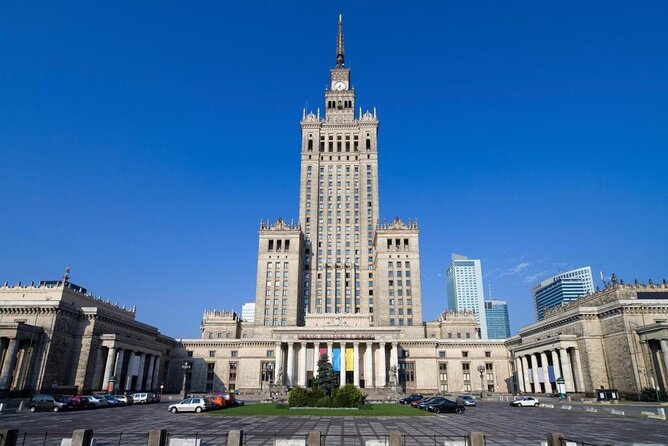
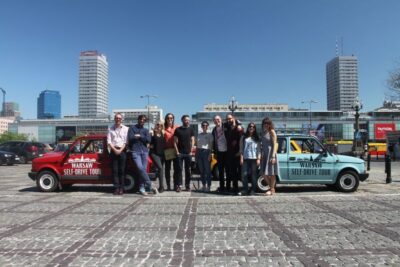
- Ride in a Polish Fiat 125p: The vintage car is not just decoration. It turns the journey between stops into part of the story and often draws smiles from people on the street.
- See Communist Warsaw beyond the Palace of Culture: The route includes Constitution Square, the former Party House, Praga Północ, Mariensztat, and the old black market.
- Ask questions freely: Because the tour is private, your guide can adjust the pace and spend more time on architecture, censorship, daily life, or political leaders.
- Hear lived memories: Some guides grew up during the Communist period or during the transition away from it, adding family stories to the formal history.
- Hotel pickup and drop-off: You do not need to find your way to every stop or work out Warsaw’s tram system for this four-hour outing.
- Check expectations before departure: The tour is advertised as a Communist history experience, so ask your guide to follow the stated route if you want a focused history lesson rather than a broad city drive.
Why the Fiat 125p changes the experience
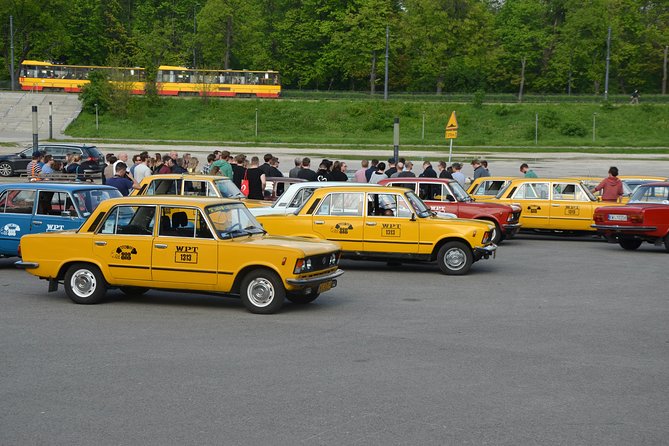
The transport is one of the strongest reasons to book this tour. You ride in a private Fiat 125p, a Polish-made car closely tied to the country’s Communist period. It is an old-fashioned way to move through modern Warsaw, and that contrast gives the outing a sense of place from the moment you get in.
I like that the car connects the subject to everyday life. The tour is not only about party buildings and monuments. It is also about the objects, streets, apartment blocks, and public spaces that ordinary people saw each day. The Fiat helps keep that focus close to the ground.
The car is also practical. Warsaw’s Communist-era sights are spread across several districts, and driving lets you cover more ground than a walking tour. You still get short walks at several stops, but you avoid spending the whole afternoon crossing town by tram or on foot.
Do not expect modern limousine comfort. A vintage car is part of the appeal, but it may feel tighter and less forgiving than a regular tour vehicle. The experience works best if you see the Fiat as a piece of living history rather than simply a ride.
More Communism Tours in Warsaw
- Warsaw: Communism Tour in an Original Socialist Van
★ 4.9 · 75 reviews - Warsaw: Communist History Self-Driving Tour
★ 4.8 · 52 reviews - Warsaw: Communism Tour in an Original Socialist Van
★ 4.5 · 35 reviews
The Palace of Culture starts the story
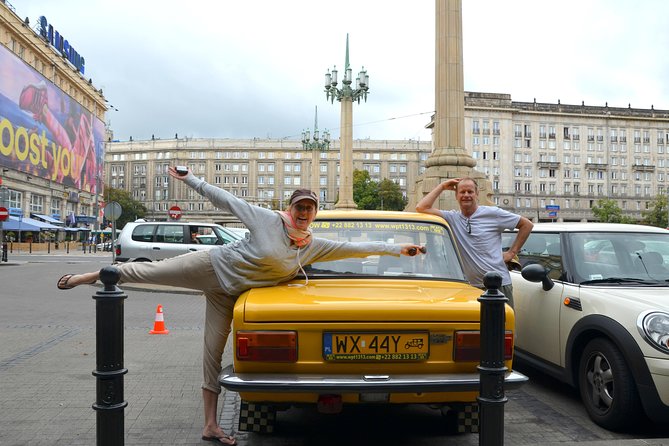
The Palace of Culture and Science is the natural opening stop. It is Warsaw’s most recognisable building and the tallest building in Poland, with theatres, museums, a cinema, pubs, and other businesses inside today.
Your guide uses the building to explain the politics behind its construction and its Socialist Realist style. That context matters. The Palace is not simply a grand tower to photograph. It represents the way Soviet influence was presented through monumental architecture, even though many people in Warsaw viewed the building with mixed feelings.
You have about 30 minutes here. The tour does not include an admission ticket, so the emphasis is on the exterior and the surrounding story rather than a guaranteed visit inside. If you want to explore the interior attractions or go higher, ask your guide whether there is enough time and how tickets would work.
The Palace is also useful as a reference point. Once you have seen its scale, later stops make more sense. The tour can then show you how the same political system appeared in housing, offices, squares, and public monuments.
Constitution Square shows the planned city
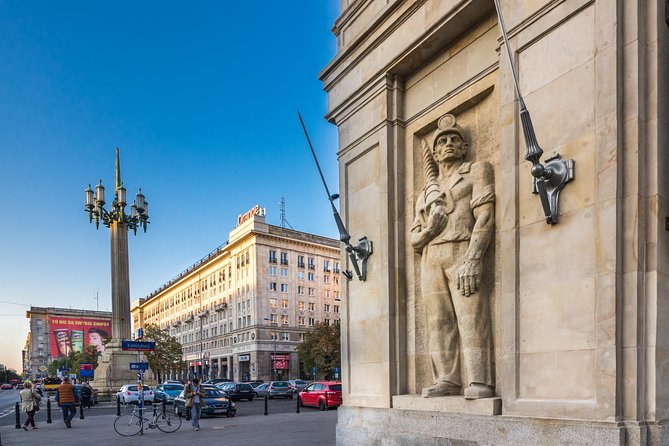
Plac Konstytucji, or Constitution Square, offers a more human-sized look at Stalin-era design. The square is part of a representative Communist housing district, built to present order, power, and a model of urban life.
I find this kind of stop more useful than simply collecting famous buildings. Here you can look at the relationship between the apartments, the open space, and the decorative details. Your guide can explain what the district was meant to communicate and how its grand public image differed from the realities of daily life.
The stop lasts about 30 minutes and is free. It is primarily an exterior visit, so wear shoes that are comfortable for a short walk and pause. The square is a good place to ask about housing standards, propaganda in architecture, and the difference between showcase buildings and ordinary apartment blocks.
The route also includes the Communist Ministerial District, created in the Socialist Realist style. This adds an official government side to the residential architecture at Constitution Square. Together, the two areas help you see how the system built both homes and offices as part of one carefully planned public image.
Censorship gets a brief but important stop
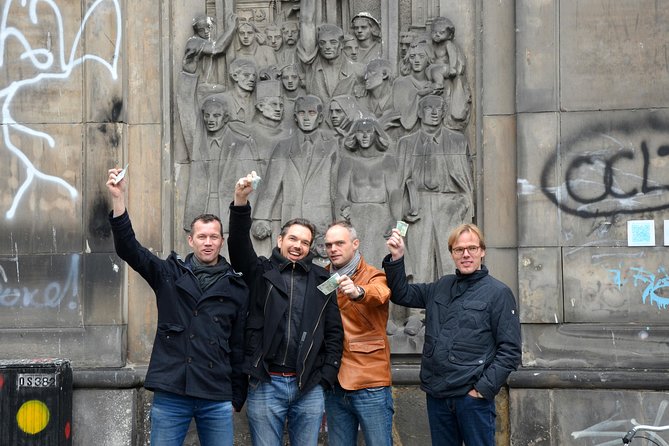
The Monument of the Free Word is a small stop, listed at about five minutes, but the subject is much larger. It opens a conversation about censorship in Communist Poland and the daily control of printed information.
This is where the quality of the guide matters most. A short pause at a monument cannot explain the whole system by itself. A good guide can use it as a starting point, explaining how censorship affected writers, newspapers, publishers, and ordinary readers.
I would ask about the practical side of censorship rather than only the official rules. What could be printed? What was removed? How did people find information outside approved channels? The private format gives you room to ask questions that would be difficult in a large group.
Because the stop is brief, do not expect a long museum-style presentation here. Its value comes from the discussion around it.
More History Tours in Warsaw
- Warsaw: POLIN Museum of the History of Polish Jews Ticket
★ 4.7 · 1,142 reviews - Warsaw: Chopin Concert at Historical Venue in Old Town
★ 4.7 · 445 reviews - Small-Group Historical Guided Tour of Warsaw with pick up/drop off. Public Tour.
★ 4.5 · 343 reviews - Warsaw: Jewish History Guided Walking Tour in English
★ 4.7 · 324 reviews
The former Party House connects politics and power
At the Statue of Charles de Gaulle, the tour points out the former Communist Party House, also described as the Polish White House. You spend about 15 minutes here, hearing about the leaders and institutions that directed Poland during the Communist period.
This is another stop where the building matters less than the explanation. The guide can help you connect political power with the streets you have already seen. The Palace of Culture represented Soviet influence through architecture. Constitution Square represented a planned social order. The Party House points to the people and structures making decisions behind that public image.
The stop is free and outside. It is short, so I would treat it as a focused political-history pause rather than a full visit. If you are especially interested in leadership, government, or the Cold War, tell your guide early. Several guides have been praised for adapting the conversation to individual interests.
Praga Północ reveals a different Warsaw
Praga Północ gives the tour a change of mood. This district was not badly destroyed during the Second World War, so it preserves a different set of buildings and streets from much of central Warsaw. The tour presents it as an important district during the Communist period.
You will spend around 30 minutes here. The value is in seeing how the city’s history varies from one neighborhood to another. Central Warsaw often tells a story of rebuilding and official grandeur. Praga can offer a more uneven picture, with older structures, later changes, and visible contrasts between past and present.
Several accounts of the tour describe guides pointing out streets and buildings that standard city tours often skip. One guide also showed areas experiencing gentrification, allowing the group to compare older conditions with newer development. That makes Praga useful for understanding that Warsaw’s Communist legacy is not sealed in a museum. It remains part of the city’s changing neighborhoods.
The district is also a good place to ask how people actually lived. Formal plans and public slogans tell only part of the story. Apartment conditions, shop supplies, public services, and neighborhood life can make the period easier to understand.
Bazar Różyckiego and the black-market economy
Bazar Różyckiego is presented as the most famous black market in Communist Poland. The stop lasts about 15 minutes and is free.
This is one of the most revealing parts of the route because it shifts attention from official policy to practical survival. Shortages and restrictions created a gap between what the state supplied and what people wanted or needed. Markets such as this one became places where goods could circulate outside the official system.
Do not expect a long shopping visit. The point is the site and its story. Ask your guide how the market worked, what kinds of goods were associated with it, and how people viewed unofficial trade.
For me, this stop gives balance to the grand architecture. The Palace of Culture and government buildings show what the state wanted to project. Bazar Różyckiego points to how people navigated the system in real life.
Mariensztat brings the tour back to housing
Mariensztat Square is another short walking stop, lasting about 20 minutes. Here you see Communist-era housing blocks in the Mariensztat district.
The area helps explain how reconstruction and Socialist planning shaped residential life. It is not only a question of how buildings look. Your guide can place the housing in the broader story of what the government promised, what it built, and how those homes compared with other districts.
This stop works well after Praga and the market because it brings the subject back to ordinary urban space. You have seen official buildings, political institutions, censorship, and informal trade. Now you can consider the homes that formed the daily setting for many residents.
The itinerary lists the stop as free, with no separate admission. Expect to walk around the square rather than enter a museum or apartment.
The guide makes or breaks the four hours
The private format is a major advantage. Only your group participates, and the guide can respond to your questions instead of giving the same speech to a busload of people. The strongest accounts describe guides who adjusted the route, answered unusual questions, and shared personal or family experiences.
Jacob was praised for being flexible and open to discussion. Karol was noted for covering lesser-known locations and architectural examples. Konrad brought a strong Cold War focus, while Olga connected the period with what her family experienced. Martin, Max, Adam, Marcin, and Pawel were also singled out for friendly and engaging guidance.
That is a useful sign, but it also reveals a risk. The tour is not a fixed museum exhibition with identical content every time. The guide’s preparation, interests, and willingness to follow the theme matter greatly.
One poor experience involved a guide asking the group what it wanted to see, then spending much of the time on general Warsaw sights instead of following the Communist itinerary. If this history is your main reason for booking, say so clearly at the start. Mention the stops you most want to cover and ask for explanations tied to the Communist period.
The tour is offered in English. The strongest guide accounts describe fluent English and the ability to discuss difficult historical questions without turning the outing into a simple political slogan.
Four hours and the value of a private car
The tour lasts about four hours, which is enough time to connect several districts without rushing from one photograph to the next. It is also long enough for a conversation, especially because the driving links the stops.
At $108.24 per person, the price needs to be judged by group size. For one person, it is a sizeable half-day expense. For a small private group, the cost buys a dedicated guide, a private vehicle, hotel pickup and drop-off, and a route that covers more ground than a standard walk.
There are no food or drinks included unless specifically stated at booking. One account referred to a snack and vodka tasting, plus a souvenir photo, but those extras were not provided on that occasion. I would not count on them unless the operator confirms them directly.
The tour has a 4.9 rating from 115 reviews, with 98 percent recommending it. Those figures support the idea that the experience usually delivers strong personal service, but they do not remove the need to clarify the route and included extras.
Pickup is offered from your hotel lobby or in front of the building. If your hotel is outside the normal pickup area, the provider asks you to make contact so another arrangement can be found. The listed start point is Dworzec Centralny, and the activity ends back at the meeting point, so confirm the exact return plan if you are relying on hotel drop-off.
You can cancel for a full refund up to 24 hours before the start time. Changes or cancellations made less than 24 hours before departure are not accepted for a refund.
Who should book this Communist Warsaw tour?
I would choose this tour if you want history explained through buildings, streets, and personal stories rather than only dates. It suits first-time visitors who want a structured introduction to Warsaw’s postwar development, as well as repeat visitors looking for districts beyond the central sights.
It is especially good for people interested in Cold War politics, Socialist Realist architecture, censorship, housing, black markets, and the daily effects of state control. The Fiat makes it a fun choice for anyone who enjoys unusual transport and does not want a routine sightseeing vehicle.
You may want something else if you prefer a museum-heavy experience or a tightly scripted academic lecture. Admission is not included at the Palace of Culture, and the listed route focuses on outdoor sites. A small Communist museum can complement the tour, but it is not included, and its opening status should be checked separately.
Should you book it?
Book it if you want a private, flexible look at Warsaw’s Communist past, and if riding in a vintage Fiat sounds like part of the fun. The best version of this tour combines the Palace of Culture, Constitution Square, government buildings, Praga, Bazar Różyckiego, and Mariensztat with the guide’s own memories and clear historical explanations.
Before setting off, state that you want the full Communist-history route, not a general city tour. Ask which guide is assigned, confirm hotel pickup, and clarify any promised snack, vodka, or photo. With those points settled, the tour offers a lively and useful four hours, especially for a small group that values conversation over a standard sightseeing script.
FAQ
How long does the tour last?
The tour lasts approximately four hours.
What vehicle is used?
Transport is provided in a private Fiat 125p, a vintage Polish-made car associated with the Communist period.
Is the tour private?
Yes. Only your group participates, allowing for personal attention and questions.
Is hotel pickup available?
Yes. The guide can pick you up from your hotel lobby or meet you in front of the building. If your hotel is outside the usual pickup area, contact the provider to discuss another solution.
What language is the tour offered in?
The tour is offered in English.
Is admission to the Palace of Culture and Science included?
No. Admission to the Palace of Culture and Science is not included.
Are food and drinks included?
Food and drinks are not included unless specifically stated. Confirm any snack or vodka tasting before the tour, as these extras may not be guaranteed.
Where does the tour end?
The activity ends back at the meeting point. Pickup and drop-off arrangements can be discussed with the provider if you are using hotel pickup.
Can I cancel for a full refund?
Yes. You can cancel at least 24 hours before the experience start time for a full refund. Cancellations or changes made less than 24 hours before the start time are not accepted for a refund.
Just added in Warsaw
- Historical Walking Tour of Jewish Warsaw★ 5.0 · 68 reviews
- Deluxe Polish Food Tour Experience in Warsaw★ 5.0 · 19 reviews
- CO2-Offset Arrival Transfer from Warsaw Airport to Warsaw City★ 5.0 · 1 review
- Amazing photo walk through the Old town of Warsaw★ 5.0 · 32 reviews
- 8-day tour around Poland by private car★ 5.0 · 2 reviews
- 2 Hour Super Segway City Tour of Warsaw★ 5.0 · 5 reviews
- Electric Scooter Tour: Full Tour – 3-Hours of Magic!★ 5.0 · 3 reviews
- 2h Rental of Motorboat for 10 in Warsaw no License Needed★ 5.0 · 1 review
Communism Tours, compared.
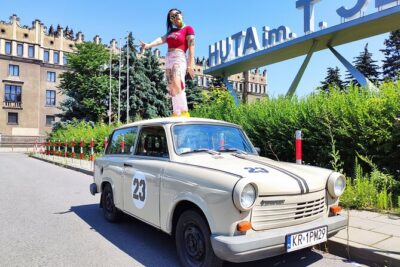
Legendary Private Nowa Huta Communism Tour with Crazy Guides
Read our review →
Private Nowa Huta Adventure Tour in Communist Cars
Read our review →
Communist Krakow – Nowa Huta Walking Tour in English
Read our review →
Private Communism Tour with Solidarity Center Museum
Read our review →Browse the lists this tour appears in