
REVIEW · JEWISH QUARTER TOURS
Private Tour: Warsaw Ghetto with a local Historian
History asks for quiet attention. This private Warsaw Ghetto tour connects memorials, wartime sites, and surviving fragments with a local historian who was born and raised in the area. I like the personal scale, with your own group rather than a large crowd, and I like the option of pickup and drop-off anywhere in Warsaw.
The tour also gives you a useful mix of walking and driving. You visit Umschlagplatz, Mila 18, the POLIN area, and a fragment of the ghetto wall, then drive through Praga. The main consideration is clarity: the advertised price is for a group of up to four, while the description also refers to groups of up to six, so confirm the exact group limit before booking. The POLIN Museum building is visited from outside, not as a full indoor museum tour.
In This Review
- Key points at a glance
- Why this private Warsaw tour works
- Starting at Umschlagplatz
- Remembering Mila 18 and the Warsaw Ghetto uprising
- Walking around the POLIN Museum area
- Finding a surviving fragment of the ghetto wall
- Driving through Praga Północ and film history
- Three hours, a driver, and the walking question
- What the price means for a small group
- Guide quality and the value of a personal approach
- Who should book this experience
- Practical details before you reserve
- Should you book the Warsaw Ghetto private tour?
- FAQ
- How long does the private Warsaw Ghetto tour last?
- Where can I be picked up?
- Is the tour private?
- How many people can join the tour?
- Is entry to POLIN Museum included?
- Is transportation provided during the tour?
- Is the tour offered in English?
- What is the cancellation policy?
Key points at a glance

- A personal guide with local roots: Your guide is described as someone born and raised in the Warsaw Ghetto area, adding a human connection to the sites.
- Five meaningful stops: The route includes Umschlagplatz, Mila 18, the POLIN Museum area, a surviving ghetto wall fragment, and Praga Północ.
- Private and flexible: Only your group takes part, and pickup and drop-off are available anywhere in Warsaw.
- A driver can save your legs: One guest found the driver upgrade especially helpful because the sites cover a wide area.
- A serious, reflective subject: This is a history tour about Nazi persecution, the Holocaust, resistance, and the destruction of Warsaw’s Jewish community.
- Strong value for a small group: At $321.68 per group of up to four, the cost works out to about $80 per person for four people.
Why this private Warsaw tour works
The Warsaw Ghetto is not one neatly preserved quarter waiting behind a gate. Much of the ghetto was destroyed, rebuilt, or absorbed into the modern city. That makes a guide especially useful. Without context, you may see a monument, a street, or a low section of wall and miss why it matters.
This experience gives you roughly three hours with a guide rather than asking you to piece the story together alone. The guide explains the events of World War II and the Holocaust while taking you between places tied to deportation, resistance, remembrance, and daily life.
I like the private format for this subject. You can ask direct questions, pause when a place affects you, and move at a pace that suits your group. It also avoids the awkwardness of trying to hear a guide across a large crowd at memorials where quiet matters.
The guide is presented as a local historian born and raised in the area. Two names appear in the available feedback: Paulina received warm praise for her commentary and thoughtful approach, while Artur was praised for being flexible, punctual, communicative, and good at shaping the tour around the group. Since guide assignment may vary, confirm who will lead your visit if a particular guide matters to you.
More Jewish heritage tours in Warsaw:
- Warsaw: Warsaw Ghetto Private Walking Tour with Hotel Pickup
★ 4.9 · 369 reviews - Private Tour: Warsaw’s Jewish Heritage by Retro Fiat
★ 5.0 · 208 reviews - Warsaw: Ghetto, Jewish Cemetery & POLIN Museum Private Tour
★ 4.8 · 132 reviews
Starting at Umschlagplatz
Umschlagplatz is the former railway loading area from which Jews were deported from the Warsaw Ghetto to Treblinka. The stop is listed for about five minutes, with no separate admission charge.
That may sound brief, but the importance of the place does not depend on a long visit. This is where the scale and machinery of deportation become easier to grasp. A guide can explain what happened here and connect the site to the wider German occupation and the destruction of Warsaw’s Jewish population.
You should expect a reflective stop rather than a conventional sightseeing photo opportunity. Ask your guide to explain the meaning of the memorial and how the deportations fit into the timeline of the ghetto. Since the listed time is short, anyone wanting a long period for private reflection may find this portion rushed.
Remembering Mila 18 and the Warsaw Ghetto uprising
The next stop is the memorial at Mila 18, connected with the bunker used by Mordechai Anielewicz and other fighters during the Warsaw Ghetto uprising. The listed visit lasts about ten minutes.
Mila 18 is central to understanding Jewish resistance. The uprising was not a military campaign that could defeat the German forces. It was an act of defiance by people facing near-certain death, and this site helps place that decision in physical space.
The memorial area is also a reminder of what is missing. You are not walking through a preserved underground bunker with original rooms and displays. Instead, the guide helps you understand the ground beneath and around the memorial, the people connected with it, and why this address remains so important.
Ten minutes is enough for an introduction, but not for every detail. If you have read about the uprising or want more time at Mila 18, tell your guide early. A private tour gives you a better chance of adjusting the emphasis than a fixed large-group excursion.
Walking around the POLIN Museum area
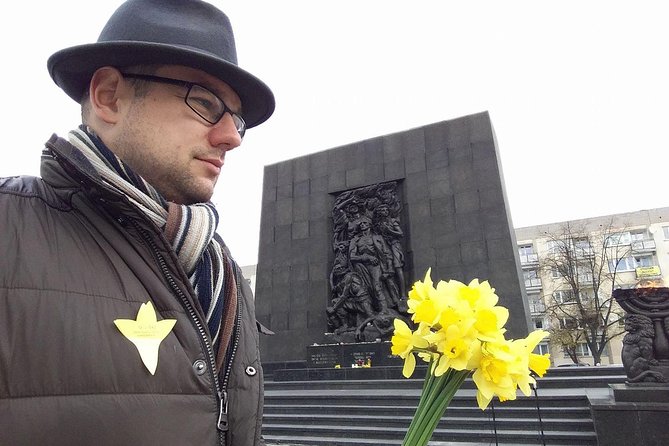
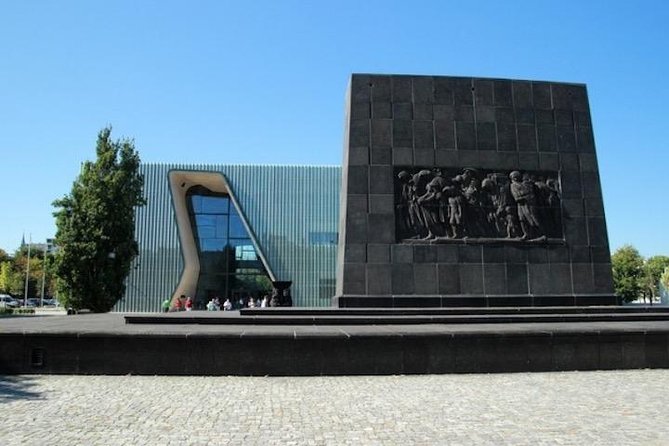
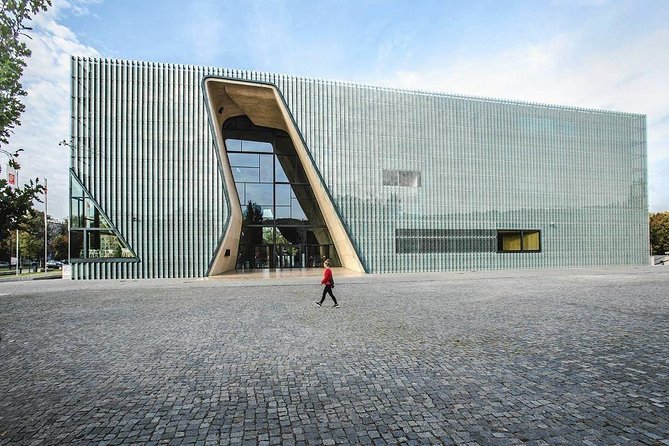
The tour then spends about thirty minutes around POLIN Museum of the History of Polish Jews. This portion focuses on the museum exterior and the important monuments in the surrounding area. It does not include entry into the museum’s indoor exhibition.
That distinction matters. POLIN is a major museum, and a full visit can take several hours, particularly if you use an audioguide. This tour gives you orientation and outside context, but it is not a substitute for museum admission.
I see that as both a strength and a limit. If your main goal is to understand the memorial zone and the physical setting, the half-hour stop is useful. You can learn why the museum stands here, how the nearby monuments relate to the former ghetto, and how modern Warsaw remembers the Jewish community.
If you want the full POLIN experience, plan it separately. Do not assume that the $321.68 tour price includes entry or time inside the galleries. One booking became confusing because the group expected museum highlights indoors, but the guide understood the visit as an exterior stop. The written details support the exterior interpretation, so ask before departure if this point is important to you.
A few more in Warsaw
- Warsaw: Chopin Concert in the Old Town
★ 4.8 · 2,287 reviews - Warsaw: Traditional Galar Cruise on The Vistula River
★ 4.6 · 1,640 reviews - Warsaw: Old Town Highlights Walking Tour in English
★ 4.7 · 1,516 reviews - Warsaw Concert: Chopin – Painted by Candlelights with Wine
★ 4.8 · 1,442 reviews
Finding a surviving fragment of the ghetto wall
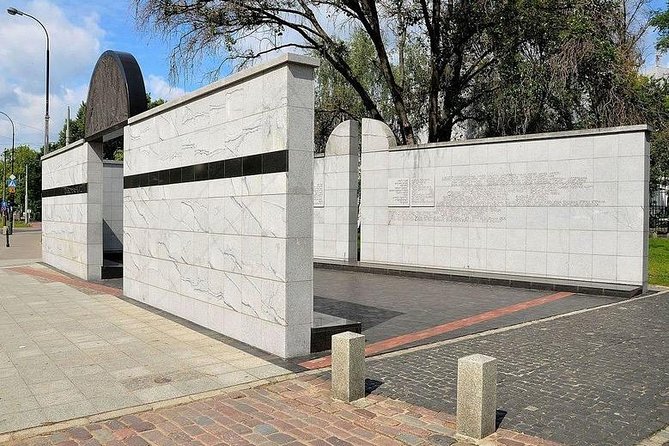
A fragment of the ghetto wall is listed as another stop, with about twenty minutes to see it. This is one of the most valuable parts of the route because the remaining sections are modest and easy to overlook.
The wall fragment gives you a concrete sense of how the ghetto was separated from the rest of the city. It also shows why Warsaw needs interpretation. The surviving piece is not a vast medieval-style structure. It is a small physical remnant surrounded by an active modern city, and its meaning comes from the story attached to it.
Use this stop to ask about the ghetto’s boundaries, the lives of the people confined there, and what happened to the surrounding buildings. The available feedback indicates that the tour can include original buildings from the former ghetto and monuments to victims and heroes, depending on the guide’s route and timing.
Because the city has changed so much, exact route details may vary. That flexibility is useful, but it also means you should ask which original structures and monuments are planned for your visit.
Driving through Praga Północ and film history
The final listed stop takes you through Praga Północ, on the eastern side of Warsaw. About thirty minutes are allocated for the drive, including places connected with scenes from Roman Polanski’s film The Pianist.
This change of setting gives the tour a wider frame. You are no longer looking only at memorials in the former ghetto area. You are seeing another part of Warsaw that has a connection to a film about wartime survival and the city’s destruction.
The Praga segment is a drive-through rather than a long walking visit. That makes the vehicle useful, especially if you have already spent time on foot at the memorials. It also means you should treat this portion as added context, not a full tour of the district.
One guest specifically praised the driver upgrade because it reduced the walking required and made it possible to see more of the area. If your group includes older people, anyone with limited stamina, or simply people who prefer a gentler pace, the vehicle option is worth considering.
A guest also reported seeing the Warsaw Zoo and additional original buildings during a version of the tour. Those stops are not clearly part of the listed core route, so ask your guide what is included on your date rather than counting on them.
Three hours, a driver, and the walking question
The official duration is about three hours. That is enough for a focused introduction, but not enough to examine every memorial, building, and museum in detail.
The route covers several locations, so the tour is not just a short walk around one square. Some movement is by vehicle, and the available upgrade can make a real difference. The basic experience may involve more walking than the short stop times suggest, especially if you want to pause and listen at each site.
Pickup and drop-off anywhere in Warsaw are included as an option. That is a practical benefit because you do not need to find a starting point across town, and you can finish near your accommodation or another Warsaw address.
The details say pickup is offered, but they do not specify the exact vehicle arrangement or upgrade cost. Ask for that information before booking. Also clarify whether your group is being quoted for four people or can include six, since both figures appear in the tour information.
Bottled water is provided. It is a small touch, but useful during a three-hour outing that combines outdoor stops, walking, and driving.
What the price means for a small group
The price is $321.68 per group of up to four. For four people, that is roughly $80 per person. For two people, it is about $161 per person, so the value improves sharply as your group gets closer to the stated limit.
There is no separate admission fee listed for the five stops. That does not mean every possible add-on is covered. In particular, the POLIN indoor exhibition is not part of the described visit, and the driver upgrade may cost extra.
For a private history tour with hotel pickup and a local guide, the group price can make sense if you have three or four people and want personal attention. A couple may find it expensive compared with a shared walking tour, but you are paying for privacy, route flexibility, and transport rather than simply for a guide’s speech.
This format is best for people who value explanation over a checklist of attractions. The places are serious, and the guide’s ability to add context is the main product. If you want a low-cost overview, a group tour may be better. If you want to ask questions and shape the visit around your interests, the private rate is easier to justify.
Guide quality and the value of a personal approach
The strongest praise centers on the guides. Paulina was described as excellent, adding depth through her commentary and showing important monuments, original buildings, and sites connected with both victims and heroes. Artur was praised for communication, punctuality, flexibility, humor, and the ability to work with a group on a good plan.
Those qualities matter here. The Warsaw Ghetto story includes dates, names, locations, political decisions, resistance efforts, deportations, and personal tragedies. A guide who can explain clearly without turning the visit into a dry lecture makes a major difference.
The tone also needs care. The positive feedback points to guides who combine seriousness with an approachable manner. A little humor can help a difficult three-hour experience feel human, but you should still expect a respectful visit rather than light entertainment.
There is one important warning about communication. One booking missed expected inclusions because the guide did not have the same understanding of the tour details. The tour provider acknowledged the need to improve how information reaches guides. You can protect yourself by confirming the route, indoor POLIN access, duration, driver option, and extra stops before the day begins.
Who should book this experience
I would choose this tour if you want a focused introduction to Warsaw’s wartime Jewish history and prefer a private setting. It suits families, couples, and small groups who want to discuss difficult subjects at their own pace.
It is also a good choice if you want hotel pickup or need to limit walking. The driver option helped one group see more while reducing the physical strain between sites.
You should think twice if your priority is a full day inside POLIN Museum. This tour does not provide that. You may also prefer another option if you want a long, slow visit at every memorial, since the schedule gives some sites only five or ten minutes.
The subject is not casual sightseeing. You should allow yourself time afterward to process what you have seen. The private format helps because you can regroup with your own companions instead of immediately being swept into a large group’s next activity.
Practical details before you reserve
Confirmation is normally sent at booking. If you book within one hour of departure, confirmation is sent as soon as possible and depends on availability.
The experience is offered in English, uses a mobile ticket, and allows service animals. It is near public transportation, and most people can participate.
Cancellation is free up to 24 hours before the local start time for a full refund. Inside that 24-hour window, the amount paid is not refunded, and changes are not accepted. Build in that deadline when making plans.
Before paying, I would ask four direct questions:
- Is my group limit four or six people?
- Is the guide walking, driving, or offering a paid driver upgrade?
- Does the route include only the outside of POLIN?
- Which extra buildings, monuments, or possible Warsaw Zoo stop are planned?
These questions take little time and can prevent the confusion one guest experienced.
Should you book the Warsaw Ghetto private tour?
Book it if you want a personal, serious introduction to the former Warsaw Ghetto, especially with three or four people sharing the cost. The local guide, private format, hotel pickup, and vehicle option give it practical value, while the stops cover the key themes of deportation, resistance, remembrance, and surviving traces.
Do not book it expecting a full POLIN Museum visit or a complete tour of every wartime site in Warsaw. Confirm the group size and driver details first. If you do that, this can be a thoughtful and efficient way to understand a difficult part of the city’s past without rushing through it in a large crowd.
FAQ
How long does the private Warsaw Ghetto tour last?
The tour lasts approximately three hours.
Where can I be picked up?
Pickup and drop-off are offered anywhere in Warsaw.
Is the tour private?
Yes. Only your group participates in the activity.
How many people can join the tour?
The price is stated for a group of up to four people, while another description refers to a private group of up to six. Confirm the exact limit before booking.
Is entry to POLIN Museum included?
The tour includes walking around the POLIN Museum area and seeing important nearby monuments from outside. Indoor museum admission and a full exhibition visit are not listed as included.
Is transportation provided during the tour?
Pickup and drop-off are offered, and a driver option is available. One version of the experience included driving between areas, but confirm the exact vehicle arrangement and any upgrade cost before booking.
Is the tour offered in English?
Yes. The experience is offered in English.
What is the cancellation policy?
You can cancel at least 24 hours before the local start time for a full refund. Cancellations or changes made within 24 hours are not refunded or accepted.
Just added in Warsaw
- Wroclaw Small-Group Tour with Lunch from Warsaw★ 5.0 · 2 reviews
- World War II Warsaw Old Town, Military Cemetery Walking Tour★ 4.7 · 3 reviews
- Warsaw: Wolf’s Lair & Swieta Lipka Small-Group Tour + Lunch★ 5.0 · 3 reviews
- Wilanów Palace: 2-Hour Guided Tour with Entrance Tickets★ 4.8 · 8 reviews
- Warsaw Zoo Skip-the-Line Entry Ticket with Private Transport★ 4.8 · 3 reviews
- Warsaw: Private Vodka Tasting Night with Snacks and Pickup★ 5.0 · 7 reviews
- Warsaw Private Wilanow Palace & Garden Tour★ 4.6 · 30 reviews
- Warsaw Wolf’s Lair with St. Lipka and Mamerki Private Guided★ 4.2 · 3 reviews