
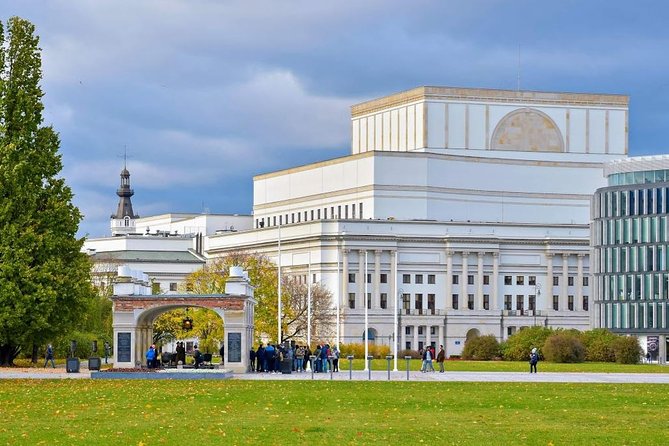
REVIEW · AUDIO TOURS
Warsaw at War 1939-1945: A Self-guided Audio Tour
Warsaw remembers everything. This 90-minute audio walk follows the city’s wartime scars from just outside Old Town to the statue of Józef Piłsudski. I like the freedom to pause for food, photos, or extra exploring, and I like the mix of narration, music, and sound effects. At $9.99, it is an inexpensive way to add serious historical context to a walk through central Warsaw.
The main weakness is navigation. The audio is easy to follow in general, but the map can be less clear when streets or crossings confuse you. One review found the off-route alarm too sensitive, even sounding when the listener walked on the opposite side of the street. Download the tour before setting out, and keep your phone handy when changing direction.
In This Review
- Key points to know before you go
- Starting near St. Anne’s Church in Old Town
- The Mały Powstaniec and the human cost of 1944
- Warsaw as a city caught between two powers
- The Tomb of the Unknown Soldier
- Saxon Garden and useful pauses along the route
- Ending with Józef Piłsudski
- Sound design, pacing, and the self-guided format
- Is $9.99 a fair price?
- Who will enjoy this Warsaw audio walk?
- Should you book Warsaw at War?
- FAQ
- How long does the tour take?
- Where does the tour start?
- Where does the tour end?
- Is the tour guided in person?
- What is included in the price?
- Is the tour available in English?
- Can I cancel or change my booking?
Key points to know before you go
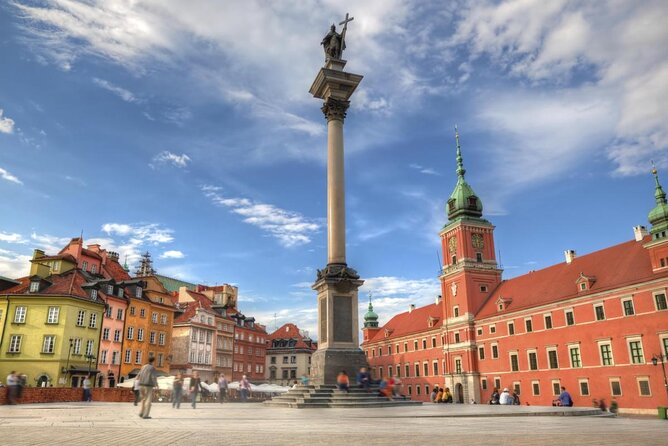
- A 3-kilometer route through central Warsaw: The walk takes about 90 minutes at a steady pace, with plenty of room for pauses.
- The Warsaw Uprising gets personal: The Mały Powstaniec memorial introduces the story of child soldiers who fought and died in 1944.
- Two powerful memorial stops: You pause at the Tomb of the Unknown Soldier and learn why it contains soil and ashes from Polish battlefields.
- A self-guided format with no fixed group: Start when you wish, walk at your speed, and listen through headphones, earbuds, or a small speaker.
- The route ends with Józef Piłsudski: The final stop recalls the Polish leader’s fight against Russian control and his victory over Lenin’s Red Army in 1920.
- Good value, with one practical catch: The $9.99 fee includes lifetime access and offline maps, but the purchase cannot be refunded or changed.
Starting near St. Anne’s Church in Old Town
The walk begins at Kościół Akademicki św. Anny, at Krakowskie Przedmieście 68, just outside Warsaw’s famous Old Town. This is a sensible starting place because you are already in one of the city’s main sightseeing areas, close to public transportation and the historic center.
The audio tour is designed to be simple. Start it in the VoiceMap app, put your phone away, and let the narration guide you from point to point. That hands-free approach is useful when you want to look at buildings, memorials, and streets instead of staring at a screen.
You still need to pay attention to the route. The tour includes offline audio, maps, and location data, but one review found the map arrow insufficiently clear. The off-route warning also seems over-sensitive. If you cross the road or walk along the other side of a street, the alarm may tell you that you have left the route.
I would treat the app as an audio guide with map support, not as a perfect turn-by-turn navigation system. Before beginning, check the route while you have a good connection. Then keep your phone available for quick checks at corners and crossings.
A few more in Warsaw
- Warsaw: Chopin Concert in the Old Town
★ 4.8 · 2,287 reviews - Warsaw: Traditional Galar Cruise on The Vistula River
★ 4.6 · 1,640 reviews - Warsaw: Old Town Highlights Walking Tour in English
★ 4.7 · 1,516 reviews
The Mały Powstaniec and the human cost of 1944
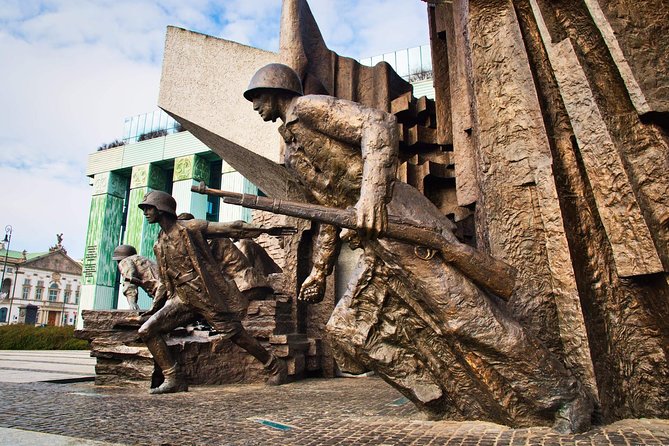
One of the most memorable points is the Mały Powstaniec, or Little Insurgent. This small memorial honors the children who fought and died during the Warsaw Uprising of 1944.
The subject gives the tour an important human scale. Military history can become a list of dates, armies, and commanders. This stop brings the story back to young people caught in a city fighting for survival. The memorial is especially effective because it connects Warsaw’s rebuilt streets with the lives lost beneath them.
The audio explains the background of the monument rather than asking you simply to take a photograph and move on. You are given a reason to pause and think about what the uprising meant for ordinary residents, including children.
The route does not ask you to rush. You can stop the narration, spend extra time at the memorial, and then continue when you are ready. That flexibility is one of the strongest parts of this format. A fixed group tour would keep moving. Here, you control the pace.
Parents should use their judgment, since the subject involves war, death, and child soldiers. The tour is presented as suitable for anyone who can use earbuds, headphones, or a small speaker, but the emotional weight of this stop may call for a quiet explanation with younger children.
Warsaw as a city caught between two powers
The wider story focuses on Poland’s struggle during World War II against Nazi Germany and Communist Russia. That framing helps explain why Warsaw’s wartime experience cannot be reduced to one enemy or one battle.
You will hear about a country fighting to protect its independence and culture while caught between two powerful European states. The tour presents Warsaw as a city destroyed by war and later rebuilt into a major center of culture, art, and beauty.
That idea of a city rising from destruction gives the walk its shape. You are not only hearing about wartime events in a museum room. You are walking through a living city, moving between memorials, gardens, streets, and public spaces that now serve everyday life.
I like this connection between past and present. The tour asks you to notice what is around you, then supplies the story that explains why those places matter. It is not just a sightseeing route with historical facts added on top.
At the same time, the tour is short. Ninety minutes cannot explain every stage of Warsaw’s wartime experience or cover every major site. Think of it as a focused introduction, not a complete course in Polish history. If you want a fuller treatment, you can add a museum visit or spend more time exploring the city after the audio ends.
The Tomb of the Unknown Soldier
The route pauses at the Tomb of the Unknown Soldier, one of Warsaw’s most solemn memorials. Here, the audio explains the monument’s history and the meaning of the sacred space.
The tomb contains ashes and soil from every 20th-century battlefield where Polish soldiers lost their lives. That detail gives the monument a national reach. It does not honor one battle alone. It gathers the memory of many Polish battlefields into a single place.
This is a good stop for slowing down. The tour asks you to pay respect, not merely to locate another point on the map. The narration also helps you understand why the monument matters to Poland’s public memory.
Because the tomb is an active memorial site, keep your volume low and behave respectfully. A small speaker may work for a private group, but headphones or earbuds are the better choice here. They let you listen without disturbing people nearby.
The stop also breaks up the walk nicely. After the emotional focus on the Little Insurgent, the Tomb of the Unknown Soldier broadens the story from one group of young fighters to generations of Polish soldiers.
Something quite different:
- Warsaw Concert: Chopin – Painted by Candlelights with Wine
★ 4.8 · 1,442 reviews - Warsaw: City Sightseeing Hop-On Hop-Off Bus Tour
★ 3.6 · 1,415 reviews - Warsaw: POLIN Museum of the History of Polish Jews Ticket
★ 4.7 · 1,142 reviews - #1 Pub Crawl Warsaw with Optional Premium 1 Hour Open Bar
★ 5.0 · 790 reviews
Saxon Garden and useful pauses along the route
The route gives you the option to pause and explore places such as the beautiful Saxon Garden. You might also stop for lunch, take photographs, or visit the Vodka Museum along the way.
These are not included admission stops. The audio experience itself has no entrance fee, but any museum visit, meal, drink, or other attraction costs extra. That distinction matters when planning your time.
Saxon Garden can serve as a pleasant pause if you want a break from the memorials and wartime narration. The tour allows you to take that pause without losing the value of your purchase. Lifetime access means you can return to the audio later, although the supplied information does not promise any particular number of repeat visits beyond that lifetime access.
The optional stops also make the tour easier to fit into a day of sightseeing. You can complete it in roughly 90 minutes, or stretch it into a longer outing by adding lunch and extra walks. If you have only one free morning in Warsaw, the route can work as a compact historical introduction. If you have several days, it can anchor a fuller day around Old Town and nearby central sights.
Ending with Józef Piłsudski
The final stop is the statue of Józef Piłsudski at plac Marszałka Józefa Piłsudskiego. The audio recalls his role as a political and military hero who fought to free Poland from Russian control.
It also covers his victory over Lenin’s Red Army at the gates of Warsaw in 1920. That ending places the World War II story within a longer struggle for Polish independence. The route begins with a city shaped by occupation and destruction, then closes with one of Poland’s major figures in the fight for sovereignty.
The statue is not a face-to-face meeting with Piłsudski, of course, but it provides a strong visual ending. You finish beside a figure linked to Poland’s earlier battles for freedom, after hearing how the country later faced Nazi Germany and Communist Russia.
The ending also gives you a clear endpoint. You do not have to wonder where the audio walk finishes. From there, you can continue exploring the city, eat, use public transportation, or return to other parts of central Warsaw.
Sound design, pacing, and the self-guided format
The narration was professionally mastered and includes music and sound effects. That production work should appeal to you if a plain voice recording feels too dry. The added audio gives the story more atmosphere while keeping the experience suitable for a broad age range.
The format is particularly useful if you prefer independent sightseeing. You are not tied to a guide’s schedule, a meeting time, or a fixed group pace. You can pause when you need a drink, stop for a photograph, or repeat a section that deserves more attention.
The tour has a maximum group size of 10, but its real character is self-guided. You are not joining a traditional walking group with a live guide. If you want questions answered on the spot or lively conversation with a local guide, this may feel limited.
If you enjoy walking alone or with a small party, the privacy is a benefit. You can listen quietly and discuss the story with your companions. The audio also lets you start any time because the listed opening hours run from midnight to midnight every day.
You need your own smartphone. The price does not include a device, transportation, food, drinks, or entrance fees. Service animals are allowed, and most people can take part, but you should be comfortable walking about 3 kilometers and managing the app.
Is $9.99 a fair price?
At $9.99 per person, this is a strong low-cost option for a history-focused walk. You receive lifetime access to the tour, the VoiceMap app, and offline access to the audio, map, and location data.
The offline feature is especially useful when you do not want to rely on mobile data. It also gives you a backup if your connection becomes weak. Still, offline access does not remove the need to understand the route before you start, since the navigation arrow and warning system may not always be clear.
The value is best if you already plan to walk around central Warsaw. You are paying for the story and structure, not for transport or entry to a museum. At less than the price of many paid attractions, it can give a familiar sightseeing area a stronger sense of place.
The non-refundable policy deserves attention. Once booked, the experience cannot be canceled or changed for a refund. Since the walk is self-guided and available throughout the day, it is flexible after purchase, but you should buy only when your Warsaw plans are firm.
Who will enjoy this Warsaw audio walk?
I would recommend it most strongly to:
- Solo visitors who want historical context without joining a group
- Couples and small groups who prefer to set their own pace
- History fans interested in battles, resistance, sacrifice, and Polish independence
- People with a free hour and a half near Old Town
- Visitors who want an inexpensive introduction before visiting more museums
- Anyone who likes to pause often for photographs, meals, or extra sightseeing
It may be less suitable if you dislike phone-based navigation or want a live guide who can answer questions. The route is also not ideal for anyone unable to manage about 3 kilometers of walking, although the information provided does not specify accessibility details beyond saying most people can participate.
The experience is offered in English only. If you are comfortable listening through headphones or a small speaker, the language should be easy to manage. You may want to bring earphones with a secure fit, since you will be walking and checking your position at times.
Should you book Warsaw at War?
Book it if you want an affordable, flexible walk that connects Warsaw’s streets with the city’s wartime suffering and long fight for independence. The Mały Powstaniec, Tomb of the Unknown Soldier, and Piłsudski statue give the route a clear emotional and historical arc.
Skip it if you need flawless navigation, a live guide, or a fully planned museum experience. The sensitive route warning and unclear map arrow are real annoyances, but they are manageable if you download everything first and check your position at turns.
For $9.99, I think the tour offers good value, especially for a solo visit or a first day in Warsaw. Give yourself more than the stated 90 minutes if you want to pause, eat, photograph the memorials, or explore Saxon Garden.
FAQ
How long does the tour take?
The audio walk takes approximately 1 hour and 30 minutes. The route covers about 3 kilometers, and you can pause whenever you wish.
Where does the tour start?
It starts at Kościół Akademicki św. Anny, Krakowskie Przedmieście 68, 00-322 Warszawa, Poland.
Where does the tour end?
It ends at the statue of Józef Piłsudski on plac Marszałka Józefa Piłsudskiego, 00-073 Warszawa, Poland.
Is the tour guided in person?
No. It is a self-guided audio tour operated through the VoiceMap application.
What is included in the price?
The price includes lifetime access to the Warsaw at War: 1939-1945 tour, the VoiceMap application, and offline access to the audio, maps, and geodata.
Is the tour available in English?
Yes. The experience is offered in English.
Can I cancel or change my booking?
No. The experience is non-refundable and cannot be changed for any reason.
Just added in Warsaw
- Wroclaw Small-Group Tour with Lunch from Warsaw★ 5.0 · 2 reviews
- World War II Warsaw Old Town, Military Cemetery Walking Tour★ 4.7 · 3 reviews
- Warsaw: Wolf’s Lair & Swieta Lipka Small-Group Tour + Lunch★ 5.0 · 3 reviews
- Wilanów Palace: 2-Hour Guided Tour with Entrance Tickets★ 4.8 · 8 reviews
- Warsaw Zoo Skip-the-Line Entry Ticket with Private Transport★ 4.8 · 3 reviews
- Warsaw: Private Vodka Tasting Night with Snacks and Pickup★ 5.0 · 7 reviews
- Warsaw Private Wilanow Palace & Garden Tour★ 4.6 · 30 reviews
- Warsaw Wolf’s Lair with St. Lipka and Mamerki Private Guided★ 4.2 · 3 reviews
Audio Tours, compared.

Vistula River Sightseeing Cruise with Audio Guide
Read our review →
Sightseeing Cruise on Vistula River with Audio Guide
Read our review →Vistula River Sightseeing Cruise with Audio Guide
Read our review →
Vistula Night Cruise by Gondola w/ Audio Commentary
Read our review →
The Birthplace of Poland: A Self-Guided Audio Tour of Poznań
Read our review →Browse the lists this tour appears in