
REVIEW · AUDIO TOURS
The Birthplace of Poland: A Self-Guided Audio Tour of Poznań
Poland’s story begins beside the river. This low-cost audio walk leads you across Poznań’s Cathedral Island and into Śródka, two compact districts packed with royal, religious, military, and artistic history. The route lasts about 45 minutes to 1 hour 15 minutes, depending on your pace and stops.
I like the freedom to pause and restart whenever you want, and I like that the app uses GPS to play the next section as you reach each place. At $8.99 per person, it is also an easy way to add some historical context without joining a scheduled group. The main drawback is simple: you are on your own if the app or GPS misbehaves, so download everything before you start.
In This Review
- Key points to know before you go
- Why Cathedral Island matters to Polish history
- The Church of Our Lady in Summo and Mieszko’s palace
- Poznań Cathedral, the oldest Polish cathedral
- The Archbishop’s Palace and changing power
- Crossing Jordan Bridge into Śródka
- Śródka, an independent district with a big mural
- Saint Margaret Church and the local scale
- Brama Poznania, a museum worth considering
- The Cathedral Lock and Prussian fortifications
- Genius Loci and the oldest walls
- Finishing at the Archdiocese Museum
- How the VoiceMap format works in real use
- Is $8.99 good value?
- Who should book this walk?
- Should you book The Birthplace of Poland?
- FAQ
- How long does the audio tour take?
- Where does the tour begin?
- Where does the tour end?
- Is the tour available in English?
- What do I need to take part?
- Can I use the tour without mobile internet?
- Are museum tickets included?
Key points to know before you go
- Poland’s early story is concentrated on Cathedral Island: Hear how Mieszko’s palace and chapel once occupied ground beneath the Church of Our Lady in Summo.
- The route crosses from history into daily life: Jordan Bridge links Cathedral Island with the Śródka District, once independent from the rest of Poland.
- The walk includes several important sights: You pass Poznań Cathedral, the Archbishop’s Palace, Saint Margaret Church, and the Archdiocese Museum.
- The Srodka mural adds a modern pause: This large wall painting is among the earliest works of its kind in Poland.
- The app works offline: Audio, maps, and location data can be downloaded for use without a live internet connection.
- Museum admission is extra: The route passes Brama Poznania and Genius Loci, but your $8.99 does not include entry.
Why Cathedral Island matters to Polish history
Poznań’s Cathedral Island, known in Polish as Ostrów Tumski, is the natural setting for a tour called The Birthplace of Poland. The name is not just marketing fluff. This island was a major early center of power and Christian life, and the route uses its churches, palaces, fortifications, and archaeological sites to explain that role.
The walk begins at the scale model of the island at Ostrów Tumski 9. This is a practical starting point because you first get a visual sense of the area before walking through it. The opening audio also explains how VoiceMap works, which should help you understand how the location-based narration will guide you.
You do not need to rush. The stated duration is fairly short, but the route passes museums and historic buildings that may tempt you to stop. If you want only the audio walk, you can finish within the advertised time. If you plan to enter one or more museums, allow extra time and check admission details separately.
A few more in Poznan
- Poznań Experience 2-Hours Guided Walking Tour
★ 5.0 · 155 reviews - Undercover City Games: Poznan
★ 5.0 · 88 reviews - Old Town Poznan: Guided Walking Tour in English
★ 4.6 · 78 reviews
The Church of Our Lady in Summo and Mieszko’s palace
One of the most striking early stops is the Church of Our Lady in Summo. From the outside, it may look like one more historic church along the route. The audio gives it greater weight by explaining what lies beneath it: the remains of Mieszko’s palace and palace chapel.
That detail changes how you look at the ground under your feet. You are not simply passing an old religious building. You are standing above traces of the earliest ruling center described on this walk.
The tour does not include entrance fees, so the value here comes from the narration and the surrounding view rather than from an included archaeological visit. If you have a strong interest in Poland’s first rulers, you may want to spend extra time in this area, but the tour itself keeps moving at a manageable pace.
Poznań Cathedral, the oldest Polish cathedral
The route then passes Poznań Cathedral, described as the oldest Polish cathedral. This is the grandest religious stop on the walk and one of the places where the story of faith and political power comes together.
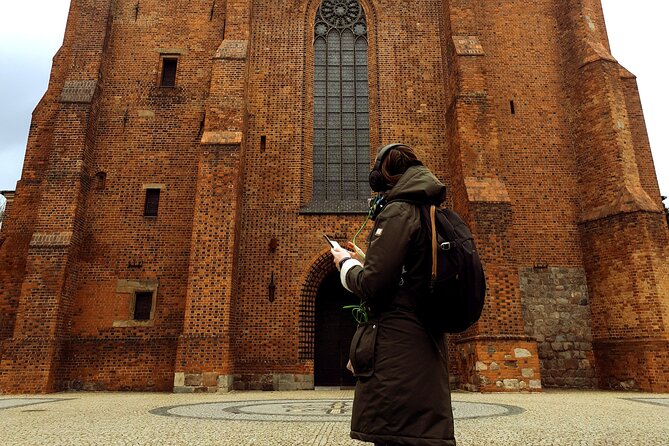
The audio explains the cathedral as you approach and pass it, giving you context without requiring you to stand in one place for a long lecture. That format suits me. You can look up at the building, notice its setting, and keep walking while the story unfolds.
The important practical point is that passing the cathedral is not the same as visiting it. The tour fee does not cover admission to attractions along the way, and the supplied details do not promise interior access. If you want to see inside, treat that as a separate stop and allow time for it.
The Archbishop’s Palace and changing power
Near the cathedral, the route passes the Archbishop’s Palace. The narration covers the building’s many versions and changes over time. That is useful because historic palaces rarely remain exactly as their first builders intended. Additions, rebuilding, and changing owners often tell you as much as the original facade.
This stop also broadens the story beyond kings and cathedrals. The archbishop’s residence points to the long influence of church leadership in Poznań and in Poland. You get a sense of how religious authority operated alongside political power.
The walk is private in the sense that only your own group takes part, but there is no live guide answering questions. If you enjoy stopping to ask about details, a guided walk may suit you better. If you prefer quiet sightseeing with narration on demand, this arrangement is the stronger choice.
Something quite different:
- Poznań: Private or Public Highlights Tour with a local guide
★ 5.0 · 66 reviews - Poznan Private City Walking Tour from Cathedral Island
★ 4.5 · 24 reviews - Poznan Old Town and Top Attractions Private Walking Tour
★ 4.8 · 24 reviews - From Golden Age to Fall and Rebirth of Poland
★ 5.0 · 17 reviews
Crossing Jordan Bridge into Śródka
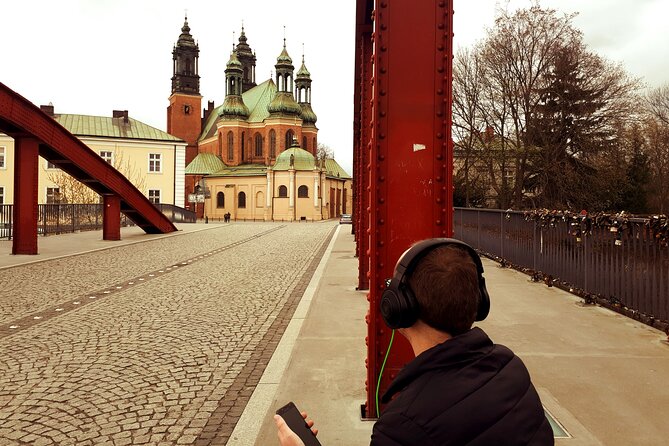
Jordan Bridge provides the route’s clearest physical transition. The audio explains how the bridge was built, destroyed, and rebuilt before reconnecting Cathedral Island with the Śródka District.
That story gives the crossing more meaning than a simple walk over water. You can hear how infrastructure shapes a city, and how a bridge can reconnect districts that had become separated. It is also a natural point to pause, look around, and reset before the second half of the route.
The supplied information does not give details about traffic, pavement, or seating on the bridge, so you should expect an ordinary city walk rather than a specially arranged pedestrian excursion. Wear comfortable shoes and keep your phone charged. Those are small preparations, but they matter when your directions and audio depend on the phone.
Śródka, an independent district with a big mural
Śródka has a different feel from the cathedral area. The narration explains that the district was, at one stage, independent from the rest of Poland. That political detail helps you see Śródka as more than a neighborhood attached to the main historic center.
The route passes the Srodka mural, one of the first wall paintings of this type in Poland. It adds a splash of modern public art to a walk otherwise focused on medieval and early modern subjects. The contrast is welcome. You get a reminder that historic districts are not frozen museum pieces.
I especially like this part of the route because the mural gives you a clear visual marker. Audio tours can sometimes blur together when one old building follows another. A large contemporary artwork breaks up the sequence and makes the walk easier to remember.
Saint Margaret Church and the local scale
The tour continues past Saint Margaret Church. The narration explains the church while you walk, adding another layer to Śródka’s religious story.
This stop is less about a single famous event and more about seeing how churches fit into local community life. Because the tour includes several religious buildings, you may notice repeated themes: worship, authority, rebuilding, and the changing shape of Poznań over time.
The route’s strength is its range. In little more than an hour, you move from royal foundations to church power, from a rebuilt bridge to neighborhood identity, and from archaeology to public art. The weakness is that each stop receives only a limited amount of time. Anyone wanting a detailed architectural study should plan additional visits.
Brama Poznania, a museum worth considering
The route passes Brama Poznania, also called the Porta Posnania Heritage Center. It opened in 2014 as a modern museum focused on Cathedral Island and the Śródka District.
The museum is described as state-of-the-art, with exhibitions about the area’s past and connections. It is an important option for anyone who wants more than an outdoor introduction. The audio tour gives you orientation first, then lets you decide if the museum deserves a separate visit.
That is a good use of a self-guided route. You are not locked into a fixed schedule or forced to pay for an attraction you may not have time to see. On the other hand, admission is not included, so the $8.99 price is for the audio experience only.
If you are trying to keep costs low, you can pass the entrance and still receive the outdoor commentary. If you want displays and a more structured presentation, budget separately for Brama Poznania.
The Cathedral Lock and Prussian fortifications
The route next passes the Cathedral Lock, a 19th-century part of the Prussian fortification system. This is a useful change of subject. The walk begins with Poland’s earliest rulers and church foundations, then moves into the military history of a later period when Prussian control shaped Poznań.
A lock may not sound as impressive as a cathedral, but it can reveal how a city was defended and managed. The stop also reminds you that Poznań’s past is not one single national story. Different governments left physical marks on the city, and the route places those layers close together.
You will likely get the most from this section if you pay attention to the relationship between the fortification element and the surrounding streets. The audio supplies the historical frame, while your job is to look carefully at what remains.
Genius Loci and the oldest walls
Genius Loci is another modern museum along the route. It presents relics of the borough’s one-thousand-year-old walls and uses 3D immersive films to bring the site to life.
This stop is particularly useful for visitors who have trouble imagining an old settlement from scattered foundations. Archaeological remains can look modest without explanation. The museum’s films and displays help connect those fragments to a larger picture of the early borough.
Again, entry is not included. The tour passes the museum but does not turn your $8.99 ticket into a museum pass. If your schedule is tight, you can note the location for another visit. If early urban archaeology interests you, this is one of the most logical places to add time.
Finishing at the Archdiocese Museum
The walk ends in front of the Archdiocese Museum in Poznań, at Jana Lubrańskiego 1, near the Lubrański Academy. The museum’s setting is fitting because the route has spent so much time connecting church buildings with national history.
The narration explains that this place played an important role in Poznań and across Poland from the 1500s through the 1700s. That gives the final stop a wider purpose. You finish not just with a list of buildings, but with a clearer idea of how the city’s religious institutions shaped public life.
The tour ends outside, so plan separately if you want to visit the museum. The published opening information lists the attraction as open every day around the clock for the stated period, but museum hours can change, so checking before setting out is sensible.
How the VoiceMap format works in real use
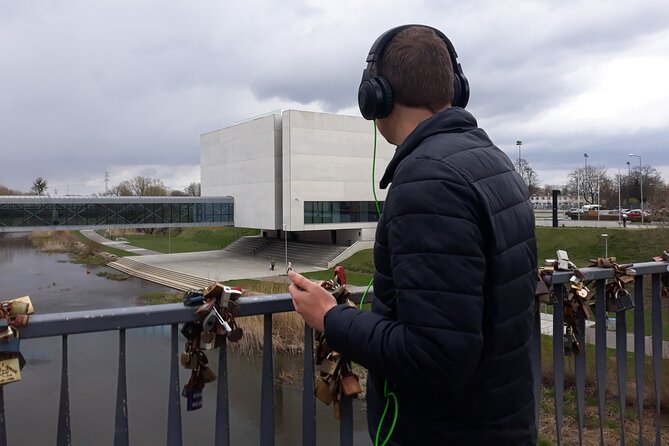
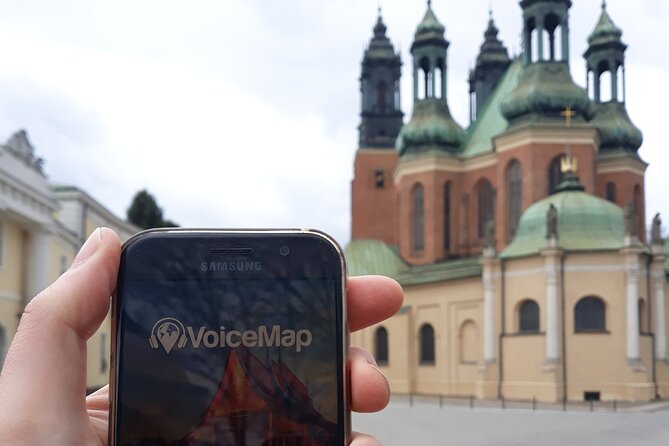
VoiceMap uses your phone’s location to trigger the correct audio as you move along the route. You receive access through the VoiceMap app for Android or iOS, with offline access to the audio, maps, and geodata.
That offline feature is one of the tour’s best practical advantages. Download the tour before you leave reliable Wi-Fi, then you should not need a constant data connection while walking. You still need a smartphone and headphones, neither of which is included.
The format is designed for self-paced sightseeing. You can stop for a photo, pause the narration, take a break, and continue later. One useful benefit is that you can return to the audio after the walk, since access is lifetime rather than limited to one day.
There is a technical risk. One customer had trouble at the start but received a fast response from support and solved the issue after downloading again. Another person found the guide unclear about their location and considered the tour a waste of money. Those opposite outcomes tell you what to do: download in advance, test the app, and contact VoiceMap support quickly if the GPS or audio fails.
Is $8.99 good value?
At $8.99 per person, this is a low-cost introduction to a historically important part of Poznań. The price is especially fair if you want flexibility, dislike fixed tour times, or are visiting Cathedral Island and Śródka independently anyway.
You are paying for narration, route design, maps, and lifetime access. You are not paying for a guide, transport, food, headphones, or entry to Brama Poznania, Genius Loci, the Archdiocese Museum, or other attractions.
I would compare it with the cost of a live walking tour, but price is not the only difference. A live guide can answer questions and adjust the pace. This audio tour lets you walk privately, pause freely, and revisit the material later. For a couple or small group that wants independence, that trade-off works well.
The overall rating is 4.4 from 13 reviews, which suggests a generally positive experience but not a flawless one. The most praised qualities are ease of use, flexible pacing, clear English narration, and good value. The main concern is technical reliability and orientation if the app does not correctly track your position.
Who should book this walk?
I would choose this tour if you want a short introduction to Poznań’s oldest districts, especially if you are comfortable using a smartphone for directions. It suits independent visitors, couples, small private groups, and anyone with a tight schedule.
It also works well as a first look before visiting the museums. The route tells you what Cathedral Island and Śródka are about, then lets you decide where to spend more time.
I would hesitate if you want a human guide, detailed question-and-answer time, or guaranteed help at every turn. The walk is also a poor fit if you do not have a charged smartphone, headphones, or confidence with a GPS app.
The cancellation terms are strict: the experience is non-refundable and cannot be changed after booking. Make sure your plans are firm before paying.
Should you book The Birthplace of Poland?
Book it if you want an inexpensive, flexible way to understand the two sides of Poznań’s old river districts. The route covers an impressive range in about an hour: Mieszko’s palace remains, Poland’s oldest cathedral, the Archbishop’s Palace, a rebuilt bridge, Śródka’s political past, a pioneering mural, Prussian defenses, ancient walls, and several museums.
Do not book it expecting a full guided visit to every attraction. You will pass the museums rather than receive included admission, and the experience depends on your phone working properly.
For most independent visitors, the balance is good. Download the route before leaving, bring headphones, allow extra time for museum stops, and use the audio as a practical historical companion rather than a replacement for exploring the sites themselves.
FAQ
How long does the audio tour take?
The tour takes approximately 45 minutes to 1 hour 15 minutes, depending on your walking pace and how long you pause.
Where does the tour begin?
It begins in front of the scale model of Cathedral Island at Makieta Ostrowa Tumskiego, Ostrów Tumski 9, 61-109 Poznań, Poland.
Where does the tour end?
It ends in front of the Archdiocese Museum in Poznań, near the Lubrański Academy at Jana Lubrańskiego 1, 61-003 Poznań, Poland.
Is the tour available in English?
Yes. The tour is offered in English.
What do I need to take part?
You need a smartphone and headphones. The VoiceMap app, audio, maps, and geodata are included, but the phone and headphones are not.
Can I use the tour without mobile internet?
Yes. The tour provides offline access to its audio, maps, and geodata. Download the material before beginning the walk.
Are museum tickets included?
No. Entrance fees for museums and other attractions along the route are not included in the $8.99 price.
Just added in Poznan
- Explore the Instaworthy Spots of Poznan with a Local★ 5.0 · 1 review
- The Best of Poznan 4 Hour Guided Private Walking Tour★ 5.0 · 7 reviews
- Private walking city tour in Poznan★ 4.0 · 9 reviews
- Private 3-hour Poznan Old Town Tour★ 5.0 · 5 reviews
- Poznan private tailor made tour with a local guide-driver★ 5.0 · 6 reviews
- Historic Poznan: Exclusive Private Tour with a Local Expert★ 5.0 · 1 review
- Palace, Castle and Ancient Oaks – Rogalin and Kórnik guided tour from Poznan★ 5.0 · 4 reviews
- Poznan: Srodka District and Cathedral Island Private Walking Tour★ 5.0 · 1 review
Audio Tours, compared.

Vistula River Sightseeing Cruise with Audio Guide
Read our review →
Sightseeing Cruise on Vistula River with Audio Guide
Read our review →Vistula River Sightseeing Cruise with Audio Guide
Read our review →
Vistula Night Cruise by Gondola w/ Audio Commentary
Read our review →
Browse the lists this tour appears in