
REVIEW · SCHINDLER'S FACTORY TOURS
Krakow: Schindler’s Factory & Jewish Ghetto Guided Tour
Krakow’s wartime story comes into sharp focus here. This three-hour tour pairs Schindler’s Enamel Factory with a walk through the former Jewish Ghetto, giving you both the museum’s carefully built exhibits and the streets where these events unfolded. I like the film connections, especially if you have seen Schindler’s List, and I like the chance to follow the factory visit with places such as Ghetto Heroes Square and the surviving wall. The main consideration is that two small museum stops cost extra, so the advertised price is not the full admission cost.
The tour costs $53.65 per person, includes the factory ticket, and limits the group to 24 people. Guides Olga and another guide with a family connection to a Holocaust survivor received especially warm praise for clear explanations and personal insight. You should allow for serious subject matter, a fair amount of standing, and a walk that ends away from the starting point.
In This Review
- Key points before you book
- Why this Krakow tour matters
- Inside Schindler’s Factory on Lipowa Street
- The guide makes the museum easier to follow
- Eagle Pharmacy and the story of help inside the ghetto
- Ghetto Heroes Square and its empty chairs
- The surviving fragment of the ghetto wall
- Rynek Podgorski and the former ghetto entrance
- What the $53.65 price includes
- Practical planning for the three-hour route
- Who will get the most from this experience
- Should you book the Schindler’s Factory and Jewish Ghetto tour?
- FAQ
- Where does the tour begin?
- Where does the tour end?
- How long does the tour last?
- How much does the tour cost?
- Is admission to Schindler’s Factory included?
- Is admission to Eagle Pharmacy included?
- Is admission to the Ghetto Wall Fragment included?
- How many people can join the tour?
- Is the tour near public transportation?
- Can I cancel for a full refund?
Key points before you book
- Schindler’s Factory takes about 90 minutes: The main museum visit is the heart of the experience, with admission included.
- The Jewish Ghetto walk adds important context: The upgraded route visits Ghetto Heroes Square, a wall fragment, the former Judenrat building, and Eagle Pharmacy.
- The movie connection is useful: You will recognize locations and themes from Schindler’s List, though the museum is about Krakow’s wider wartime story, not only Oskar Schindler.
- Two admissions are extra: Eagle Pharmacy and the Ghetto Wall Fragment list separate admission charges.
- The group can reach 24 people: That is small enough for a guide-led visit, though not a private tour.
- The route is one-way: You begin at Lipowa 4 and finish at Plac Bohaterów Getta, so plan your next stop from the ending point.
Why this Krakow tour matters
Krakow offers many ways to learn about the Second World War, but this experience links objects, buildings, and streets in a useful order. You begin inside the former enamel factory, then move into the Podgórze district and see physical traces of the ghetto.
That sequence matters. The museum gives you the larger picture of daily life and persecution under Nazi occupation. The outdoor walk then shows how that story occupied real streets, squares, walls, and buildings.
The tour lasts about three hours. That is enough time for a serious introduction without taking up an entire day, though the subject matter can feel heavy. I would not schedule a rushed restaurant booking or another timed attraction immediately afterward.
The experience is also a practical choice if you want help making sense of a museum known for dense material. A guide can point out connections between the exhibits and the surrounding district, rather than leaving you to read every panel alone.
More Schindler Factory tours:
- Krakow: Oskar Schindler’s Factory Entry Ticket & Guided Tour
★ 4.2 · 3,793 reviews - Krakow: Schindler’s Factory Tour with Entrance Ticket
★ 4.5 · 3,182 reviews - Krakow: Schindler’s Factory Skip-the-Line Ticket
★ 4.4 · 3,105 reviews
Inside Schindler’s Factory on Lipowa Street
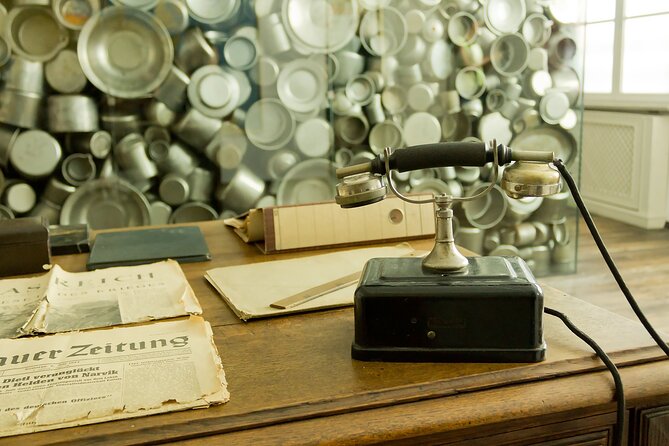
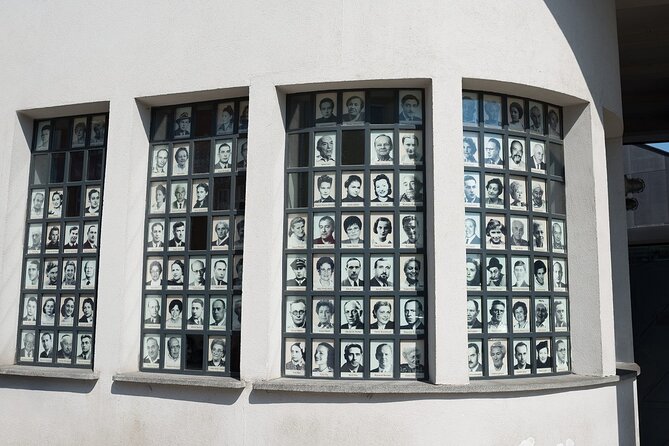
The tour begins at Lipowa 4, the former enamel factory associated with Oskar Schindler. The building is now home to the Historical Museum of Krakow’s main exhibition, Kraków under Nazi Occupation 1939 to 1945.
The factory is famous because it appears in Steven Spielberg’s Oscar-winning film Schindler’s List. That link gives the visit an immediate point of reference, but the museum’s subject is broader than Schindler himself. It presents the daily life, fear, restrictions, and tragic events that shaped Krakow during the war.
I like this balance. Oskar Schindler is an important part of the story, but focusing only on the industrialist and the people he helped would leave out much of what happened to Krakow’s Jewish population and the city’s wider community.
The exhibition is described as modern and unusual in its design. You can expect a presentation built around the wartime city and the people who lived through it, rather than a simple collection of factory machinery. The guide’s role is important here because the exhibition covers many subjects, and a good explanation helps connect them.
You receive admission to the factory as part of the $53.65 price. The planned visit lasts about 1 hour and 30 minutes, which gives the guide time to explain the museum without turning the stop into a quick glance around.
If you have seen Schindler’s List, you may recognize places, names, and visual references. That can make the visit more immediate. Still, you do not need to watch the film first. The museum and guide provide the needed setting, and the tour is not presented as a movie-location walk alone.
One useful tip is to watch the film before coming if you have time. The connection can help you identify familiar details, as one of the strongest pieces of feedback specifically noted. Just keep in mind that the film dramatizes events, while the museum aims to explain the larger wartime experience in Krakow.
The guide makes the museum easier to follow
The guide is a major part of the value here. The published feedback gives special praise to Olga, who connected the museum to the film and explained the ghetto walk with care. Another guide was appreciated for having a family member who survived the Holocaust, a personal connection that added weight to the explanations.
That does not mean every tour will have Olga or the same family connection. Guide assignments can vary. It does show what to look for in this experience: clear storytelling, strong knowledge of the exhibition, and the ability to relate individual places to the wider events.
A guide also helps with the emotional rhythm of the museum. This is not a light cultural attraction where you simply move from one display to the next. The subject includes confinement, deportation, forced labor, and murder. Having a guide explain the setting can make the visit more understandable, though it cannot make the material easy.
The maximum group size is 24 people. That is not an intimate private tour, but it is a manageable limit for a guided museum visit. You should still stay close to the guide, especially in a museum with many rooms and displays.
Eagle Pharmacy and the story of help inside the ghetto
The next stop is Eagle Pharmacy, another museum connected with the wartime ghetto. The owner received permission from the occupation authorities to operate there, and the pharmacy became a cover for helping Jewish residents.
The pharmacy’s work went far beyond dispensing medicine. Food and documents were delivered, and the site became a meeting point for cultural, intellectual, and social life inside the closed district.
The planned stop lasts only 10 minutes. That is enough for a guide to explain why the pharmacy matters, but it is not a long museum visit. The separate admission charge is not included in the tour price, so check the cost before booking if you want to enter.
This stop adds an important human dimension to the route. The factory explains the occupation and Schindler’s role. Eagle Pharmacy shows how a place of business could become a channel for aid and communication under extreme pressure.
Because the stop is brief, you should think of it as a focused historical explanation rather than a full independent museum visit. It works best as part of the walking route.
More Jewish heritage tours in Krakow:
- Krakow: Schindler’s Factory & Ghetto Guided Tour
★ 4.7 · 1,694 reviews - Krakow: Jewish Quarter and Former Ghetto Tour
★ 4.9 · 1,441 reviews - Krakow: Bike Tour of Old Town, Jewish Quarter and the Ghetto
★ 4.9 · 1,155 reviews - Krakow: Kazimierz Jewish Quarter Walking Tour
★ 4.8 · 571 reviews
Ghetto Heroes Square and its empty chairs
The walk continues to Plac Bohaterów Getta, also called Ghetto Heroes Square. During the ghetto’s existence from 1941 to 1943, this was a place where Jewish residents were concentrated before being transported to concentration camps.
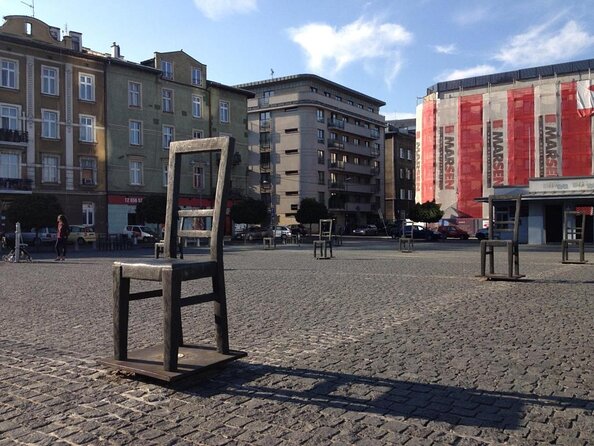
Today, several dozen cast-iron chairs are placed across the square. They represent the property and belongings left scattered in the streets after the ghetto was liquidated.
The chairs create a quiet but powerful memorial. You do not need a long explanation to understand the basic image: homes emptied, people removed, and personal belongings abandoned. The guide can add the historical setting that makes the memorial more than a visual curiosity.
This stop takes about 25 minutes and has no admission charge. It is also one of the easier places on the route to pause, look around, and absorb what you have just learned inside the factory.
The square sits in the Podgórze district, not in Krakow’s Old Town. That makes the tour useful for seeing a part of the city many short city breaks might otherwise miss.
The surviving fragment of the ghetto wall
The route includes a 12-metre section of the original ghetto wall, one of the clearest remaining physical traces of the closed district. A memorial plaque was added in 1983 in Hebrew and Polish.
The plaque says that people lived, suffered, and died there under German persecution, and that their final journey to the death camps began from that place. The wording is direct and difficult, which is appropriate for a site carrying this history.
The planned visit lasts about 15 minutes. Admission is listed separately, so this is another cost to account for beyond the base price.
The wall fragment is not a large monument or a full reconstruction. Its value comes from its authenticity and scale. A short stretch of masonry can make the ghetto’s boundaries feel less abstract than a map or museum diagram.
I would pay close attention to the guide’s explanation here. On its own, the wall may look modest. In the context of the factory exhibits and the square with its chairs, it becomes part of a clear sequence showing confinement, removal, and loss.
Rynek Podgorski and the former ghetto entrance

The final listed stop is Rynek Podgorski. Building No. 1 was the seat of the Jewish Council, known as the Judenrat, which had been established by the Nazi occupiers to carry out their orders.
The main gate of the ghetto was also located here. It carried an inscription identifying the area as a Jewish residential district.
This stop adds a layer that is easy to miss when walking alone. The ghetto was not only a collection of private homes and walls. It was also controlled through official structures, orders, gates, and forced administration.
The stop lasts about 10 minutes and is free to visit. Since the tour ends at Plac Bohaterów Getta, this final location helps you understand the surrounding district before you continue on your own.
The route information places the meeting point at Lipowa 4 and the ending point at Plac Bohaterów Getta. That one-way format is convenient if you plan to continue exploring Podgórze, but less convenient if you need to return to the factory or collect something there.
What the $53.65 price includes
At $53.65 per person, this is not the cheapest way to visit the factory. The value depends on how much you want from the guide and how useful you find the outdoor route.
The factory admission is included, and the tour offers about 90 minutes of explanation inside one of Krakow’s most important museums. You also receive a guided walk through several significant ghetto locations if you choose the upgraded version.
Two admissions are not included: Eagle Pharmacy and the Ghetto Wall Fragment. These are short stops, but you may want to pay the extra charges because they complete the story. If you are watching your budget, you can still gain a lot from the free outdoor locations and the included factory visit, but confirm the added costs before you book.
The price makes the most sense for you if you prefer guided interpretation over exploring alone. It is less compelling if you already know the museum well or want to move through the exhibits at your own speed.
The group limit of 24 helps protect the value. You are paying for a shared tour, not personal guiding, but the group is capped rather than left open-ended.
Practical planning for the three-hour route
The starting address is Lipowa 4 in Krakow, and the tour ends at Plac Bohaterów Getta. Both locations are near public transportation, which makes the route easier to fit into a day of sightseeing.
Confirmation is provided at booking. The activity is described as suitable for most people, but you should expect time on your feet inside the museum and walking between outdoor stops.
The tour is often booked about 50 days ahead on average. That does not guarantee every date will sell out, but it is a useful sign that you should reserve early if your Krakow dates are fixed.
The base group can include up to 24 people. If you want the guide’s explanation, stay within hearing range and arrive at the Lipowa 4 meeting point with enough time to find the correct entrance.
You can cancel for a full refund up to 24 hours before the start time. Changes or cancellations made inside that window are not accepted for a refund, and the cut-off follows local Krakow time.
Who will get the most from this experience
I would recommend this tour to a first-time Krakow visitor who wants a clear introduction to the city’s wartime story. It also suits anyone who has seen Schindler’s List and wants to connect the film with real locations.
Families with older children may find the route useful, but the subject is severe. The tour is not designed as light entertainment, and parents should decide if the material suits their children.
You will probably appreciate the experience most if you want a guide to explain why each location matters. The outdoor sites are more meaningful when placed in order, from the factory to the pharmacy, square, wall, and former ghetto administration building.
It may not suit you if you prefer a quiet, self-directed museum visit. The three-hour structure keeps the group moving, and the guide controls the pace.
Should you book the Schindler’s Factory and Jewish Ghetto tour?
Book it if you want more than a ticket to Schindler’s Factory. The strongest feature is the pairing of the museum with the actual Podgórze sites, especially Ghetto Heroes Square and the surviving wall fragment.
I also like the guide-led format because the subject is complex and painful. Olga received especially strong praise for linking the film, museum, and ghetto walk, while another guide brought a personal family connection to the Holocaust. You cannot count on a particular guide, but the experience clearly depends on strong storytelling.
Before paying, check the upgraded option and the extra admission charges for Eagle Pharmacy and the wall fragment. If the added cost fits your budget, I think the complete route gives you a fuller understanding of Krakow under Nazi occupation than the factory visit alone.
FAQ
Where does the tour begin?
It begins at Lipowa 4, Krakow, Poland.
Where does the tour end?
The tour ends at Plac Bohaterów Getta in Krakow.
How long does the tour last?
The tour lasts approximately three hours.
How much does the tour cost?
The listed price is $53.65 per person.
Is admission to Schindler’s Factory included?
Yes, admission to Schindler’s Enamel Factory is included.
Is admission to Eagle Pharmacy included?
No. Admission to Eagle Pharmacy is not included in the tour price.
Is admission to the Ghetto Wall Fragment included?
No. Admission to the Ghetto Wall Fragment is listed separately.
How many people can join the tour?
The tour has a maximum group size of 24 people.
Is the tour near public transportation?
Yes. The meeting and ending locations are described as being near public transportation.
Can I cancel for a full refund?
Yes. You can cancel at least 24 hours before the experience start time for a full refund. Cancellations or changes made less than 24 hours before the start time are not accepted for a refund.
Just added in Krakow
- Auschwitz-Birkenau – Skip the Line Tickets★ 3.5 · 29 reviews
- Auschwitz-Birkenau: Fast-Track Ticket & Guided Tour No Transfers★ 3.5 · 17 reviews
- Zakopane & Sleigh Ride with Bonfire – Group Tour from Kraków★ 5.0 · 2 reviews
- Sleigh Ride & Bonfire in Zakopane with Funicular – Private Trip★ 5.0 · 48 reviews
- Thermal Baths & Zakopane – Private Trip from Krakow★ 5.0 · 1 review
- Zakopane & Gubalowka Funicular – Private Winter Tour from Krakow★ 5.0 · 10 reviews
- Divine Mercy Sanctuary – Private Tour from Krakow★ 5.0 · 4 reviews
- stag dog chase Krakow prank★ 5.0 · 4 reviews