
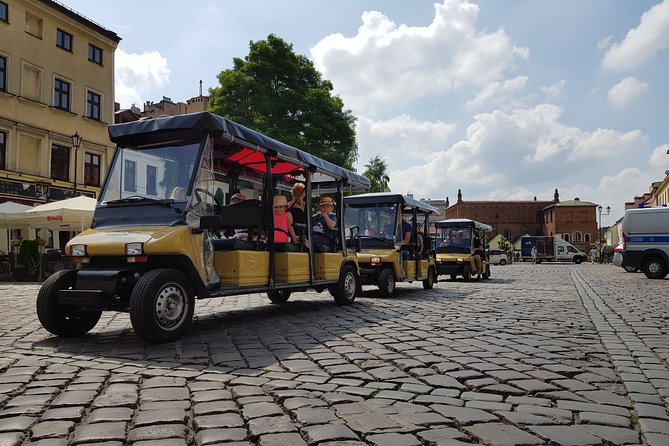
REVIEW · SCHINDLER'S FACTORY TOURS
Kazimierz, Jewish Ghetto, Schindler’s List story – Golf Cart Tour
Krakow’s past fits into a small electric cart. This one-hour ride links Kazimierz, the former Jewish Ghetto, and Oskar Schindler’s factory, giving you a useful first look at places that deserve more time on foot. I like the short photo stops and the route’s clear focus on Jewish and wartime Krakow. The main drawback is simple: one hour can feel rushed, especially if you want to leave the cart and explore.
I also like the rainproof, heated vehicle, a practical advantage in Krakow’s damp or chilly weather. The small group size, capped at 12 people, should make the ride easier to follow than a large bus tour. Still, the quality depends on the driver’s volume and commentary. One booking party found the guide too quiet and felt unable to get out and explore during the ride.
In This Review
- Key points at a glance
- What this one-hour Krakow tour actually offers
- Szeroka Street and the Jewish quarter
- Catholic Kazimierz and Corpus Christi Church
- From Kazimierz to the former Jewish Ghetto
- Schindler’s Factory and the final stop
- Why the golf cart format works
- Audio commentary, guide quality, and language choices
- Is $26.41 a fair price?
- Who should book this experience?
- Booking advice and the best way to use your hour
- Should you book the Kazimierz golf cart tour?
- FAQ
- How long does the golf cart tour last?
- Where does the tour start?
- Where does the tour end?
- Is admission to Schindler’s Factory Museum included?
- Can I visit Schindler’s Factory after the tour?
- What languages are available?
- How many people can join the tour?
- Is the golf cart suitable for rainy weather?
Key points at a glance
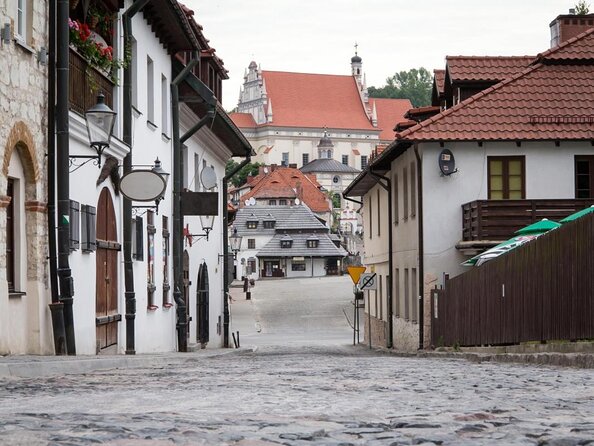
- Szeroka Street begins the Jewish Krakow story, with synagogues, cemeteries, and the old Jewish quarter gathered close together.
- The route combines Jewish and Catholic Kazimierz, including Corpus Christi Church and the town hall area.
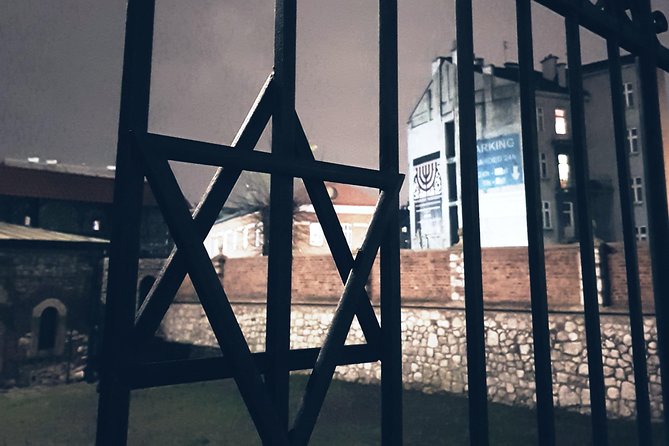
- Plac Bohaterow Getta brings the wartime story into sharp focus, with the Ghetto Heroes Square, Eagle Pharmacy, and a surviving section of wall.
- Schindler’s former enamel factory is the final stop, but museum admission costs extra.
- Audio commentary is available in 28 languages, while the tour itself is offered in English with an English-speaking driver.
- The cart is covered and heated, making this a useful sightseeing option on rainy days.
What this one-hour Krakow tour actually offers
This is an orientation tour, not a full museum visit or a long walking tour. You sit in a compact golf cart, often called a melex in Poland, and pass through two of Krakow’s most important historic districts.
The route starts at plac Jana Matejki 3, near Krakow’s central area, and finishes at Oskar Schindler’s former enamel factory on Lipowa Street. That end point is useful because you can continue directly into the museum if you have a separate ticket, or make your own way back to the starting area.
The tour covers a lot in roughly 60 minutes. You will see synagogues, cemeteries, churches, wartime sites, and the factory linked with Schindler’s List. The tradeoff is time. The cart gives you a broad picture, but it does not give you much freedom to linger.
I would treat it as a way to get your bearings fast. Then you can return later to the places that catch your attention.
More Golf Cart Tours in Kraków
- Krakow: City Sightseeing Tour by Electric Golf Cart
★ 4.5 · 3,264 reviews - Krakow: City Sightseeing Tour Eco Electric Buggy Golf Cart
★ 4.7 · 3,143 reviews - Krakow: Extended City Sightseeing Tour – Eco Buggy Golf Cart
★ 4.7 · 794 reviews
Szeroka Street and the Jewish quarter
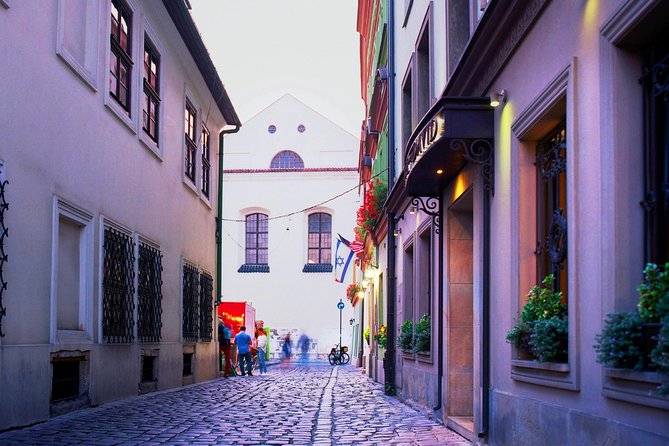
Szeroka Street is one of the strongest opening points on the route. It sits at the heart of Kazimierz’s former Jewish quarter and brings several important sights into one compact area.
You pass close to the Old Synagogue, Remuh Synagogue, Isaac Synagogue, and Tempel Synagogue. The tour also points out old Jewish cemeteries, New Square, and a house connected with Helena Rubinstein. These are not random decorative stops. Together, they show how Kazimierz functioned as a major Jewish district before the Second World War.
The five-minute stop at Szeroka Street is mainly for orientation and photographs. You should not expect a synagogue visit as part of the included tour. Admission to the stops is listed as free, but the schedule does not provide time for detailed interior visits.
That matters because the outside view only tells part of the story. If you are interested in Jewish religious life, plan to return on foot and spend longer at the synagogues. The cart gives you the names and setting. Your later walk supplies the slower look.
The guide’s commentary can make a big difference here. A strong guide connects the buildings instead of treating them as a checklist. Valentino received especially warm praise for combining local knowledge with respect, particularly when explaining the Jewish quarter and the Ghetto. If you get a guide with that same care, this short section can set the tone for the whole ride.
Catholic Kazimierz and Corpus Christi Church
Kazimierz is not only a Jewish heritage district. The route also covers its Catholic side, including the town hall area and Corpus Christi Church, or Kosciol Bozego Ciala.
The five-minute stop at Corpus Christi Church gives you a chance to photograph one of the area’s major Catholic landmarks. Its place in the itinerary helps explain that Kazimierz developed through overlapping religious communities, rather than as a single-purpose district.
This combination is one of the better features of the tour. You are not being shown only the sites made famous by wartime films. You also see the broader district and the religious buildings that shaped daily life.
Again, the stop is brief. If you want to study the church properly, you will need to return independently. The cart is best for seeing how the church fits into the neighborhood, not for replacing a dedicated church visit.
From Kazimierz to the former Jewish Ghetto
The route then moves toward the former Jewish Ghetto, where the tone changes. Kazimierz shows community life and religious heritage. The Ghetto sites bring the Nazi occupation and the destruction of Krakow’s Jewish population into the foreground.
The main stop is Plac Bohaterow Getta, or Ghetto Heroes Square. It is a five-minute photo stop, but the site carries more weight than the short timing suggests. The square is associated with the forced removal of Jews from the Ghetto and is marked by a stark memorial of empty chairs.
The route also includes the Eagle Pharmacy and a fragment of the Ghetto Wall. The pharmacy is closely tied to the wartime story of the Ghetto, while the remaining wall fragment gives you a physical sense of the confinement imposed on the area.
This is where a respectful guide matters most. Valentino was praised for slowing down at important points and treating the Ghetto visit with care. That tone is appropriate. The subject calls for clear explanation, not theatrical storytelling.
You may find the five-minute stop too short if you want time for reflection or photographs. The best approach is to listen closely during the ride, note what you want to revisit, and return later on foot. The tour can introduce the site, but it cannot give the Ghetto story the time it deserves in only an hour.
More Schindler Factory tours:
- Krakow: Oskar Schindler’s Factory Entry Ticket & Guided Tour
★ 4.2 · 3,793 reviews - Krakow: Schindler’s Factory Tour with Entrance Ticket
★ 4.5 · 3,182 reviews - Krakow: Schindler’s Factory Skip-the-Line Ticket
★ 4.4 · 3,105 reviews - Krakow: Schindler’s Factory Tour with Entrance Ticket
★ 4.6 · 1,737 reviews
Schindler’s Factory and the final stop
The last stop is Oskar Schindler’s Enamel Factory, now home to the museum exhibition Krakow under Nazi Occupation. This is the point where the tour connects the city’s wartime history with the story made widely known by Schindler’s List.
The cart takes you to the factory, but the museum ticket is not included. That separation is important when you plan your day. You can finish at the factory and visit the museum if you already have admission, or simply use the stop as the end of your ride and return another time.
Do not assume that seeing the factory exterior equals visiting the museum. The included experience provides the transport, stop, and commentary. The museum is a separate activity with its own ticket and time requirement.
Ending here makes practical sense. You do not have to retrace the entire route to reach the factory. If the museum is your main goal, this tour can serve as a short introduction before your visit. If you only want a city overview, you can finish at the factory and continue with your own plans.
Why the golf cart format works
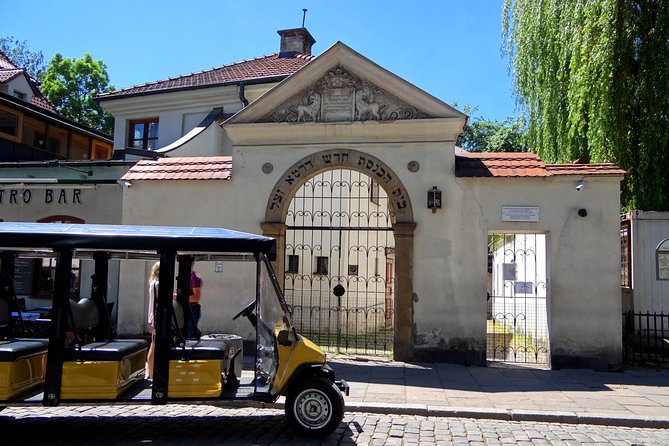
The cart covers more ground than a walking tour while keeping you closer to the streets than a standard sightseeing bus. You can see the relationship between Kazimierz and the Ghetto area without spending the whole hour on your feet.
The vehicle also has a rainproof cover and heating. That is more than a comfort detail in Krakow, where poor weather can turn a pleasant walk into a wet one. You still need suitable clothing, but the covered cart gives you a workable option when the forecast is uncertain.
The small maximum group size of 12 is another plus. It does not guarantee perfect sound, but it gives the driver a better chance to address the group than a large coach would. One negative experience centered on a quiet guide whose commentary was hard to hear. I would sit where you can clearly see and hear the driver, and ask for a repeat if the explanation gets lost.
The cart format also limits you. You may pass a place you want to examine, but the tour keeps moving. One party felt rushed and was disappointed that they could not get out of the cart to explore. That is a fair warning for anyone who prefers a slow, photo-heavy visit.
Audio commentary, guide quality, and language choices
The tour includes an English-speaking driver, and audio commentary is available in 28 languages. That gives the experience useful flexibility, particularly if not everyone in your group is comfortable with English.
At the same time, an audio system is not the same as a full walking lecture. The quality of the experience depends on how clearly the information is delivered and how well the timing matches what you are passing.
The best feedback focuses on guides who add context and enthusiasm. Valentino was singled out for his local knowledge, warm manner, and respectful handling of the Ghetto sites. Other strong comments describe the guide as friendly, talkative, and informative.
The weaker experience points to a practical issue rather than a problem with the route itself: if you cannot hear the commentary, much of the value disappears. This is a tour where the explanation is the product, not just the vehicle.
Is $26.41 a fair price?
At $26.41 per person, the tour sits in a reasonable range for a short, small-group city ride. You are paying for transport, an English-speaking driver, commentary, and a route that reaches several separated historic areas in about an hour.
The value is strongest if you have limited time, poor weather, or difficulty with a longer walk. It can also help you decide which places deserve a return visit. One booking party used a similar overview to plan later sightseeing and even received a useful local lunch suggestion from the guide.
The value is weaker if you expect a detailed tour at every stop. Five minutes at Szeroka Street, Corpus Christi Church, Ghetto Heroes Square, and Schindler’s Factory gives you a taste, not a full visit. The museum ticket is also extra, so add that cost if the factory museum is part of your plan.
I would consider the price fair for orientation and convenience, but not as a substitute for walking through Kazimierz or visiting the museums. Think of it as a compact introduction.
Who should book this experience?
I would recommend it to first-time visitors who want a quick overview before exploring independently. It suits you especially well if you want to see both Kazimierz and the Ghetto area without arranging several separate walks.
It is also a sensible choice for a rainy day. The heated, covered vehicle protects you from the worst of the weather while keeping the main route intact.
Families and mixed-age groups may appreciate the limited walking, though the serious wartime subject may not suit very young children. Most people can participate, and the group limit of 12 keeps the format fairly manageable.
You should think twice if you want long stops, interior visits, or a slow historical walk. The route is tightly timed, and the cart may not stop wherever you wish. You will get more from it if you accept that it is a moving overview.
The tour has a 4.7 out of 5 rating and is recommended by 90 percent of people who booked it. Those figures fit the experience’s strengths: a useful route, strong potential for good guiding, and a practical vehicle. They also need to be read alongside the clear weakness, which is the short duration and uneven guide delivery.
Booking advice and the best way to use your hour
Book this early if your schedule is fixed, since it is often reserved about three weeks ahead. Confirmation arrives at booking, and free cancellation is available up to 24 hours before the start time. Changes or cancellations inside that window are not accepted for a refund.
Arrive at plac Jana Matejki 3, the stated meeting point. The tour ends at Schindler’s Factory on Lipowa 4, where you can continue to the museum or make your own way back toward central Krakow.
I would avoid scheduling a tight connection immediately afterward. The ride is planned for about an hour, but you will want a little flexibility for the final stop and your onward plans.
If you visit Schindler’s Factory museum, check its admission arrangements separately. The cart tour does not include the museum ticket, and the short factory stop should not be confused with museum entry.
Should you book the Kazimierz golf cart tour?
Book it if you want a fast, weather-friendly introduction to Kazimierz, the former Jewish Ghetto, and Schindler’s Factory. The route is well chosen, the small cart is practical, and a strong guide can make the Ghetto section thoughtful and moving.
Skip it if your priority is slow exploration. You will need extra time for the synagogues, cemeteries, church interiors, Ghetto memorial, and Schindler’s museum. My best advice is to use the ride as your first pass, then return to the places that matter most to you.
FAQ
How long does the golf cart tour last?
The tour lasts approximately one hour.
Where does the tour start?
The meeting point is plac Jana Matejki 3, 31-157 Krakow, Poland.
Where does the tour end?
The tour ends in front of Oskar Schindler’s Enamel Factory at Lipowa 4, 30-702 Krakow, Poland.
Is admission to Schindler’s Factory Museum included?
No. The museum ticket is not included in the tour price.
Can I visit Schindler’s Factory after the tour?
Yes. The tour ends at the factory, so you can finish there and visit the museum if you have a separate admission ticket.
What languages are available?
The tour is offered in English with an English-speaking driver. Audio commentary is available in 28 languages.
How many people can join the tour?
The maximum group size is 12 travelers.
Is the golf cart suitable for rainy weather?
Yes. The vehicle has a rainproof cover and heating.
More Jewish Heritage Tours in Krakow
- Krakow: Schindler’s Factory & Ghetto Guided Tour
★ 4.7 · 1,694 reviews - Krakow: Jewish Quarter and Former Ghetto Tour
★ 4.9 · 1,441 reviews - Krakow: Bike Tour of Old Town, Jewish Quarter and the Ghetto
★ 4.9 · 1,155 reviews - Krakow: Kazimierz Jewish Quarter Walking Tour
★ 4.8 · 571 reviews
Just added in Krakow
- Auschwitz-Birkenau – Skip the Line Tickets★ 3.5 · 29 reviews
- Auschwitz-Birkenau: Fast-Track Ticket & Guided Tour No Transfers★ 3.5 · 17 reviews
- Zakopane & Sleigh Ride with Bonfire – Group Tour from Kraków★ 5.0 · 2 reviews
- Sleigh Ride & Bonfire in Zakopane with Funicular – Private Trip★ 5.0 · 48 reviews
- Thermal Baths & Zakopane – Private Trip from Krakow★ 5.0 · 1 review
- Zakopane & Gubalowka Funicular – Private Winter Tour from Krakow★ 5.0 · 10 reviews
- Divine Mercy Sanctuary – Private Tour from Krakow★ 5.0 · 4 reviews
- stag dog chase Krakow prank★ 5.0 · 4 reviews