
REVIEW · SCHINDLER'S FACTORY TOURS
Jewish Quarter Group Tour by Golf Cart with Schindler’s Museum visit in Krakow
Krakow’s past is written into its streets. This three-hour tour connects Kazimierz and Podgórze by comfortable ecological golf cart, then brings you inside Schindler’s Factory Museum with a live guide. I like the efficient route through several important Jewish and wartime sites, and I like that the museum visit is included rather than left for you to arrange separately. The main consideration is that the tour ends at the museum, so you must make your own way back afterward.
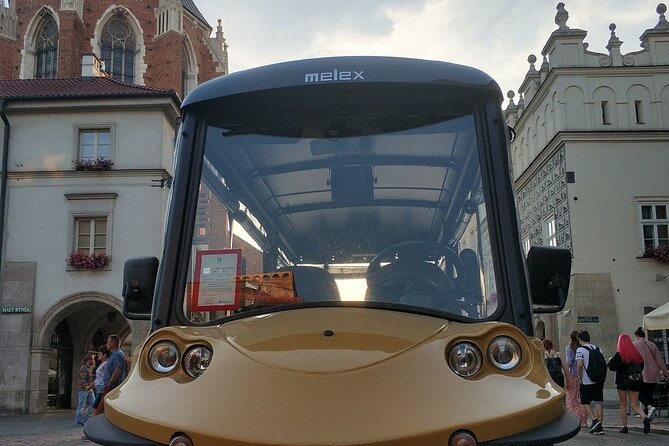
The golf cart is useful in a city where several meaningful places are spread across different districts. You get an audio guide during the ride, then a human guide inside the museum. One especially praised guide was described as exceptionally informative and even aware of the anniversary of the Good Friday Agreement in Ireland, a small detail that suggests careful attention beyond a memorized script.
In This Review
- Key points at a glance
- Why this tour works well for a first look at Jewish Krakow
- Kazimierz, once a separate town
- Szeroka Street and the center of Jewish life
- Plac Nowy, from Jewish market to Krakow meeting place
- Crossing into Podgórze
- The former ghetto wall
- Plac Zgody and the deportations
- Schindler’s Factory Museum and the limits of the film connection
- What the $75.60 price includes
- Timing, meeting point, and the ride back
- Who will get the most from this experience
- Should you book this Krakow Jewish Quarter tour?
- FAQ
- How long does the tour last?
- Where does the tour start?
- Where does the tour end?
- Is transportation back to the hotel included?
- Is the Schindler’s Factory Museum admission included?
- Is there a guide at the museum?
- Is there an audio guide during the golf cart ride?
- What is the maximum group size?
- What level of fitness is required?
- Can I cancel for a full refund?
Key points at a glance
- Two Krakow districts in one route: See Kazimierz, the former center of Jewish life, and Podgórze, the district where the Nazi ghetto was created.
- Szeroka Street’s four synagogues: Learn why this street became the center of Jewish Kazimierz and a major site of Jewish culture.
- Podgórze’s wartime traces: Visit part of the former ghetto wall and the square used as a deportation assembly point.
- Schindler’s Factory Museum included: Spend about 90 minutes with a live guide in the museum devoted mainly to Krakow and its people under Nazi occupation.
- A practical three-hour format: The tour begins near Mikołaja Zyblikiewicza Street and finishes at Lipowa 4, with no return transport included.
- A small group, not a private tour: The maximum group size is 24 people, which keeps the tour limited while still allowing a group atmosphere.
Why this tour works well for a first look at Jewish Krakow
Krakow’s Jewish story is not confined to one building or one museum. It runs through Kazimierz, crosses the Vistula area into Podgórze, and reaches its most painful chapter during the Nazi occupation. Seeing these places in sequence helps you understand how a living neighborhood became a place of persecution and deportation.
I like the way this tour joins cultural history with wartime history. Kazimierz is not treated only as a picturesque district filled with cafés and old religious buildings. Podgórze is not treated only as a stop on the way to Schindler’s museum. The route shows how the city’s neighborhoods changed, and how traces of those changes remain visible.
The golf cart also solves a practical problem. Walking from central Krakow through Kazimierz and onward to Podgórze takes time, and a three-hour visit can become rushed if you rely entirely on foot. The cart gives you an overview without turning the whole outing into a long march.
Still, this is not a slow, private exploration. The audio guide handles the ride, and the live guide appears at the museum. If you want long pauses at every synagogue, market, or memorial, you may prefer a dedicated walking tour or a private guide.
More Golf Cart Tours in Kraków
- Krakow: City Sightseeing Tour by Electric Golf Cart
★ 4.5 · 3,264 reviews - Krakow: City Sightseeing Tour Eco Electric Buggy Golf Cart
★ 4.7 · 3,143 reviews - Krakow: Extended City Sightseeing Tour – Eco Buggy Golf Cart
★ 4.7 · 794 reviews
Kazimierz, once a separate town
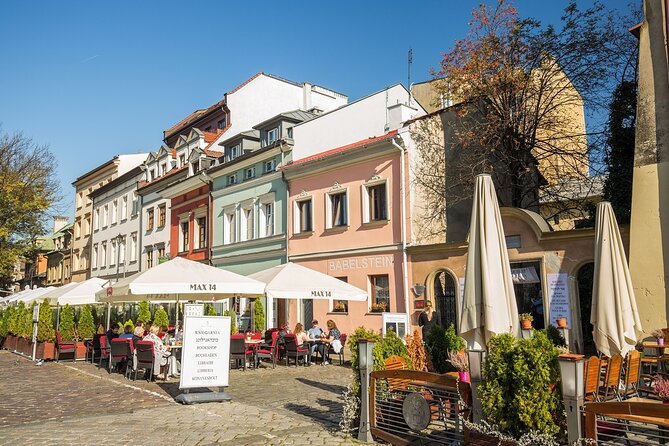
The first part begins in Kazimierz, once an independent settlement south of Wawel. For centuries, it was the center of Jewish life in Krakow, and the district still carries the marks of both Jewish and Christian communities living close together.
That shared setting is one of the most worthwhile parts of the tour. You are not simply looking at old façades. You are seeing a district shaped by two religious cultures over many generations. The tour uses the streets and surviving buildings to explain that connection.
Because the golf cart carries you through the area rather than stopping for a long visit at every location, pay attention to the commentary. The audio guide is included in the ride, so you can hear the background while taking in the streets. The exact amount of time at each point is not specified, and the pace may feel quick if you want detailed architectural study.
Szeroka Street and the center of Jewish life
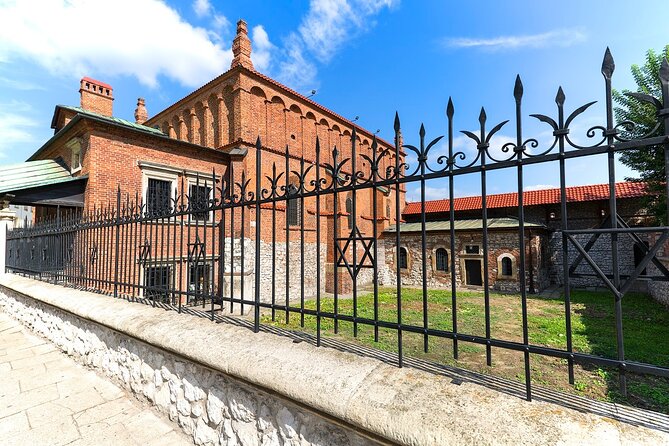
Szeroka Street is the key stop in Kazimierz. It was the center of Jewish life in the district, and four synagogues once stood along the same street, an unusual concentration in Europe.
That fact gives the street a special weight. The setting is also linked to the Jewish Culture Festival, whose final concert takes place there. In other words, Szeroka Street connects older religious life with Krakow’s continuing interest in Jewish culture.
One of the synagogues preserved here in very good condition is among the oldest in Poland. The tour does not list a separate interior visit to the synagogue, so you should expect the focus to be on the street, the building, and its place in the district’s story rather than an extended synagogue tour.
I like this stop because it gives you a clear physical center for Kazimierz. Instead of hearing about Jewish life as an abstract subject, you can picture the street where religious, social, and cultural activity once gathered.
Plac Nowy, from Jewish market to Krakow meeting place
Plac Nowy offers a different view of Kazimierz. The square was once called Plac Żydowski, or Jewish Square. In 1900, a circular pavilion was built in the middle, with grocery stalls, butcher shops, and a fast-food counter selling the casserole-like snacks that remain associated with Krakow today.
The square still changes character across the week. Weekdays bring stalls selling vegetables and antiques. Sunday morning becomes a clothing market. Cafés and pubs surround the square, and in warm weather their outdoor seating can turn the area into one large beer garden.
This is a useful stop because it links the district’s past with its everyday present. You see a place that was once part of Jewish commercial life and is now also a social center for Krakow. The drawback is that the square can feel more recreational than reflective, especially during busy periods. The tour’s historical explanation helps provide context.
More Museums in Kraków
- Auschwitz-Birkenau Museum and Memorial Guided Tour from Krakow
★ 4.5 · 1,510 reviews - Krakow: Rynek Underground Museum Guided Tour
★ 4.6 · 1,122 reviews - Krakow Schindler’s Factory Museum Guided Tour in English
★ 4.5 · 650 reviews - Krakow: Auschwitz Birkenau Museum Guided Tour with Pickup
★ 3.6 · 544 reviews
Crossing into Podgórze
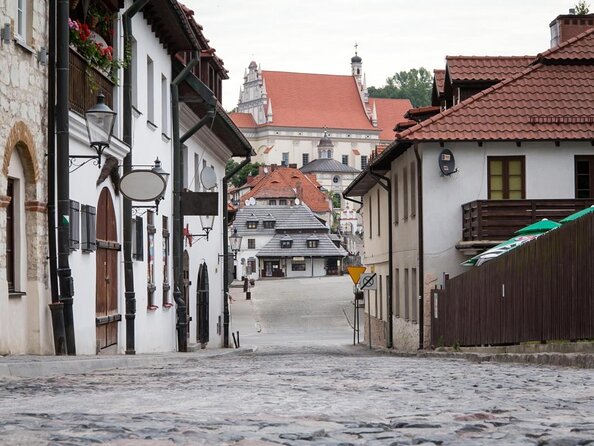
The route then moves toward Podgórze, a district that was incorporated into Krakow only in the twentieth century. Its parish church of St. Joseph dominates Podgórze Market Square and is one of the district’s most recognizable religious landmarks.
The church matters here as a marker of Podgórze’s Christian identity. Placing it alongside the Kazimierz stops helps show that Krakow’s religious geography was never limited to a single community. You get a wider view of the city before the tour turns to the Nazi occupation.
The cart is particularly helpful at this stage. It links the districts without requiring you to work out the route yourself, and it keeps the tour within its roughly three-hour schedule. Since the ride is one way, remember that the convenience applies to reaching the museum, not returning to your accommodation.
The former ghetto wall
In 1941, the Nazis turned Podgórze into the Krakow Ghetto. A small fragment of the original wall survives, with a plaque recalling the fate of the people who were confined there.
This is a modest physical remnant, not a large monument. That is exactly why it can be easy to overlook without a guide or clear explanation. The preserved fragment helps you understand that the ghetto was a real enclosed district, not simply a tragic chapter described in a museum.
Expect this part of the tour to be brief. The information provided does not promise a long stop or an extended memorial ceremony. Its value comes from placing the wall within the route, so the later museum visit has a clearer setting.
Plac Zgody and the deportations
The former Plac Zgody, now associated with the area around Ghetto Heroes Square, was used under Nazi occupation as an Umschlagplatz. It was the place where Jewish people had to gather before deportation.
This is among the most serious stops on the route. The square is not presented as a scenic attraction. It is a place where the machinery of deportation became part of daily life for the people imprisoned in the ghetto.
A moving vehicle can make this visit feel less intimate than a walking tour, but the route still gives you an important connection between geography and events. You are looking at the places where people were forced to assemble, rather than learning about deportations only through text panels.
Schindler’s Factory Museum and the limits of the film connection
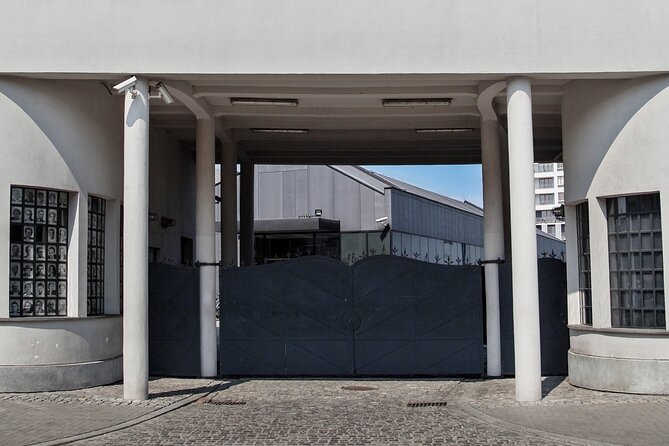
The second stage takes place at Fabryka Emalia Oskara Schindlera, or Oskar Schindler’s Enamel Factory. The museum occupies the former factory administration building, and admission is included in the tour price.
The museum is associated with Oskar Schindler, the German entrepreneur who employed Jewish workers and saved many of them from certain death. His story was later made famous by Steven Spielberg’s Oscar-winning film, but the museum’s main subject is broader: the fate of Krakow and its residents during the Nazi occupation.
That distinction matters. If you arrive expecting a museum devoted only to Schindler, you may find the focus wider than anticipated. His office and the factory setting are important, including a symbolic ark of survivors made from thousands of pots similar to those produced by his employees. Yet the museum uses his story as one part of a larger account of wartime Krakow.
The exhibition is interactive and is designed to leave a strong impression. A live guide leads this portion, which is a real advantage. Museum displays can be powerful, but a guide can explain how individual objects fit into the city’s larger story and help you separate historical fact from the film version familiar to many people.
The museum visit lasts about 90 minutes. That is enough time for a guided introduction and a substantial look at the exhibition, but not enough for every display to receive equal attention. If you are especially interested in World War II history, you may want to return independently for a longer visit, if time and museum arrangements allow.
What the $75.60 price includes
At $75.60 per person, this is not the cheapest way to see Kazimierz. The price becomes easier to assess when you separate the included pieces: one-way golf cart transportation, an audio guide during the ride, a live guide at the museum, and the Schindler’s Factory Museum entrance ticket.
You are paying for a compact route, not only for admission. The cart saves walking time between Kazimierz and Podgórze, while the museum ticket removes one more planning task. For a first visit to Krakow, that combination can be worthwhile, particularly if you want the Jewish quarter and Schindler’s museum on the same morning or afternoon.
The value is weaker if you only want to wander Kazimierz. Plac Nowy, Szeroka Street, and the district’s public spaces are easy to explore independently. The tour earns its price through the transportation, historical framing, and museum guide.
The maximum group size is 24 people. That is smaller than a large city coach group, though it is not a private experience. If you want direct conversation throughout the route, ask yourself how comfortable you are with a group of that size.
Timing, meeting point, and the ride back
The starting point is Mikołaja Zyblikiewicza 2 in Krakow. The tour finishes at Lipowa 4, 32-051 Krakow, at the museum. No transport back to your hotel, the city center, or another location is included.
Plan this ending before you book. The museum is in Podgórze, so you should not assume that the tour will return you to the place where it began. The one-way arrangement is not a flaw, but it needs to fit your day.
The total duration is approximately three hours, with about 90 minutes allocated to the museum. The remaining time covers the golf cart route and the historic stops. The tour requires a moderate level of physical fitness, although the cart reduces the amount of walking compared with a fully walking-based route.
Confirmation is provided at booking, and the starting area is near public transportation. Free cancellation is available up to 24 hours before the start time. Inside that 24-hour window, the payment is not refunded and changes are not accepted.
Who will get the most from this experience
I would recommend this tour to a first-time visitor who wants a clear introduction to Jewish Krakow and the Nazi occupation without arranging separate transport and museum admission. It also suits anyone who wants to limit walking while still seeing two districts.
The tour is a good match for people who prefer an organized historical overview. The combination of an audio guide on the cart and a live guide at the museum gives you two different ways to receive information. The particularly positive guide feedback, including the detail about the Good Friday Agreement anniversary, suggests that at least one guide brought broad awareness and personal attention to the conversation.
You may want another format if you have already spent a full day in Kazimierz, want to enter several synagogues, or prefer to set your own pace. The tour is also not ideal if you need a return transfer included. For a deeper study of Jewish religious life, a specialist walking tour may be more focused.
Should you book this Krakow Jewish Quarter tour?
Book it if you want to connect Kazimierz’s Jewish streets with Podgórze’s ghetto memorials and finish at Schindler’s Factory Museum in one organized outing. The strongest feature is the route itself: it moves from everyday culture and religious life to persecution, deportation, and the wider wartime story of Krakow.
Before paying, make two checks. First, confirm that a one-way tour ending at Lipowa 4 fits your plans. Second, decide if $75.60 is fair for you based on the included museum ticket, cart ride, audio guide, and live museum commentary.
I would choose it for a first visit, a limited schedule, or a day when you want less walking. I would skip it in favor of independent exploration if you already know the districts well and want long, quiet visits at individual sites.
FAQ
How long does the tour last?
The tour lasts approximately three hours.
Where does the tour start?
It starts at Mikołaja Zyblikiewicza 2, 31-029 Kraków, Poland.
Where does the tour end?
It ends at Lipowa 4, 32-051 Kraków, at Schindler’s Factory Museum.
Is transportation back to the hotel included?
No. The tour provides golf cart transportation one way, and no return transport to your hotel or another location is included.
Is the Schindler’s Factory Museum admission included?
Yes. The entrance ticket to Schindler’s Factory Museum is included.
Is there a guide at the museum?
Yes. A live guide leads the museum portion of the experience.
Is there an audio guide during the golf cart ride?
Yes. An audio guide is provided in the golf cart.
What is the maximum group size?
The tour allows a maximum of 24 travelers.
What level of fitness is required?
A moderate level of physical fitness is recommended.
Can I cancel for a full refund?
Yes. You can receive a full refund if you cancel at least 24 hours before the experience start time. Cancellations or changes made within 24 hours are not refunded or accepted.
More Jewish Heritage Tours in Krakow
- Krakow: Schindler’s Factory & Ghetto Guided Tour
★ 4.7 · 1,694 reviews - Krakow: Jewish Quarter and Former Ghetto Tour
★ 4.9 · 1,441 reviews - Krakow: Bike Tour of Old Town, Jewish Quarter and the Ghetto
★ 4.9 · 1,155 reviews - Krakow: Kazimierz Jewish Quarter Walking Tour
★ 4.8 · 571 reviews
More Schindler Factory Tours
- Krakow: Oskar Schindler’s Factory Entry Ticket & Guided Tour
★ 4.2 · 3,793 reviews - Krakow: Schindler’s Factory Tour with Entrance Ticket
★ 4.5 · 3,182 reviews - Krakow: Schindler’s Factory Skip-the-Line Ticket
★ 4.4 · 3,105 reviews - Krakow: Schindler’s Factory Tour with Entrance Ticket
★ 4.6 · 1,737 reviews
Just added in Krakow
- Auschwitz-Birkenau – Skip the Line Tickets★ 3.5 · 29 reviews
- Auschwitz-Birkenau: Fast-Track Ticket & Guided Tour No Transfers★ 3.5 · 17 reviews
- Zakopane & Sleigh Ride with Bonfire – Group Tour from Kraków★ 5.0 · 2 reviews
- Sleigh Ride & Bonfire in Zakopane with Funicular – Private Trip★ 5.0 · 48 reviews
- Thermal Baths & Zakopane – Private Trip from Krakow★ 5.0 · 1 review
- Zakopane & Gubalowka Funicular – Private Winter Tour from Krakow★ 5.0 · 10 reviews
- stag dog chase Krakow prank★ 5.0 · 4 reviews
- Divine Mercy Sanctuary – Private Tour from Krakow★ 5.0 · 4 reviews