
REVIEW · CITY TOURS
Faces of Warsaw’s 3-hour orientation city tour with hotel pick-up
Warsaw tells a big story quickly. This three-hour private tour links royal parks, wartime memorials, communist-era architecture, and the rebuilt Old Town in one efficient ride. I like the personal hotel pickup and the chance to ask questions throughout, especially with a guide such as Marzena, whose patient answers and historical perspective earned high praise. I also like the thoughtful route, which moves from Łazienki Park to Jewish Warsaw, the Old Town, and Maria Skłodowska-Curie’s birthplace.
The main trade-off is pace. You will see many important places, but most stops last only 10 to 30 minutes. The $72.72 per-person price can make sense for a private introduction, especially if your group shares the vehicle, but it does not include lunch or admission to the Curie museum. This is best viewed as a smart first look, not a full museum day.
In This Review
- Key points to know before booking
- Why this three-hour Warsaw tour works as an introduction
- Łazienki Park and Palace: Warsaw’s elegant opening
- The parliament and the Palace of Culture
- Grzybowski Square and the former ghetto area
- POLIN Museum and the ghetto heroes monument
- Umschlagplatz and the machinery of deportation
- Sigismund’s Column and the rebuilt Old Town
- The Presidential Palace and famous Polish figures
- Rynek Starego Miasta: a half-hour Old Town walk
- Maria Skłodowska-Curie’s birthplace and the final stop
- Is $72.72 a fair price?
- Who should book this private Warsaw tour?
- Should you book Faces of Warsaw?
- FAQ
- How long is the Faces of Warsaw tour?
- Is hotel pickup available?
- Is this a private tour?
- What language is the tour offered in?
- Is transportation included?
- Is lunch included?
- Are admission tickets included?
- Where does the tour end?
- Can I cancel for a full refund?
Key points to know before booking
- Private hotel pickup: A guide collects you from a city-center hotel or accommodation, either at reception with a PolinTours sign or in a car outside.
- A strong Warsaw overview: The route covers Łazienki Park, the former Jewish ghetto area, the Palace of Culture, royal monuments, and the UNESCO-listed Old Town.
- Serious history handled in a short window: Grzybowski Square, POLIN, Umschlagplatz, and the ghetto heroes monument introduce the story of Warsaw’s Jewish community and wartime destruction.
- Mostly outdoor sightseeing: The listed stops have free admission, but the Maria Skłodowska-Curie Museum admission is not included.
- A private, question-friendly format: Only your group takes part, so you can ask for clarification or adjust your attention during the ride.
- A useful ending point: The tour finishes near the Old Town at Freta Street, close to the Maria Skłodowska-Curie Museum.
Why this three-hour Warsaw tour works as an introduction
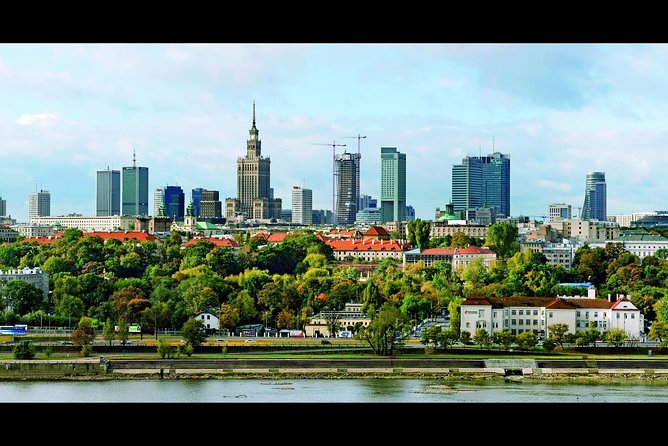
Warsaw can be hard to read at first. Its royal avenues, rebuilt medieval center, communist apartment blocks, Jewish memorials, and new development do not always appear to belong to the same city. This tour gives you the basic map and the key stories before you set off on your own.
The private format matters. You are not waiting for a large group to cross a street or gather around a distant guide. Your transport is an air-conditioned car or minibus, and parking fees are included. That saves time in a city where a short ride can connect places that would otherwise take more planning.
You should also keep your expectations in check. This is an orientation tour, so the schedule favors breadth over long visits. You will not have time to fully explore the POLIN Museum, spend hours in Łazienki Park, or study every room in the Old Town. Instead, you get a guided framework that helps you decide what deserves a second visit.
The guide is central to the experience. Marzena received especially warm praise for her historical perspective, patience, and good humor. Another review noted an exceptional guide who explained both Polish history and life in Poland. Since the tour is private, that conversation can be as useful as the monuments themselves.
A few more in Warsaw
- Warsaw: Chopin Concert in the Old Town
★ 4.8 · 2,287 reviews - Warsaw: Traditional Galar Cruise on The Vistula River
★ 4.6 · 1,640 reviews - Warsaw: Old Town Highlights Walking Tour in English
★ 4.7 · 1,516 reviews
Łazienki Park and Palace: Warsaw’s elegant opening
The tour begins with about 30 minutes at Royal Łazienki Park and Palace Complex. This is a calm way to start, particularly after arriving in a city that can feel visually busy.
Łazienki is known here as one of Europe’s distinctive park and palace complexes. The stop gives you a taste of royal Warsaw, with formal grounds and historic residences rather than only streets and monuments. You receive free admission to the listed stop, though the schedule does not promise entry into every building.
Thirty minutes is enough for a guided look and a few photographs. It is not enough for a leisurely park walk or a detailed palace visit. If you like gardens, architecture, or quiet city spaces, note the location and consider returning later with more time.
This first stop also creates a useful contrast for the rest of the morning. Warsaw is not only a city of wartime memorials and modern construction. It has royal settings and grand civic spaces, too.
The parliament and the Palace of Culture
As the vehicle moves through the city, the guide points out the seat of the Polish Reichstag, as described in the tour plan. You also learn about the legacy of communism and the controversial Palace of Culture, Stalin’s well-known gift to Warsaw.
These moments are important because they show how political power shaped the city’s appearance. The Palace of Culture is not presented simply as a tall building to photograph. Its meaning is tied to Soviet influence, Polish memory, and the uneasy place of communist architecture in today’s capital.
The route also introduces Warsaw as a city of contrasts, where modern development meets older buildings and reconstructed districts. That observation is more useful than a quick list of sights. As you move between areas, you begin to understand why the city can feel both historic and newly made.
The supplied details do not give a separate timed stop for the parliament or Palace of Culture. Treat these as part of the drive and commentary rather than as extended visits.
Grzybowski Square and the former ghetto area
The approximately 15-minute stop at Grzybowski Square shifts the mood. Here, the focus is Warsaw’s Jewish heritage and the grounds of the former Warsaw ghetto.
A short stop cannot tell the whole story of Jewish Warsaw, but it can establish the geography. That matters. The former ghetto was not an abstract chapter in a book. It occupied real streets and squares within the city you are seeing now.
The guide’s role is especially valuable here. A map and a few plaques can give you dates, but a private explanation helps connect the area to the larger story of Warsaw’s Jewish community, the wartime occupation, and the destruction that followed.
You should allow the pace to feel more reflective than the earlier park visit. The route is not built around entertainment at this point. It asks you to pay attention to place, memory, and what has disappeared.
Something quite different:
- Warsaw Concert: Chopin – Painted by Candlelights with Wine
★ 4.8 · 1,442 reviews - Warsaw: City Sightseeing Hop-On Hop-Off Bus Tour
★ 3.6 · 1,415 reviews - Warsaw: POLIN Museum of the History of Polish Jews Ticket
★ 4.7 · 1,142 reviews - #1 Pub Crawl Warsaw with Optional Premium 1 Hour Open Bar
★ 5.0 · 790 reviews
POLIN Museum and the ghetto heroes monument
The next stop is the POLIN Museum of the History of Polish Jews, with about 20 minutes around the building and the nearby monument to the heroes of the Warsaw Ghetto Uprising.
The stop includes the setting of the museum and the monument, but it does not provide time for a full museum visit. That distinction is important. If POLIN is high on your list, plan a separate visit, because twenty minutes will only give you an introduction.
The monument is especially significant. The tour connects it with the Warsaw Ghetto Uprising and with Willy Brandt’s famous act of kneeling there. A guide can explain why the site carries such emotional and political weight without turning the stop into a rushed checklist.
This is one of the places where Marzena’s praised style would make a difference. Patient answers are useful when a site raises difficult questions. You can ask for context instead of simply taking a photograph and moving on.
Umschlagplatz and the machinery of deportation
The roughly 15-minute visit to Umschlagplatz is one of the tour’s most serious stops. This was the place connected with the deportation of Warsaw’s Jews during the Holocaust, and the tour addresses how the Nazi policy of mass murder was put into practice.
The wording in the tour plan is direct, and the subject deserves that seriousness. You are not being shown a general memorial with a vague message. You are being taken to a specific place tied to deportation and loss.
Again, the timing is short. You will hear an explanation and see the site, but you will not receive a full museum lesson. I would treat this as a first encounter that may shape how you later approach POLIN or other Warsaw memorials.
The sequence from Grzybowski Square to POLIN and then Umschlagplatz is well chosen. It moves from the wider former ghetto area to the uprising monument and then to the mechanics of deportation. The subject becomes more focused as the route continues.
Sigismund’s Column and the rebuilt Old Town
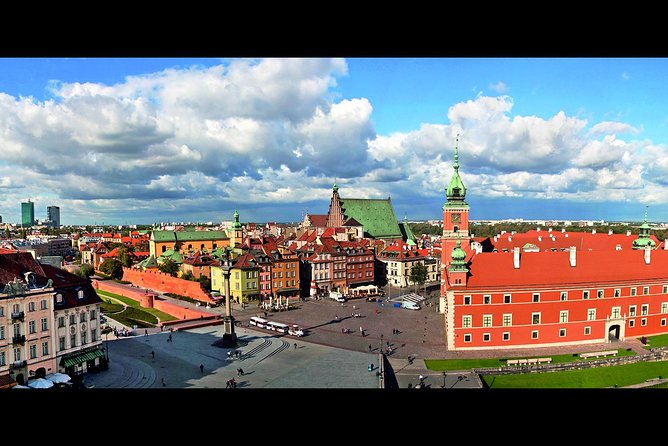
The tour then turns toward historic Warsaw, beginning with King Sigismund’s Column at Castle Square. The stop lasts about 15 minutes.
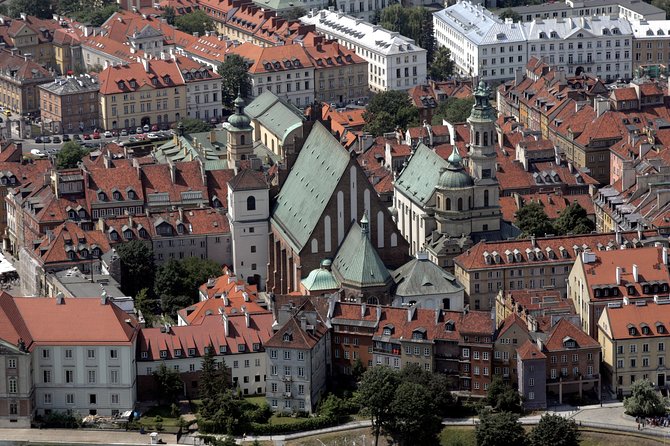
The column introduces the royal city and the completely reconstructed Old Town, which is recognized as a UNESCO World Heritage Site. You will hear about important monuments, royal residences, and architectural details in the central historic area.
The word reconstructed is essential here. Warsaw’s Old Town looks historic, but much of it had to be rebuilt after the Second World War. A guide can help you appreciate both the appearance of the district and the enormous work behind it.
This is also the point where the tour changes tone. After the difficult stops connected with the former ghetto, the route returns to royal Warsaw, public squares, and city architecture. The contrast is not accidental. It reflects the many layers you are trying to understand in a limited time.
The Presidential Palace and famous Polish figures
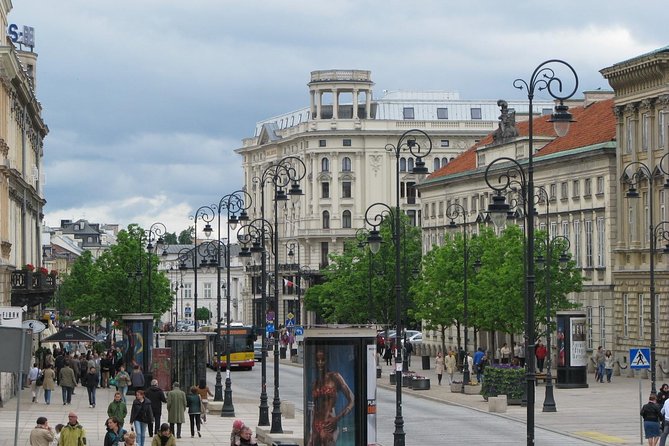
The Palace on Krakowskie Przedmieście is covered in a 10-minute stop. Here you hear about major Polish figures such as Frédéric Chopin, Marie Curie, and Lech Wałęsa.
This part broadens the tour beyond buildings. Poland’s story is also told through music, science, politics, and social change. You may already know these names, but hearing them placed within Warsaw gives them a stronger local connection.
Ten minutes is enough for an introduction, not a full biographical talk. If one figure interests you, ask the guide a direct question. The private format is useful here because you can steer the conversation toward music, science, modern politics, or another subject without holding up a group.
The stop also helps connect the grand public buildings with the people who shaped Poland’s identity. That makes the route feel less like a parade of facades.
Rynek Starego Miasta: a half-hour Old Town walk
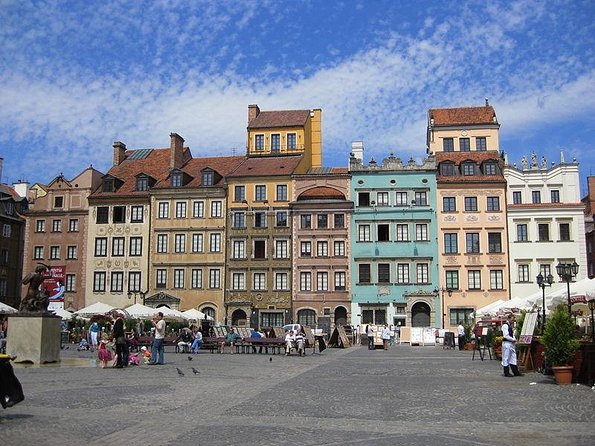
The 30-minute visit to Rynek Starego Miasta is the longest walking stop in the central historic area. You stroll through the romantic streets of the Old Town and take in the UNESCO-listed setting.
This is the part of the tour where you can slow down a little. The market square and surrounding lanes give you a better sense of Warsaw as a place to walk, not simply a city seen through a vehicle window.
Still, half an hour is not a lot. You will have time to look around and hear the story of reconstruction, but not to settle into a café, shop at length, or visit several buildings. Wear comfortable shoes, since the route includes outdoor walking and historic streets.
The Old Town works well near the end because you now have context. You have seen royal Warsaw, communist Warsaw, Jewish Warsaw, and the memorial sites of the war. The rebuilt center becomes part of a larger story instead of an isolated pretty square.
Maria Skłodowska-Curie’s birthplace and the final stop
The tour finishes at the Maria Skłodowska-Curie Museum on Freta Street, in the Old Town area. The visit lasts about 10 minutes, and admission is not included.
The museum is located in the birthplace of Marie Curie, one of Warsaw’s most famous figures. Even a short stop gives the tour a fitting human ending after its broad sweep through politics, war, architecture, and national identity.
Because the tour ends here, you can decide if you want to enter on your own. The supplied details do not state how much extra time you should allow, so check the museum’s current opening information separately before planning a visit.
The end point is practical, too. You finish in the Old Town rather than being returned to a distant part of the city. If your plans allow, you can continue exploring on foot after the guide leaves.
Is $72.72 a fair price?
At $72.72 per person, this is not the cheapest way to see Warsaw. The value comes from the private vehicle, hotel pickup and return arrangement, parking fees, air conditioning, and a guide focused only on your group.
The price makes more sense for two or more people sharing the booking than for a solo visitor. Group discounts are offered, though the exact discount is not specified. Compare the total cost with the time and effort of arranging several separate rides and hiring a private guide.
You are also paying for orientation. If you already know Warsaw well, the route may feel too basic. If you have only a short stay, the tour can save planning time and show you which places deserve a longer visit.
Lunch is not included. The listed stops are free except for the Maria Skłodowska-Curie Museum, where admission is also not included. Budget separately if you want to go inside.
Who should book this private Warsaw tour?
I would recommend it to first-time visitors who want a broad introduction without managing public transport between far-flung sights. It also suits families, couples, and small groups who value a private guide and hotel pickup.
It is a good fit if you enjoy asking questions. The best part of a private tour is not just the car. It is the chance to stop and ask why the Palace of Culture remains controversial, how the Old Town was rebuilt, or how different Polish figures connect to Warsaw.
It is less suitable if you want extended museum time. POLIN receives only a short stop, and the Curie museum is not included. It is also not ideal if you prefer to spend a whole morning in one neighborhood rather than cover many parts of the city.
Confirmation arrives at booking, service animals are allowed, and most people can participate. The tour is offered in English, and pickup is available from city-center accommodation. You can cancel for a full refund up to 24 hours before the start time, which gives you some useful flexibility.
Should you book Faces of Warsaw?
Book this tour if you want to get your bearings quickly and understand the forces that shaped Warsaw: royalty, war, Jewish life, communism, reconstruction, and modern Poland. The route is thoughtful, the private setup is convenient, and the guide’s ability to answer questions is a major advantage.
Skip it if you want long museum visits or a slow, neighborhood-by-neighborhood walk. For most first-time visitors with limited time, though, this is a strong opening chapter. Use the three hours to learn the city’s basic story, then return to POLIN, Łazienki, the Old Town, or another site that catches your interest.
FAQ
How long is the Faces of Warsaw tour?
The tour lasts approximately three hours.
Is hotel pickup available?
Yes. Pickup and return are offered from city-center hotels or accommodations. The guide collects you at reception with a PolinTours sign or waits in the car outside the entrance.
Is this a private tour?
Yes. Only your group participates in the activity.
What language is the tour offered in?
The tour is offered in English.
Is transportation included?
Yes. Private transportation in an air-conditioned car or minibus is included, along with parking fees.
Is lunch included?
No. Lunch is not included in the price.
Are admission tickets included?
The listed outdoor stops have free admission. Admission to the Maria Skłodowska-Curie Museum is not included.
Where does the tour end?
The tour ends at the Maria Skłodowska-Curie Museum on Freta Street, near Warsaw’s Old Town.
Can I cancel for a full refund?
Yes. You can cancel at least 24 hours before the experience start time for a full refund. Cancellations or changes made less than 24 hours before the start time are not accepted for a refund.
Just added in Warsaw
- Wroclaw Small-Group Tour with Lunch from Warsaw★ 5.0 · 2 reviews
- World War II Warsaw Old Town, Military Cemetery Walking Tour★ 4.7 · 3 reviews
- Warsaw: Wolf’s Lair & Swieta Lipka Small-Group Tour + Lunch★ 5.0 · 3 reviews
- Wilanów Palace: 2-Hour Guided Tour with Entrance Tickets★ 4.8 · 8 reviews
- Warsaw Zoo Skip-the-Line Entry Ticket with Private Transport★ 4.8 · 3 reviews
- Warsaw: Private Vodka Tasting Night with Snacks and Pickup★ 5.0 · 7 reviews
- Warsaw Private Wilanow Palace & Garden Tour★ 4.6 · 30 reviews
- Warsaw Wolf’s Lair with St. Lipka and Mamerki Private Guided★ 4.2 · 3 reviews
City Tours, compared.
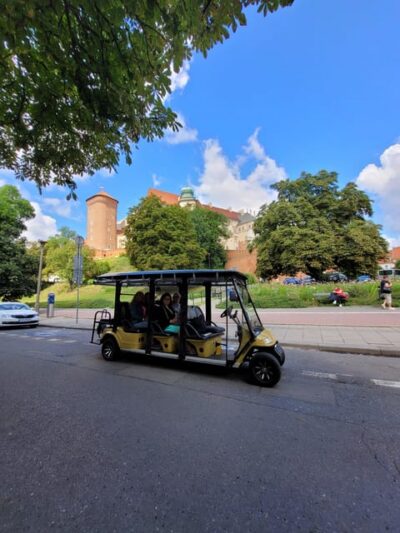
City Sightseeing Tour Eco Electric Buggy Golf Cart
Read our review →
Gdańsk City Sights & History Guided Walking Tour in English
Read our review →
Extended City Sightseeing Tour – Eco Buggy Golf Cart
Read our review →
Browse the lists this tour appears in