
REVIEW · WARSAW TOURS
Warsaw for WWII Buffs – private tour with hotel pickup
Warsaw’s past is hiding in plain sight. This three-hour private tour makes the city’s wartime story easier to follow by linking scattered sites in a vintage Żuk minibus, while guides such as Marcin, Tom, Karol, and Lukas add personal stories, photos, and clear historical context. I especially like the flexible format and the chance to visit places many city tours skip. The main drawback is that the three hours pass quickly, and hotel transfers count toward that time.
You pay $169.38 per person, so the value depends on your group size and interest in the subject. For a private group, the price buys direct conversation, a custom route, and transport between widely separated locations. Just prepare for walking at the stops, a bumpy ride, and a historic vehicle that may lack air conditioning or seat belts.
In This Review
- Key things to know before booking
- Why the vintage Żuk matters
- Warsaw before and during the occupation
- Waliców Street and the last traces of the Ghetto
- Chłodna Street and the wooden bridge
- Muranów and the Monument to the Ghetto Heroes
- The Soviet occupation and the eastern deportations
- The 1944 Warsaw Uprising Monument
- How much can fit into three hours?
- Guides, customization, and the right level of detail
- Price, group size, and practical value
- Who should book this tour?
- Should you book Warsaw for WWII Buffs?
- FAQ
- How long is the Warsaw for WWII Buffs tour?
- Is the tour private?
- What language is the tour offered in?
- Is hotel pickup included?
- Does hotel transfer time count toward the tour?
- What vehicle is used?
- Does the vehicle have air conditioning?
- Do all vehicles have seat belts?
- Can children join the tour?
- What is included in the price?
Key things to know before booking
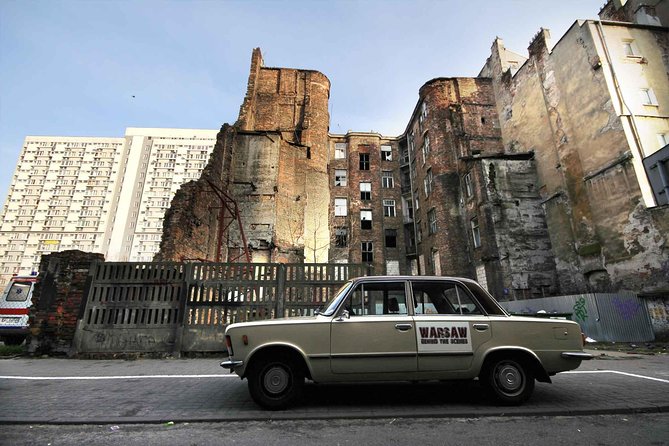
- The 1970s Żuk is part of the experience: You travel in a restored communist-era minibus, not a modern coach.
- The tour connects several difficult subjects: Nazi occupation, the Warsaw Ghetto, the 1943 Ghetto Uprising, Soviet deportations, the 1944 Warsaw Uprising, and postwar communist rule.
- Private touring gives you a say: Your guide can adjust the focus to your interests and answer questions as you go.
- Hotel pickup has a limit: Pickup and drop-off are included within 3 kilometers of central Warsaw, but that transfer uses part of the three-hour tour.
- Expect short walks at each stop: The Żuk is mainly used to move around the city, not to provide a continuous sightseeing ride.
- The experience is serious, not light entertainment: The history includes mass murder, deportation, destruction, and political repression.
Why the vintage Żuk matters
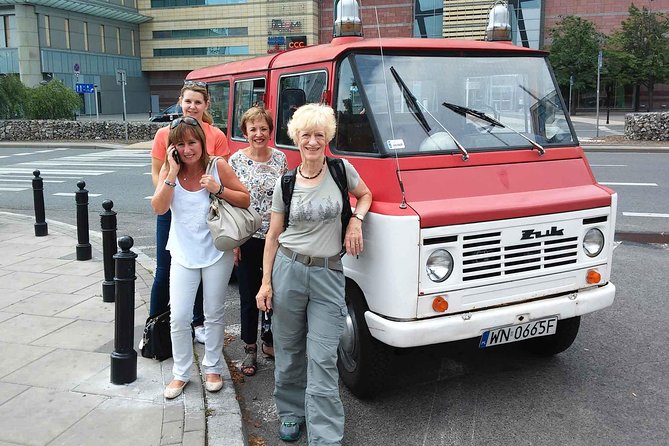
The vehicle gives the outing a strong sense of place before the history even begins. The Żuk was a Polish communist-era workhorse, and traveling around Warsaw in one makes the tour feel less like a standard sightseeing circuit.
That charm comes with tradeoffs. The ride can be bumpy, and one vehicle may feel cramped or awkward for older passengers, especially when getting in and out. A senior visitor specifically found the seats uncomfortable and the entrance difficult, so ask about the exact vehicle before booking if mobility is a concern.
Some historic minibuses do not have seat belts, which is permitted for classic vehicles in Poland. None has air conditioning, though all have heating for winter. In warm weather, dress lightly and carry water.
Each minibus holds up to eight people, and the operator has a fleet of five. Since the activity is private, your group is not mixed with strangers. That makes it easier to ask questions, pause on a subject, or request a different emphasis.
A few more in Warsaw
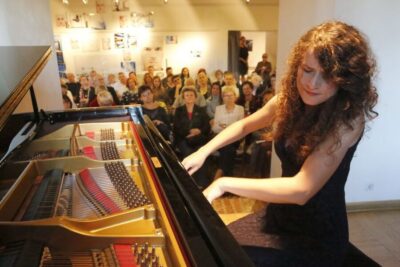
- Warsaw: Chopin Concert in the Old Town
★ 4.8 · 2,287 reviews - Warsaw: Traditional Galar Cruise on The Vistula River
★ 4.6 · 1,640 reviews - Warsaw: Old Town Highlights Walking Tour in English
★ 4.7 · 1,516 reviews
Warsaw before and during the occupation
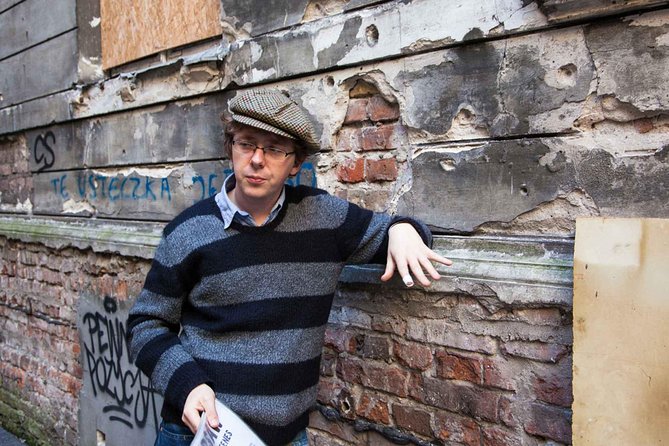
The tour begins in central Warsaw, then sets the political scene before reaching the memorials. Your guide explains the late 1930s, Germany’s invasion of Poland in 1939, and the Soviet occupation of eastern Poland soon afterward.
This opening matters because Warsaw’s wartime story cannot be reduced to a single conflict. Poland was attacked from both sides, and the occupation shaped daily life, political choices, resistance, deportations, and relations among different communities.
The guide-led format helps you keep the chronology straight. You move from the prewar political climate to German rule, then to the growth of resistance and the later Soviet takeover. Tom has been praised for using photographs to support his explanations, while other guides have been noted for connecting wartime events to Poland’s postwar years.
You may already know the broad outline of World War II. Even so, the local focus adds useful detail. This is not just a tour of famous monuments. It is an explanation of how occupation changed the city and its people.
Waliców Street and the last traces of the Ghetto
One of the most important stops is a surviving fragment of the Warsaw Ghetto Wall. It is easy to miss because sections of the wall are tucked between modern buildings and follow old property lines rather than forming a grand monument.
Your guide explains that roughly 300,000 Jews lived in Warsaw before the war, within a prewar Polish Jewish population of about three million. In 1940, Nazi authorities created the Warsaw Ghetto and forced nearly half a million people into its confined area.
The physical remains make the scale of that system easier to grasp. A wall fragment may look modest, but its location between ordinary buildings shows how occupation was imposed onto an existing city. You are not looking at a complete structure or a polished museum display. You are seeing a surviving piece of a boundary that once controlled movement, food, work, and family life.
Waliców Street adds another layer. A damaged tenement house remains in ruins, described as the last ghost of the Ghetto. A piece of the wall is preserved in the same area.
This stop is powerful because the setting is so un theatrical. You are surrounded by present-day Warsaw, yet the ruined building and wall fragment interrupt the modern city. Wear comfortable shoes, since the route includes short walks and uneven urban surfaces.
Chłodna Street and the wooden bridge
At Chłodna Street, your guide explains how the Ghetto was split into two sections in 1941. The street carried east-west traffic, separating the smaller and larger sections of the enclosed district.
A wooden bridge once linked the two areas near Chłodna and Żelazna streets. It rose to the third floor of nearby buildings, allowing trams, German military vehicles, and cars to pass underneath. Period photographs show the bridge crowded above the road, an image that helps explain the strange vertical geography of the Ghetto.
There is no need to expect a full structure still standing. The value here comes from understanding the location and comparing it with historical photographs. A good guide turns an ordinary street into a clear lesson about forced separation.
This is also a stop where a private tour helps. You can ask how the bridge functioned, why the Ghetto was divided, and what the traffic below meant for people trapped inside. The stop itself is short, about ten minutes, so the quality of the explanation matters more than the amount of time spent standing there.
Something quite different:
- Warsaw Concert: Chopin – Painted by Candlelights with Wine
★ 4.8 · 1,442 reviews - Warsaw: City Sightseeing Hop-On Hop-Off Bus Tour
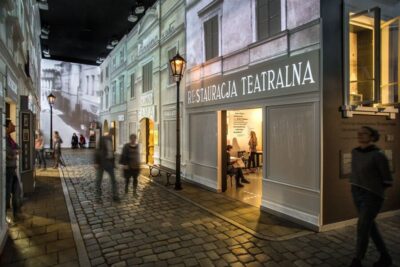
★ 3.6 · 1,415 reviews - Warsaw: POLIN Museum of the History of Polish Jews Ticket
★ 4.7 · 1,142 reviews - #1 Pub Crawl Warsaw with Optional Premium 1 Hour Open Bar
★ 5.0 · 790 reviews
Muranów and the Monument to the Ghetto Heroes
Muranów initially looks like a regular district of square apartment blocks. That appearance is part of the lesson. Much of the former Ghetto was destroyed, and postwar Warsaw was rebuilt over the area.
Your guide helps you read the district beneath its present-day appearance. The streets and buildings do not offer a simple preserved historic quarter. Instead, Muranów asks you to understand what was lost and how the city was reconstructed.
The tour then reaches the Monument to the Ghetto Heroes and the area around the POLIN Museum of the History of Polish Jews. The visit is to the surrounding area and memorial setting. The supplied details do not include admission to the museum, so plan a separate museum visit if you want its indoor exhibitions.
The monument area is connected to the first armed clashes of the 1943 Ghetto Uprising. It also carries a broader message of remembrance, dialogue, and reconciliation among Polish, Jewish, and German communities.
Many people find this the emotional center of the tour. The guide can explain the military events, but also the political and human meaning of the memorial. Karol, for example, has been praised for discussing both the facts and the larger political forces around them. That kind of conversation is useful here, since a memorial deserves more than a quick photograph.
The Soviet occupation and the eastern deportations
The Monument to the Fallen and Murdered in the East shifts the focus from Nazi Germany to the Soviet attack and occupation. On September 17, 1939, two weeks after the war began in Europe, the Soviet Union invaded eastern Poland.
The monument honors Poles deported to Siberian Gulags, people killed in executions, and victims of the Katyń massacres. It was built after the fall of the Soviet Union, when public discussion of these subjects became more open.
This stop prevents the tour from presenting Polish wartime history as a story involving only Germany. Poland suffered under two occupying powers, and the Soviet period that followed the war shaped the country for decades.
If you have limited background on eastern Poland, listen closely here. The subject can be complex, especially when the tour moves from invasion to deportation, execution, and later communist rule. A private setting gives you room to ask your guide to slow down or explain the sequence again.
The 1944 Warsaw Uprising Monument
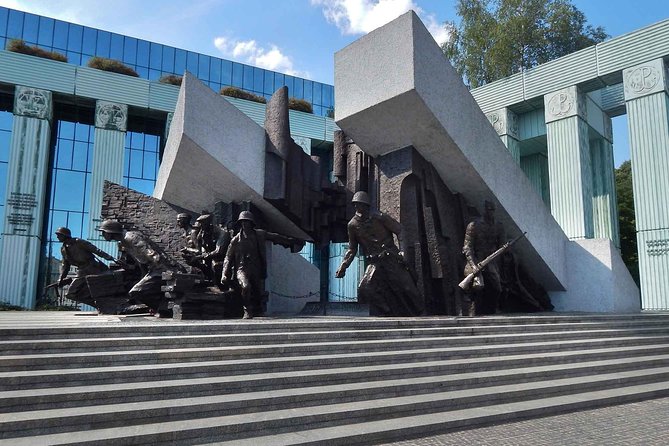
The final major stop focuses on the Warsaw Uprising of 1944. This was the city’s attempt to regain independence before the arrival of the Red Army.
The uprising was defeated, and German forces then systematically destroyed much of Warsaw. Soviet troops entered the ruins in January 1945, beginning a new period of communist rule.
The monument is an appropriate ending because it brings together the tour’s main themes: resistance, political power, destruction, and the difficult end of the war. It also shows why Warsaw’s rebuilt appearance can be misleading. The city may look polished and modern today, but much of it was reconstructed after deliberate destruction.
Several guides have used the final portion to discuss Poland after 1945, not just the war itself. That extra context is valuable because the end of German occupation did not mean a return to full independence. If you want a tour focused only on battlefield facts, say so at the beginning. If you want the political aftermath included, this route can provide it.
How much can fit into three hours?
Three hours is enough to cover a wide sweep of Warsaw, but not enough for long visits at every site. The tour includes about nine stages, with many stops lasting ten to twenty-five minutes.
That timing works because the Żuk carries you between locations. You do not need to solve Warsaw’s public transport system or spend your limited sightseeing time changing trams. The vehicle is mainly for transfers, while the historical work happens during short walks and explanations outside.
The tradeoff is pace. Lucas reportedly felt that he needed at least four hours to share everything he wanted to explain. Another guide extended the experience when a participant wanted more time. Do not assume that extra time is included, but do tell the operator if you would prefer a longer private tour.
Hotel pickup can also reduce the time available at the sites. Pickup is offered from hotels, apartments, and Airbnb properties within 3 kilometers of the city center. If your accommodation is farther away or hard for a vehicle to reach, you may be assigned a nearby meeting point.
For the fullest use of your three hours, meeting in central Warsaw may be smarter than spending a large part of the tour driving to and from your accommodation.
Guides, customization, and the right level of detail
The guides are the heart of the experience. Names attached to especially strong tours include Konrad, Tom, Martin, Marcin, Karol, Lukas, Marek, and Lucas.
The most useful quality is not simply knowing dates. It is the ability to explain them in plain English, answer questions, and adjust the conversation. Marcin has been praised for making the tour feel like a discussion rather than a lecture. Martin has been effective with teenagers by combining stories, historical explanation, and links to current events.
You can ask for more attention to the Ghetto, the 1944 uprising, Soviet-era Poland, military history, Jewish Warsaw, or the city’s reconstruction. You should make your priorities clear at the start, especially if you have already visited some central sights.
This format also suits people who are not dedicated history specialists. You do not need to arrive with a long reading list. The tour can give you the framework needed to understand later visits to the POLIN Museum, the Warsaw Uprising Museum, memorials, and reconstructed parts of the Old City.
Price, group size, and practical value
At $169.38 per person, this is not a budget sightseeing ride. But it is a private experience, and the cost can make more sense when shared by a small group. You receive a local English-speaking guide, transport in the Żuk, and pickup and drop-off within the stated central area.
The strongest value comes from the route and conversation. Many of the sites are free to view, but reaching them efficiently and understanding their meaning takes time and local knowledge. You are paying less for entrance tickets and more for the guide’s interpretation, vehicle, and ability to link separate places into one story.
Group discounts are available. Since each minibus carries up to eight people, ask about the price for your exact party size before deciding. A private tour is especially useful for families, couples with focused interests, and groups that want to ask many questions without holding up strangers.
Free cancellation is available until 24 hours before the start time. Changes or cancellations made inside that window are not refunded.
Who should book this tour?
I would choose this tour if you want a clear introduction to Warsaw’s World War II story in a limited amount of time. It is also a good choice if you want to see less obvious Ghetto remains and prefer a private guide to a large group.
It suits adults, older children over 150 centimeters, and teenagers who respond better to stories and conversation than to a formal lecture. Children under 150 centimeters require a booster seat under Polish law, so contact the operator before booking to check availability.
You should think twice if you need modern vehicle comfort, air conditioning, easy step-free access, or a slow museum-style visit. The Żuk is fun and distinctive, but it is still an old minibus. The subject matter is also heavy, with no attempt to soften the violence or political realities of the period.
Should you book Warsaw for WWII Buffs?
Yes, if your priority is understanding how World War II shaped Warsaw and you value a private, flexible guide. The strongest reasons to book are the compact route, the surviving Ghetto wall and Waliców ruins, the memorials to both Nazi and Soviet crimes, and the chance to ask direct questions in English.
Book with realistic expectations. Three hours gives you a strong framework, not an exhaustive study. Request the most comfortable available vehicle if anyone in your group has mobility concerns, and consider meeting centrally so you do not lose valuable sightseeing time to transfers.
If those points suit you, the Żuk’s bumps and quirks become part of the charm rather than a problem. You finish with a better understanding of why modern Warsaw looks the way it does, and why so much of its story must be read between the buildings.
FAQ
How long is the Warsaw for WWII Buffs tour?
The tour lasts approximately three hours.
Is the tour private?
Yes. Only your group participates in the activity.
What language is the tour offered in?
The tour is offered in English with a professional local English-speaking guide.
Is hotel pickup included?
Yes. Pickup and drop-off are available from hotels, Airbnb properties, and apartments within 3 kilometers of Warsaw’s city center.
Does hotel transfer time count toward the tour?
Yes. Pickup and return transfers count toward the total three-hour duration.
What vehicle is used?
Transport is provided by a retro communist-era Żuk minibus. Each minibus accommodates up to eight passengers.
Does the vehicle have air conditioning?
No. The classic minibuses are not equipped with air conditioning, though all vehicles have heating for winter.
Do all vehicles have seat belts?
Some of the historic vehicles do not have seat belts. This is permitted for classic vehicles under Polish regulations.
Can children join the tour?
Adults and children over 150 centimeters can book instantly online. Children under 150 centimeters need a mandatory booster seat, so contact the operator in advance to check availability.
What is included in the price?
The price includes an English-speaking local guide, transport by retro Żuk minibus, and eligible hotel or apartment pickup and drop-off. Tips and gratuities are not included.
Just added in Warsaw
- Historical Walking Tour of Jewish Warsaw★ 5.0 · 68 reviews
- Deluxe Polish Food Tour Experience in Warsaw★ 5.0 · 19 reviews
- CO2-Offset Arrival Transfer from Warsaw Airport to Warsaw City★ 5.0 · 1 review
- Amazing photo walk through the Old town of Warsaw★ 5.0 · 32 reviews
- 8-day tour around Poland by private car★ 5.0 · 2 reviews
- 2 Hour Super Segway City Tour of Warsaw★ 5.0 · 5 reviews
- Electric Scooter Tour: Full Tour – 3-Hours of Magic!★ 5.0 · 3 reviews
- 2h Rental of Motorboat for 10 in Warsaw no License Needed★ 5.0 · 1 review
Warsaw Tours, compared.
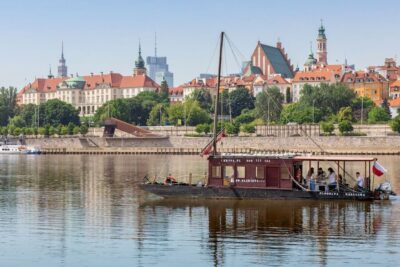
Traditional Galar Cruise on The Vistula River
Read our review →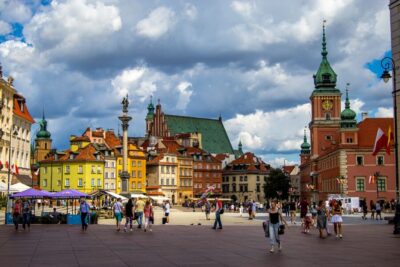
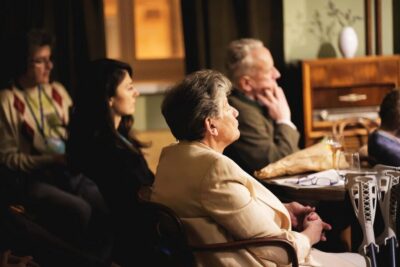
Warsaw Concert: Chopin – Painted by Candlelights with Wine
Read our review →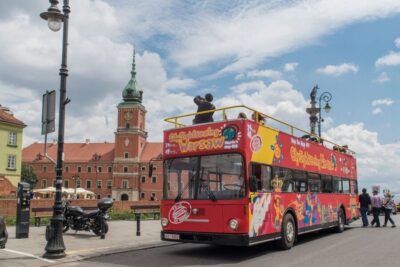
POLIN Museum of the History of Polish Jews Ticket
Read our review →
#1 Pub Crawl Warsaw with Optional Premium 1 Hour Open Bar
Read our review →
Browse the lists this tour appears in