
REVIEW · WARSAW TOURS
Warsaw Behind the Scenes – small group tour with hotel pickup
Warsaw rewards a closer look. This three-hour outing links the former Jewish Ghetto, wartime ruins, Praga, and communist-era central Warsaw in a way that makes the city’s past easier to understand. I especially like the small-group format and the use of old photographs, which help you picture places that have been rebuilt or transformed. The main drawback is the vintage minibus: some vehicles lack air conditioning and seat belts, so comfort is more basic than on a modern coach.
The tour costs $133.08 per person and includes hotel pickup and drop-off for selected hotels. Guides such as Tom, Marcin, Artur, Mark, Jan, and Lucas have been praised for their storytelling, humor, and careful handling of painful subjects. I’d choose this for your first day in Warsaw, though you should wear good shoes and expect a serious history lesson rather than a light sightseeing ride.
In This Review
- Key points before you book
- Why this three-hour route helps you understand Warsaw
- Hotel pickup and the old Zuk ride
- Muranów and the ground of the former Ghetto
- Chłodna Street and the vanished bridge
- Nowolipki and the Ghetto Uprising
- Bielańska and the road to total destruction
- Praga Polnoc, Warsaw’s surviving prewar side
- Central Warsaw and communist rebuilding
- 1989 and Warsaw after communism
- The guides make the difference
- Is $133.08 a fair price?
- Who should book this Warsaw tour?
- FAQ
- What time does the tour start?
- Is hotel pickup included?
- How many people fit in each minibus?
- Is the tour suitable for children?
- Does the minibus have air conditioning and seat belts?
- Can I cancel for a full refund?
- Should you book Warsaw Behind the Scenes?
Key points before you book
- The Zuk minibus is part of the experience: These classic vehicles add character and connect the ride to Poland’s communist-era past.
- Muranów reveals a city beneath the city: Modern housing sits over the former Jewish Ghetto, with traces of wartime destruction still woven into the streets.
- Praga offers a different Warsaw: Belle Époque buildings, old courtyards, and a creative local feel make this one of the least polished and most interesting stops.
- Historical photographs do real work: Guides use old images at Chłodna Street and other locations to show what disappeared.
- It suits a first day in Warsaw: The route gives you a broad sense of the city, its districts, and the forces that shaped modern Poland.
- Prepare for a moving subject: The tour covers the Holocaust, the Warsaw Ghetto Uprising, the 1944 Warsaw Uprising, Nazi destruction, and Soviet control.
Why this three-hour route helps you understand Warsaw
Warsaw can be confusing at first. Its Old Town looks centuries old, yet much of it was rebuilt after World War II. Wide modern avenues sit beside prewar fragments. New cafés and restored buildings appear in districts that were once sealed, burned, or left behind.
This tour gives you the framework to make sense of those contrasts. It begins with a short introduction to Poland and Warsaw, then follows the city’s wartime destruction, postwar rebuilding, communist period, and return to democracy in 1989.
The order matters. You are not simply checking off monuments. You are seeing how one event led to another. The destruction of the Jewish Ghetto, the failed Warsaw Uprising, the near-erasure of the capital, Soviet influence, and the changes after 1989 all appear in the streets around you.
The tour runs in English, starts at about 10:00 a.m., and uses the minibus mainly to move between walking stops. You will not spend the whole time seated. At each location, expect a short explanation and a chance to look around.
Some published accounts describe the outing as lasting closer to four hours, although the stated duration is approximately three hours. Build a little flexibility into your day, especially if you have a train, museum booking, or restaurant reservation afterward.
A few more in Warsaw
- Warsaw: Chopin Concert in the Old Town
★ 4.8 · 2,287 reviews - Warsaw: Traditional Galar Cruise on The Vistula River
★ 4.6 · 1,640 reviews - Warsaw: Old Town Highlights Walking Tour in English
★ 4.7 · 1,516 reviews
Hotel pickup and the old Zuk ride
Pickup and drop-off are offered only at listed hotels. After booking, the operator contacts you through the Viator message system to confirm the exact time, since the vehicle collects people from several hotels. If your hotel is not on the pickup list, you are asked to contact the operator for a convenient meeting point.
The fleet includes five minibuses, with up to eight passengers in each. The overall activity can reach 39 people, but the actual vehicle experience remains small-scale. That is useful at street stops, where a compact group is easier to gather and hear than a large coach party.
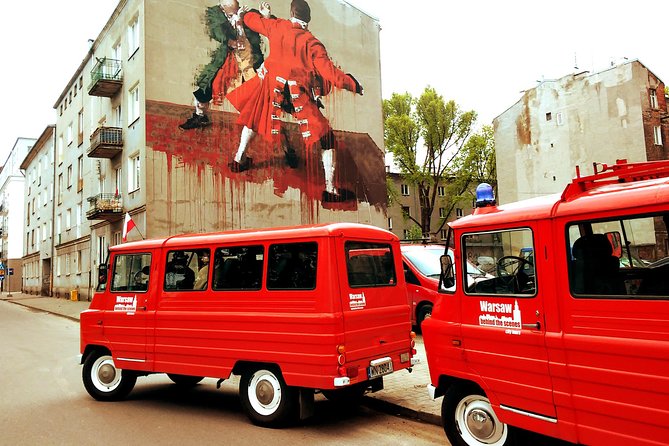
The star of the ride is often the Zuk, a classic Polish minibus associated with the communist era. It is quirky, compact, and a little rough around the edges. Guides such as Marcin, Tom, Mark, and Artur have used the vehicle’s appearance as part of the story, giving the ride a period flavor without turning the history into a gimmick.
There are practical tradeoffs. The vintage vehicles are not fitted with air conditioning, and some do not have seat belts, which is permitted for historic vehicles. They do have heating in winter. If you need modern vehicle comfort, this may not be your ideal choice. If you enjoy unusual transport and do not mind a basic ride, the Zuk adds a memorable touch.
Wear comfortable clothing and sturdy shoes. The minibus handles the longer transfers, but each stop includes walking. Rain does not necessarily cancel the outing, and one guide was able to bring the vehicle close to sights during wet weather, but sensible outdoor clothing will help.
Muranów and the ground of the former Ghetto
The first major stop is Muranów, built over the former Jewish Ghetto. In 1940, Nazi Germany sealed Warsaw’s Jewish population into this area. The district was later destroyed, and postwar construction changed its appearance almost completely.
At first glance, Muranów can seem like an ordinary housing neighborhood. That is exactly why a guide helps. The streets do not always announce what happened there. Your guide points out the layers beneath the postwar buildings and explains how the area was erased, rebuilt, and remembered.
This is one of the strongest parts of the tour, but it is also one of the most demanding. The subject is not treated as a quick photo stop. You will hear about confinement, destruction, deportation, and resistance. The tone is serious, though the guides are described as approachable and willing to answer questions.
The stop lasts about 20 minutes. That is enough for an introduction, but not enough for every detail. If you want a full study of Jewish life in Warsaw and the Holocaust, plan a separate visit to the POLIN Museum. One guide’s opening explanations made more sense to a visitor after a later museum visit, so the museum works well either before or after this tour.
Chłodna Street and the vanished bridge
At Chłodna and Żelazna Streets, the guide explains the wooden bridge once built above the road. It connected two sections of the sealed Ghetto while traffic continued below. The structure became widely known through The Pianist.
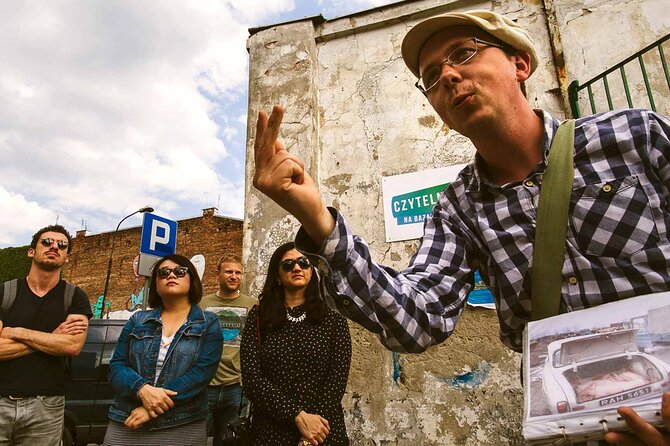
Today, you will not see the bridge itself. The value of this stop comes from the guide’s photographs and clear explanation of how the intersection functioned. Historical images turn an ordinary road crossing into a place where you can picture barriers, movement, and forced separation.
This is a good example of the tour’s method. Warsaw’s wartime sites are often not preserved as complete structures. You need photographs, maps, and careful narration to read the modern streets. Tom and other guides have been praised for using visual aids well, which is especially helpful here.
Allow about 15 minutes. It is a short stop, so listen closely and ask questions while the group is gathered.
Something quite different:
- Warsaw Concert: Chopin – Painted by Candlelights with Wine
★ 4.8 · 1,442 reviews - Warsaw: City Sightseeing Hop-On Hop-Off Bus Tour
★ 3.6 · 1,415 reviews - Warsaw: POLIN Museum of the History of Polish Jews Ticket
★ 4.7 · 1,142 reviews - #1 Pub Crawl Warsaw with Optional Premium 1 Hour Open Bar
★ 5.0 · 790 reviews
Nowolipki and the Ghetto Uprising
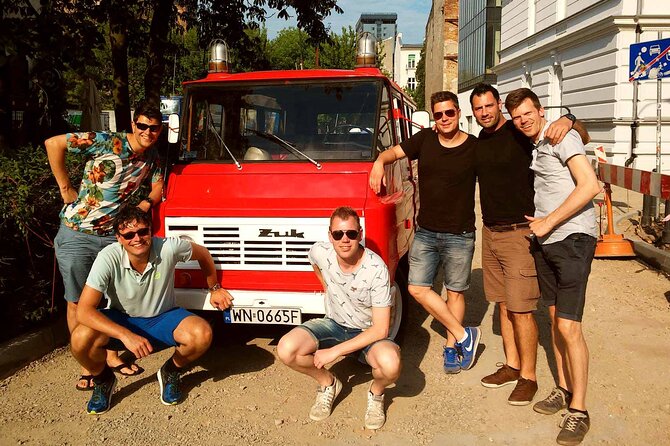
At Nowolipki, the story moves to the Warsaw Ghetto Uprising of 1943. Jewish resistance fighters made a final stand against deportation, fighting for several weeks before the Ghetto was destroyed.
The guide explains how the uprising is remembered and how its events connect with the present-day city. You will see how history is not confined to one preserved building or formal memorial. It appears in street names, commemorative spaces, gaps in the urban fabric, and the contrast between what once stood here and what exists now.
This portion lasts about 15 minutes. I would treat it as a powerful introduction rather than a complete account of the uprising. The subject deserves time, and the tour must keep moving to cover the wider city.
The pace can feel brisk during the wartime section. That is useful if you want an overview, but less suitable if you prefer long periods of quiet reflection at each site.
Bielańska and the road to total destruction
At Bielańska, the tour widens its focus beyond the Ghetto. You learn how the decisions of the Western Allies and Stalin left Poland under Soviet control after the war. You also hear about the Warsaw Uprising of 1944, the city’s last major effort to alter that future.
After the uprising collapsed, Nazi forces systematically destroyed about 85 percent of Warsaw. The Red Army entered the ruins in January 1945, finding a capital that had been reduced to a shell.
That figure gives the rest of the tour its force. The rebuilt city is not simply old Warsaw with a few modern additions. It is a new city shaped by loss, planning, politics, and memory.
This stop takes about 15 minutes. The guide’s job is to connect military events with the city you are looking at now. Mark, Tom, and Artur have been singled out for explaining the war years and postwar period with detail and candor, including the difficult subject of antisemitism.
Praga Polnoc, Warsaw’s surviving prewar side
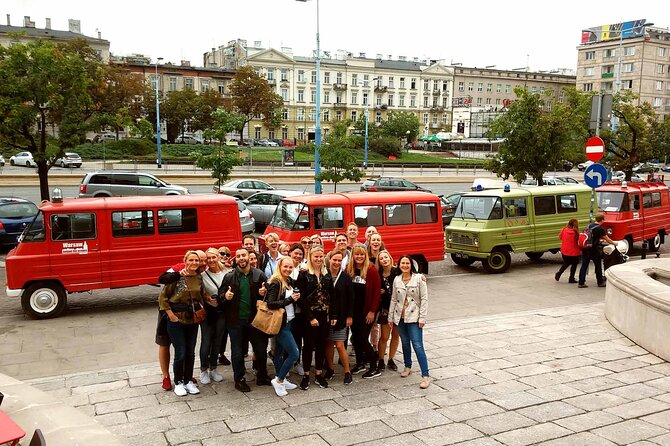
After crossing the Vistula River, you reach Praga Polnoc. This district survived the war more intact than much of central Warsaw, so it offers a different sense of the prewar city.
Look for Belle Époque buildings, traditional courtyards, and older street patterns. Praga has a strong local identity and was once overlooked by many visitors. Today, creative businesses and new development have changed parts of the district, but it still feels less polished and less built around sightseeing than the historic center.
The tour spends about 30 minutes here, making Praga one of its longer stops. You get river views, a look at the neighborhood, and a sense of everyday Warsaw beyond the reconstructed center.
I like this section because it keeps the experience from becoming only a war-history tour. You see a district where ordinary urban life, old architecture, and new creative energy sit side by side. The tour does not promise a full neighborhood walk, though. The vehicle transfers between locations, and your time on foot is limited.
Central Warsaw and communist rebuilding
Back in Śródmieście, the route stops near the former headquarters of the Polish Communist Party. Here, the question changes from how Warsaw was destroyed to how it could be rebuilt.
After 1945, architects faced a nearly impossible task. They had to create a functioning capital from ruins. Some wanted a modern, efficient city, but their ideas had to fit Soviet-inspired political demands. The streets and buildings around this part of central Warsaw show the compromises.
This is an important counterpoint to the rebuilt Old Town. The reconstruction of Warsaw was not only about restoring what had existed before. It also involved modern planning, ideology, housing needs, and the image the new authorities wanted the capital to project.
The stop lasts about 30 minutes. That gives the guide room to explain the political setting and point out how the built environment reflects it. If you are interested in architecture or twentieth-century politics, this may be one of the most useful parts of the route.
1989 and Warsaw after communism
The final explanation covers 1989, when the Solidarity movement and Pope John Paul II played key roles in ending communist rule in Poland. The guide then brings the story into the present, describing the shift toward democracy and capitalism and the changes that followed.
This closing section helps prevent the tour from stopping in 1945 or 1989. Warsaw is still changing. A district such as Praga can move from neglected to fashionable, while central streets reveal the physical results of decades of political change.
The final stop lasts about 15 minutes. By this point, you have seen enough of the city to connect the broad story with actual neighborhoods. That is the tour’s real strength: it explains why Warsaw looks so different from one district to the next.
The guides make the difference
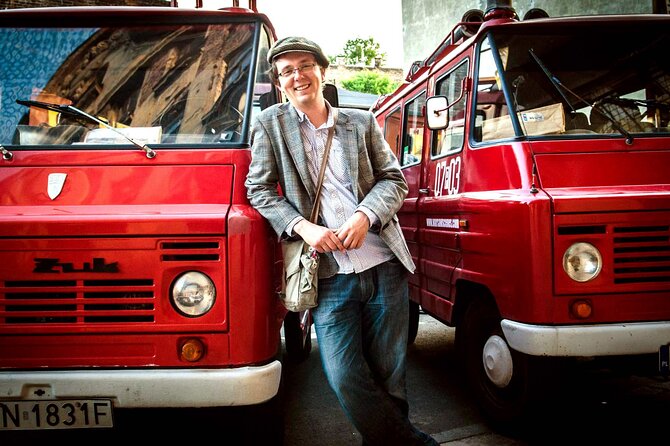
The operator uses several guides, so the personality of your outing will vary. Tom has been praised for making the time pass quickly with engaging stories. Marcin is described as personable, flexible, and passionate about Warsaw, with a willingness to adjust the emphasis to questions and interests.
Artur and Art have earned praise for clear historical explanations and a friendly manner. Mark is valued for his extensive command of Warsaw’s wartime and communist periods, as well as his excellent English. Jan is described as relaxed, funny, and easy to spend time with, while Lucas has been praised for professionalism, empathy, and humor.
That range matters. This route includes difficult material, and a guide who can be both respectful and human makes a major difference. The strongest experience will come when you ask questions. Some guides may assume a basic understanding of the war or Polish history, so tell them early if you want more background before reaching the Ghetto sites.
The visual aids are another plus. Old photographs help bridge the gap between the present street and the vanished city. A good guide will not only recite dates, but explain what you are seeing and why the location matters.
Is $133.08 a fair price?
At $133.08 per person, this is not a bargain-priced city transfer. The value rests in the combination of a small vehicle, hotel pickup, a knowledgeable English-speaking guide, and access to districts you may not connect easily on your own.
The route covers a lot in roughly three hours. You receive an introduction to Warsaw, a serious explanation of the Ghetto and both uprisings, a look at Praga, a discussion of communist rebuilding, and a final link to 1989. A private guide and separate transport across all these areas could cost more, especially if you are traveling alone or with a small party.
The price feels easiest to justify on your first day, when orientation has real value. It also helps if you want history explained in context rather than visiting isolated memorials. It is less compelling if you mainly want museum interiors, long walks, or extensive time at each location.
The tour has earned a five-star rating from 228 reviews, with 100 percent recommending it. That strong record supports the idea that the guide quality is usually the main value. Still, the old vehicles, short stops, and emotional subject matter are not for everyone.
Who should book this Warsaw tour?
I would recommend it to first-time visitors, history enthusiasts, architecture fans, and anyone who wants to see districts beyond the standard center. It also suits families with older children, provided they can manage the serious wartime content and meet the 150-centimeter booking rule.
The tour is a good fit if you enjoy asking questions and learning through stories. It is less suitable if you need step-free access, modern vehicle features, or a slow pace. The available information says most people can participate, but the walking portions and historic minibuses may not suit every mobility need.
Children under 150 centimeters require a booster seat under Polish law. Instant online booking is available for adults and children over that height. For younger children, contact the operator ahead of time to check booster-seat availability.
You can cancel for a full refund up to 24 hours before the start time. Changes or cancellations made less than 24 hours before departure are not accepted for a refund.
FAQ
What time does the tour start?
The listed start time is 10:00 a.m. The operator confirms the exact pickup time after booking because the vehicle collects people from several hotels.
Is hotel pickup included?
Pickup and drop-off are available for hotels on the operator’s list. If your hotel is not listed, contact the operator to arrange a suitable pickup point.
How many people fit in each minibus?
Each minibus holds up to eight passengers. The operator has five minibuses, and the entire activity can have a maximum of 39 participants.
Is the tour suitable for children?
Adults and children over 150 centimeters can book instantly online. Children under 150 centimeters need a booster seat under Polish law, so contact the operator in advance to check availability.
Does the minibus have air conditioning and seat belts?
The classic vintage minibuses do not have air conditioning, and some do not have seat belts, which is permitted for historic vehicles. All vehicles have heating for winter.
Can I cancel for a full refund?
Yes. You must cancel at least 24 hours before the experience start time for a full refund. Cancellations or changes made less than 24 hours before the start time are not accepted.
Should you book Warsaw Behind the Scenes?
Book it if you want Warsaw explained through its neighborhoods, not just its postcard sights. The former Ghetto, Chłodna Street, Praga, communist-era central Warsaw, and the story of 1989 form a strong introduction to a city that was destroyed, rebuilt, and reshaped more than once.
I would schedule it early in your stay, then use what you learn to choose museums and longer walks. Bring comfortable shoes, prepare for serious history, and accept the Zuk’s old-fashioned comfort. If that sounds like part of the fun, this is a thoughtful and unusually personal way to get your bearings in Warsaw.
Just added in Warsaw
- Historical Walking Tour of Jewish Warsaw★ 5.0 · 68 reviews
- Deluxe Polish Food Tour Experience in Warsaw★ 5.0 · 19 reviews
- CO2-Offset Arrival Transfer from Warsaw Airport to Warsaw City★ 5.0 · 1 review
- Amazing photo walk through the Old town of Warsaw★ 5.0 · 32 reviews
- 8-day tour around Poland by private car★ 5.0 · 2 reviews
- 2 Hour Super Segway City Tour of Warsaw★ 5.0 · 5 reviews
- Electric Scooter Tour: Full Tour – 3-Hours of Magic!★ 5.0 · 3 reviews
- 2h Rental of Motorboat for 10 in Warsaw no License Needed★ 5.0 · 1 review
Warsaw Tours, compared.
Traditional Galar Cruise on The Vistula River
Read our review →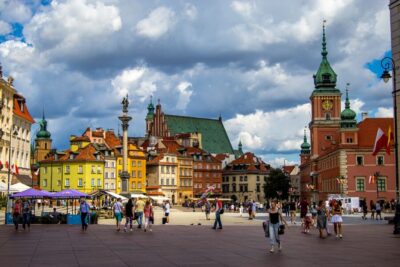
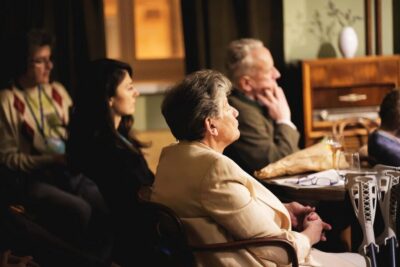
Warsaw Concert: Chopin – Painted by Candlelights with Wine
Read our review →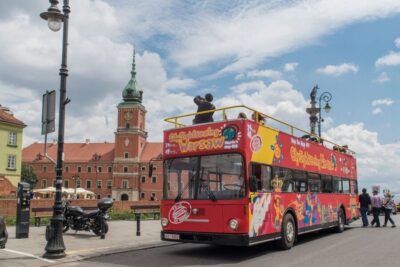
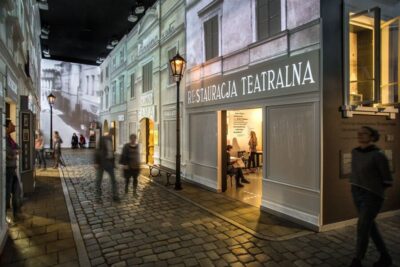
POLIN Museum of the History of Polish Jews Ticket
Read our review →
#1 Pub Crawl Warsaw with Optional Premium 1 Hour Open Bar
Read our review →
Browse the lists this tour appears in