
REVIEW · WALKING TOURS
Jewish Warsaw Walking Tour
Warsaw remembers in fragments. This 2.5-hour walking tour links the surviving pieces of Jewish Warsaw with clear explanations of what once stood around them. I like the route’s strong opening at Grzybowski Square and its finish beside POLIN, where the story gains a wider setting. I also like the guides’ personal style: Olivia, Jacek, Andrew, Tomas, and others are praised for careful facts, warmth, dry humor, and vivid storytelling. The main drawback is simple: you spend much of the tour outdoors, often standing, and some people may want more monuments or a brief synagogue visit.
This is a serious history walk, not a sightseeing circuit packed with grand buildings. Much of the former ghetto is gone, so the guide must help you picture streets, borders, bridges, and lives that are no longer visible. Cold, wind, and a group of up to 40 people can affect the experience, but the price of $26.59 offers a useful introduction for anyone who wants Warsaw’s Jewish story explained rather than merely pointed out.
In This Review
- Key points to know before you go
- Why this Warsaw walk matters
- Starting at Grzybowski Square
- Nożyk Synagogue, a rare survivor
- Waliców and the former ghetto boundary
- Chłodna Street and the vanished footbridge
- POLIN and the Ghetto Heroes memorial
- The guides are the main reason to book
- How much walking and standing to expect
- Price, timing, and the value of the experience
- Who will get the most from this walk
- Should you book the Jewish Warsaw Walking Tour?
- FAQ
- Where does the Jewish Warsaw Walking Tour begin?
- Where does the tour end?
- How long does the tour last?
- Is admission to POLIN Museum included?
- Can I go inside Nożyk Synagogue?
- How large can the group be?
- What happens if I need to cancel?
Key points to know before you go
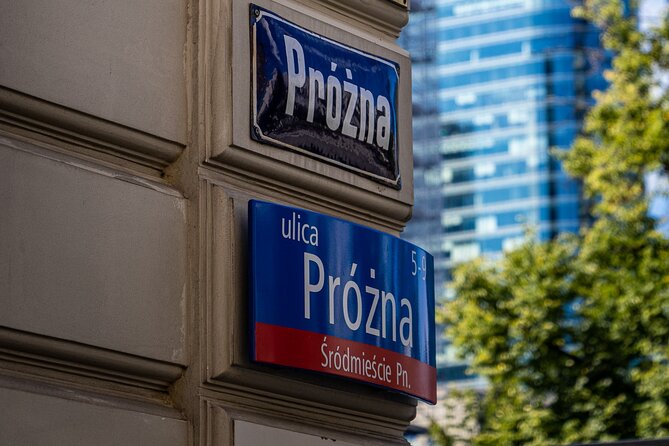
- The route begins at All Saints Church on Grzybowski Square and ends at POLIN Museum, making the walk easy to place within a day of sightseeing.
- Nożyk Synagogue is the only surviving prewar Warsaw synagogue, though entry inside is not included.
- Waliców and Chłodna Street make the former ghetto border and footbridge easier to understand, even where little remains.
- The strongest part is the guiding, with praised leaders including Olivia, Jacek, Andrew, and Tomas.
- You will be outside for about two and a half hours, with a moderate level of physical effort and plenty of standing.
- The listed fee covers the reservation and guide payment, so this is not a free walking tour despite its pay-as-you-wish format.
Why this Warsaw walk matters
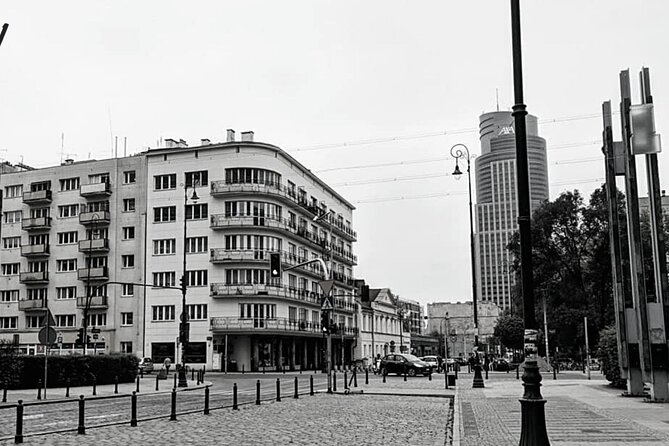
Jewish Warsaw cannot be understood by looking only for intact old buildings. The Nazi destruction of the city and the Warsaw ghetto left an urban story full of absences. A wall line, a square, a surviving synagogue, or a small memorial may be all that remains in a particular spot.
That is why a guide matters here. You are not simply walking from one monument to another. You are being asked to compare the present street with the vanished city that once filled it. The best guides on this tour use stories, dates, questions, and visual clues to build that picture.
The subject is painful. The route deals with the destruction of the Jewish community in Warsaw and the Nazi occupation, so this is not a light morning stroll. Still, the tone can include dry humor and small moments of human warmth, which helps keep the walk focused and understandable rather than relentlessly bleak.
The tour receives a 4.8 rating from 95 reviews, with 95 percent of people recommending it. That high mark appears to come mainly from the guides’ command of the subject and their ability to explain difficult events in fluent English.
More Walking Tours in Warsaw
- Warsaw: Old Town Highlights Walking Tour in English
★ 4.7 · 1,516 reviews - Warsaw: Old Town Guided Walking Tour
★ 4.9 · 599 reviews - Half-Day Polish Food Walking Tour with Guide and Dinner
★ 4.5 · 381 reviews
Starting at Grzybowski Square
Meet at All Saints Church, at Grzybowski Square, at 10:00 in the morning. This square is one of the few parts of Warsaw that survived the destruction of the ghetto, giving the tour a rare piece of physical ground from the prewar city.
The first 20 minutes help set the scene. You can expect the guide to explain why this area survived, how Jewish Warsaw related to the surrounding city, and what changed under German occupation. The square is not a preserved Jewish quarter in the usual sense. Its value is that it allows you to stand in a place where the street pattern and setting offer a link to the past.
I like this as a meeting point because the tour starts with context instead of rushing straight to a famous memorial. You get a chance to understand that Jewish life was part of the wider city, not an isolated story confined to one attraction.
The meeting point is specific: All Saints Church, Pl. Grzybowski 3/5. Hotel pickup is not provided, and you are responsible for reaching the start. The tour is near public transportation, which helps, but allow enough time to arrive before 10:00.
Nożyk Synagogue, a rare survivor
The next stop is Nożyk Synagogue, with about 30 minutes devoted to it. It is the only surviving prewar synagogue in Warsaw, so even a short look at its place in the city carries real weight.
The synagogue is especially important because it gives you one of the few surviving structures directly connected with Jewish religious life before the war. The tour lists the stop as free admission, but you should not assume that the walking tour includes an interior visit. One person specifically wished for even a brief look inside, so the experience is best approached as an outdoor historical visit unless the guide confirms otherwise.
That limitation matters. If your main goal is to explore the synagogue interior, this walk may not be enough by itself. If your goal is to understand what the synagogue represents within the vanished Jewish community, the stop fits the route well.
Your guide can also connect the building to the wider changes around Grzybowski Square. This is where a strong storyteller makes a major difference. Olivia is praised for answering many questions and for showing clear passion for the subject. Other guides are described as willing to explain details rather than simply deliver a fixed speech.
Waliców and the former ghetto boundary
The walk continues to Waliców, a place that once marked the ghetto border. The stop lasts roughly 30 minutes, which tells you something about the tour’s method. You are not merely pausing for a photograph. The guide has time to explain how the boundary worked and what it meant for people living on either side.
Today, a border that shaped daily life may be hard to read from the street. This is one of the route’s most useful features: it gives meaning to places that could otherwise seem ordinary. You might pass through the area and see only modern Warsaw, but the guide helps you understand how control, confinement, and separation altered the city.
Expect this section to involve standing while the guide speaks. The walk is not described as strenuous, but it does require moderate physical fitness. One person found the tour longer than expected because much of the time was spent on foot, with long periods standing rather than continuous walking.
That is worth knowing if you have mobility concerns or are visiting during a cold spell. The tour runs in all weather, so shoes, a warm coat, and protection from rain are sensible choices. There may be places to sit, but seating is not guaranteed throughout.
Something quite different:
- Warsaw: Chopin Concert in the Old Town
★ 4.8 · 2,287 reviews - Warsaw: Traditional Galar Cruise on The Vistula River
★ 4.6 · 1,640 reviews - Warsaw Concert: Chopin – Painted by Candlelights with Wine
★ 4.8 · 1,442 reviews - Warsaw: City Sightseeing Hop-On Hop-Off Bus Tour
★ 3.6 · 1,415 reviews
Chłodna Street and the vanished footbridge
Chłodna Street brings the physical shape of the former ghetto into sharper focus. Here, a monument marks the footbridge that once connected separate parts of the Warsaw ghetto.
This is a powerful stop because it shows how geography became a tool of control. A road and a bridge could determine who could move, who was cut off, and how people maintained contact. The monument is not a complete reconstruction, so the guide’s explanation does much of the work.
The stop lasts about 20 minutes. You will likely hear how the bridge fitted into the divided ghetto and why this location matters. The scene is a good example of the tour’s larger purpose: showing you the relationship between present-day streets and a city that has largely disappeared.
The route works best if you resist the urge to judge it by the number of intact buildings. This is a memorial walk shaped by missing evidence. The stories are often more important than the objects in front of you.
POLIN and the Ghetto Heroes memorial
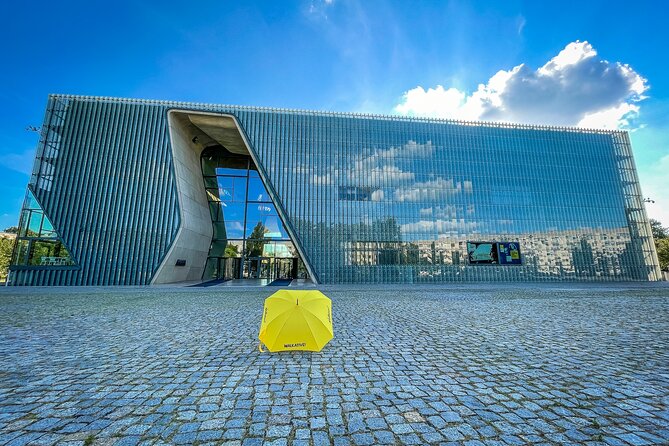
The route then reaches the POLIN Museum of the History of Polish Jews and the 1948 Monument to the Ghetto Heroes. The tour allows about 20 minutes here, and the walk ends at the museum, on Mordechaja Anielewicza 6.
The museum itself is listed as a stop, but admission to the museum is not included. The same applies to the Monument to the Ghetto Heroes: you can visit the area as part of the walk, but the fee is for the guided outdoor experience rather than a museum ticket.
This is an important planning point. I would treat the tour as an introduction and schedule a separate museum visit if you want a longer look at the history of Polish Jews. The walking tour gives you physical orientation and a narrative framework. POLIN can then provide a much broader museum experience, but you will need to arrange that separately.
The itinerary also lists a final 30-minute stop called the Monument to the Heroes of Warsaw, described again as the Monument to the Ghetto Heroes. Since the route ends at POLIN and the descriptions overlap, check the exact meeting instructions with the operator if you want to know how the final two stops are handled. The key point is that the tour finishes in the POLIN and Ghetto Heroes memorial area, not back at Grzybowski Square.
The guides are the main reason to book
The route is valuable, but the guide determines how much you take away. The strongest praise focuses on clear facts, vivid stories, fluent English, patience with questions, and a sense of humor that never erases the seriousness of the subject.
Jacek is praised for painting a vivid picture of Jewish Warsaw and for offering a detailed, powerful account of what remains after the Nazi destruction and World War II. Olivia receives especially warm comments for her personality, accuracy, pace, and willingness to answer questions. Andrew is praised for well-documented detail and fluent English, while Tomas is described as making Polish Jewish history easy to follow.
You may receive a different guide, so do not book based on one particular name. Still, the repeated pattern is useful. Walkative! TOUR appears to put real weight on guide-led interpretation rather than treating the walk as a basic route between monuments.
One practical detail is the payment arrangement. This is a general pay-as-you-wish tour, but the $26.59 booking fee covers the reservation and the guide’s payment. Guides may still explain that tips are welcome, and one person felt that the request was made very clearly from the start. I would simply decide in advance how you want to handle gratuity so there is no awkwardness at the end.
How much walking and standing to expect
The advertised duration is about two hours and 30 minutes. You move between six listed stops, but the time is not all spent walking. Much of it is spent listening at each location, so you should expect regular pauses and periods on your feet.
The walk requires a moderate level of physical fitness. It is not presented as a strenuous hike, but cobbled or uneven city surfaces, weather, and standing can add up. One person described a cold, windy day as less than ideal for two and a half hours outside and wished the tour included more sitting.
I would wear warm layers in cool weather, bring rain protection when needed, and use comfortable shoes in every season. Children must be accompanied by an adult. Service animals are allowed, and the route is near public transportation.
The maximum group size is 40 people. That is not a tiny private walk, and a large group can make questions or street-side listening less personal. On the other hand, the guides’ repeated praise suggests that good delivery remains a major strength. If you prefer a smaller group, the operator says a private tour can be arranged on request.
Price, timing, and the value of the experience
At $26.59 per person, this is a reasonable price for a 2.5-hour guided introduction, especially because the fee includes the guide and the reservation. You are paying for interpretation, not for entry to POLIN or private transport.
The value is strongest if you are new to Jewish Warsaw and want a clear route through several important places. You get a local guide, a fixed morning start, and a walk that connects the surviving synagogue, former ghetto boundary, footbridge memorial, museum area, and Ghetto Heroes memorial.
The value is weaker if you want indoor visits, a small private group, or a tour centered on architecture. The experience is mainly historical and outdoors. One person also hoped to see more sites and monuments, which is a fair concern for anyone expecting a larger sightseeing circuit.
You can cancel for a full refund up to 24 hours before the start time. Changes made less than 24 hours before the start are not accepted, and a minimum number of bookings is required for the experience to operate. If that minimum is not reached, a different date or experience, or a full refund, is offered.
Who will get the most from this walk
I would choose this tour if you want a human explanation of Jewish Warsaw and prefer moving through real city streets to sitting through a lecture. It suits first-time visitors who have seen Warsaw’s main center but want to understand the places connected with the former ghetto.
It also works well early in your stay. After the route, you will have a clearer sense of where the ghetto boundary and memorials fit within Warsaw. You can then return to POLIN with better bearings, or revisit the monuments without treating them as isolated points on a map.
You may want another option if you need frequent seating, dislike outdoor tours in poor weather, or mainly want to enter Nożyk Synagogue and POLIN. You should also consider a private version if a group of up to 40 feels too large or if you want to control the pace.
Should you book the Jewish Warsaw Walking Tour?
Yes, if you want a thoughtful, guide-led introduction to a difficult part of Warsaw’s past. The strongest reason to book is the quality of the storytelling, supported by praised guides such as Olivia, Jacek, Andrew, and Tomas. Their job is not just to identify a memorial, but to help you picture the people and places that are no longer visible.
Book with realistic expectations. You will spend much of the two and a half hours outdoors, you may stand for long stretches, and the tour does not include museum admission or a guaranteed synagogue interior visit. If you dress for the weather and give the subject your attention, the $26.59 fee buys a moving and useful foundation for understanding Jewish Warsaw.
FAQ
Where does the Jewish Warsaw Walking Tour begin?
The tour begins at All Saints Church, Pl. Grzybowski 3/5, 00-115 Warszawa, Poland. The start time is 10:00 am.
Where does the tour end?
The tour ends at the POLIN Museum of the History of Polish Jews, Mordechaja Anielewicza 6, 00-157 Warszawa, Poland.
How long does the tour last?
The experience lasts approximately two hours and 30 minutes.
Is admission to POLIN Museum included?
No. The museum is part of the route, but museum admission is not included in the tour price.
Can I go inside Nożyk Synagogue?
The tour includes a stop at Nożyk Synagogue, but the provided information does not guarantee an interior visit. The stop is listed with free admission.
How large can the group be?
The tour can have a maximum of 40 people. A smaller private tour can be arranged by contacting the operator.
What happens if I need to cancel?
You can cancel up to 24 hours before the local start time for a full refund. Cancellations or changes made less than 24 hours before the start are not accepted for a refund.
Just added in Warsaw
- Historical Walking Tour of Jewish Warsaw★ 5.0 · 68 reviews
- Deluxe Polish Food Tour Experience in Warsaw★ 5.0 · 19 reviews
- CO2-Offset Arrival Transfer from Warsaw Airport to Warsaw City★ 5.0 · 1 review
- Amazing photo walk through the Old town of Warsaw★ 5.0 · 32 reviews
- 8-day tour around Poland by private car★ 5.0 · 2 reviews
- 2h Rental of Motorboat for 10 in Warsaw no License Needed★ 5.0 · 1 review
- 2 Hour Super Segway City Tour of Warsaw★ 5.0 · 5 reviews
- Electric Scooter Tour: Full Tour – 3-Hours of Magic!★ 5.0 · 3 reviews
Walking Tours, compared.
Gdańsk City Sights & History Guided Walking Tour in English
Read our review →
Old Town & Wawel Castle Walking Tour in English
Read our review →Browse the lists this tour appears in