
REVIEW · WARSAW TOURS
From Warsaw: Guided Tour of Treblinka Camp
Treblinka speaks through absence. This six-hour trip from Warsaw combines hotel pickup with a serious, carefully explained visit to one of Europe’s largest Nazi extermination camps. I like the easy transport and the way a strong guide can turn a difficult, mostly open-air memorial into a clear account of what happened here. The main drawback is simple: at $134 per person, this is not a cheap half-day outing.
You visit the museum, the memorial stones, the former penal labour camp, and the recreated railway area. English-speaking guides such as Leszek, Janusz, Marek, and Jan have earned warm praise for their personal approach, but the guide assigned to you may vary. Also, Treblinka was deliberately destroyed by the Nazis, so you will not find intact barracks or gas chambers. That absence is central to the experience, but it can surprise visitors expecting something like Auschwitz.
In This Review
- Key points to know before booking
- Why Treblinka is different from Auschwitz
- Leaving Warsaw with pickup included
- The Treblinka museum and miniature camp model
- Walking through a camp built to erase itself
- The August 1943 prisoner revolt
- How much time do you really get at the site?
- The guide and driver make the difference
- Is $134 per person fair value?
- Who should book this Treblinka tour?
- My verdict on the six-hour visit
- FAQ
- Where is Treblinka located?
- How long does the tour last?
- Is hotel pickup and drop-off included?
- Is transport provided in an air-conditioned vehicle?
- Is the tour conducted in English?
- What is included in the ticket price?
- Are food and drinks included?
- What should I wear or bring?
- Is the tour wheelchair accessible?
- Can I cancel the booking for a full refund?
Key points to know before booking
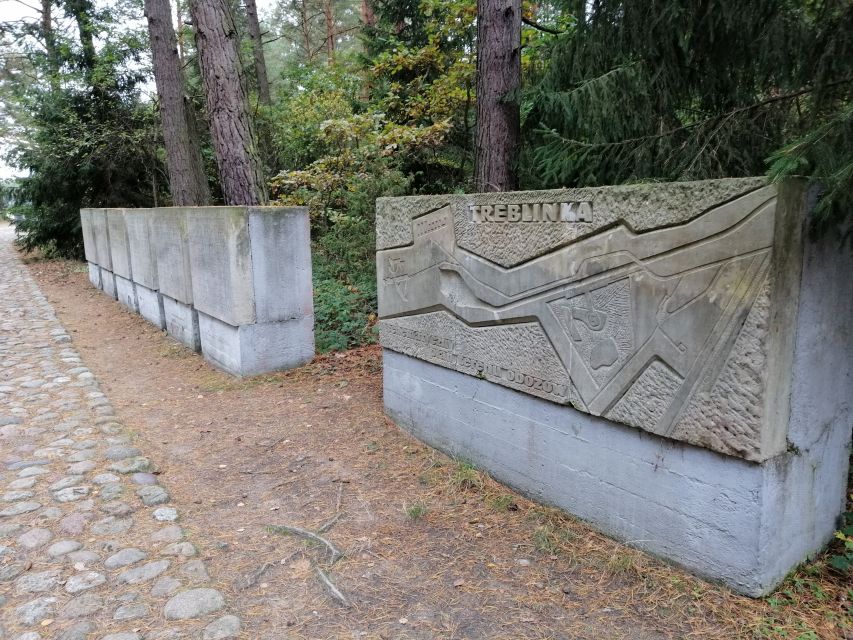
- Treblinka is a memorial of absence: The camp was dismantled and disguised after the 1943 prisoner revolt, leaving ruins, stones, earthworks, and reconstructed elements rather than intact buildings.
- Hotel pickup saves a lot of effort: You are collected at your Warsaw accommodation and returned there after the visit.
- The guide matters greatly: A skilled English-speaking guide can explain maps, testimony, the camp layout, and the link between Warsaw and Treblinka.
- The museum gives essential context: Films, displays, and a miniature model help you understand a site that is otherwise difficult to read.
- The tour lasts six hours: That includes the drive from Warsaw, the visit, and the return journey, so it fits well into a spare day.
- Pack your own food and water: Meals and drinks are not included, and comfortable shoes are important.
Why Treblinka is different from Auschwitz
Treblinka was a Nazi German extermination camp in occupied Poland, about four kilometres south of Treblinka railway station in what is now the Masovian Voivodeship. It operated from July 22, 1942, to October 19, 1943, as part of Operation Reinhard, the Nazi campaign that murdered most of the Jews killed during the Final Solution.
Between 700,000 and 900,000 Jews were murdered at Treblinka, along with about 2,000 Romani people. Only Auschwitz-Birkenau killed more Jews. Those figures are hard to grasp, and the site does not try to make them easy through grand surviving structures.
The Nazis levelled much of Treblinka after the prisoner uprising in August 1943. They attempted to erase evidence, cover the ground, and make the area look ordinary. For you, this means the visit requires more explanation than a camp with standing barracks and preserved rooms.
That is why I would not treat Treblinka as a quick photo stop. The memorial is powerful, but its meaning comes from the guide’s account of the camp, the testimony connected with it, and the careful arrangement of the site. Without that context, you may see stones and forest without understanding the machinery of murder that once operated there.
A few more in Warsaw
- Warsaw: Chopin Concert in the Old Town
★ 4.8 · 2,287 reviews - Warsaw: Traditional Galar Cruise on The Vistula River
★ 4.6 · 1,640 reviews - Warsaw: Old Town Highlights Walking Tour in English
★ 4.7 · 1,516 reviews
Leaving Warsaw with pickup included
The day begins with collection from your accommodation in Warsaw. After a short introduction to your driver and guide, you travel in an air-conditioned vehicle toward the camp north-east of the city.
This arrangement is one of the tour’s strongest practical points. Treblinka is outside Warsaw, and arranging public transport, the final connection to the site, and the return journey would take time and planning. Here, you do not need to find a station, negotiate a taxi, or watch the clock for a return departure.
The vehicle has been described as comfortable, including a Mercedes minibus on one outing. Water bottles were also provided on one trip. Those details may vary, but the general advantage remains: you can use the drive to gather your thoughts rather than manage transport.
The journey can also add useful context. One guide, Leszek, used the route to point out places in Warsaw connected with the deportation of Jews to Treblinka, including the Umschlagplatz. This is valuable because the camp was not an isolated event. Its story begins in occupied Warsaw, where people were confined and then sent by train toward death.
One small practical issue has appeared: hearing the guide while the vehicle is moving may be difficult without a microphone. If you are seated far from the front, ask politely for important points to be repeated during a quiet stretch of the drive.
The Treblinka museum and miniature camp model
The museum is an important first stop because it gives you a framework for the open-air memorial. Displays address the daily life of inmates and the structure of the camp. A miniature model helps show how the camp was arranged, which is especially useful because so little of the original complex remains.
You may also find films at the museum. One visitor specifically advised making time for them, as they help provide a fuller sense of the camp and the people affected by it. This is not entertainment, of course. It is preparation for understanding the ground outside.
The model has real value. Treblinka was built to kill people quickly, not to hold them for long periods. A guide can show how arrivals were processed, how the extermination area was separated from other sections, and how the Nazis tried to conceal the purpose of the site.
The museum also helps distinguish Treblinka II, the extermination camp, from the nearby penal labour camp often called Treblinka I. The two sites are linked, but they served different purposes. A clear explanation prevents the visit from becoming a blur of dates, names, and horrifying statistics.
Walking through a camp built to erase itself
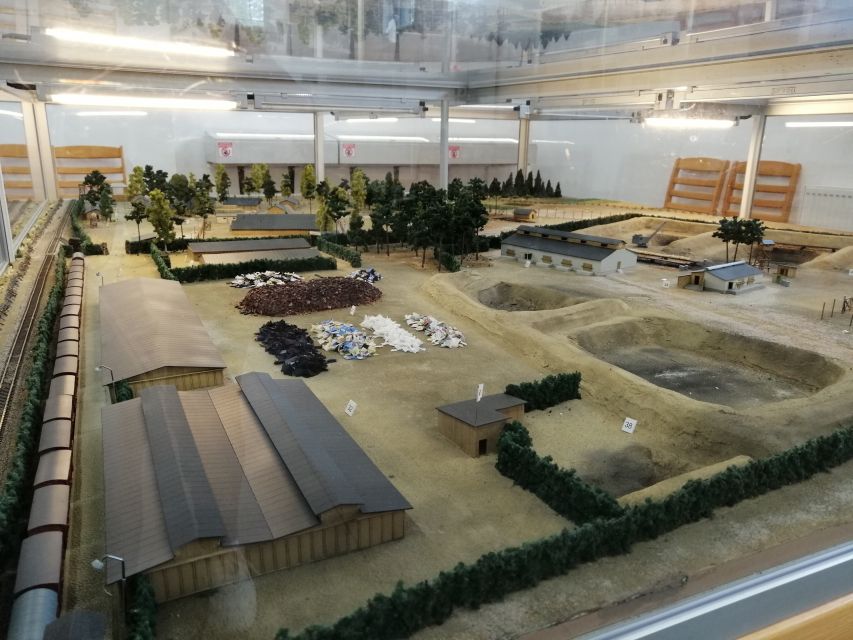
Outside, you walk among memorial works and the remains of the former penal labour camp. About 20,000 inmates were held at the penal labour camp between 1941 and 1944. This part of the visit adds another layer to the story, showing that the wider Treblinka area included forced labour as well as mass murder.
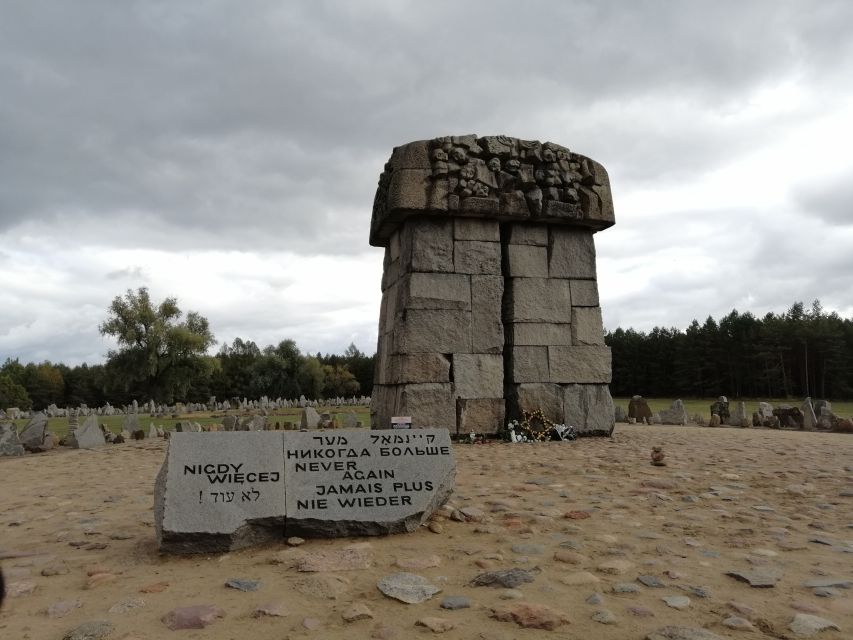
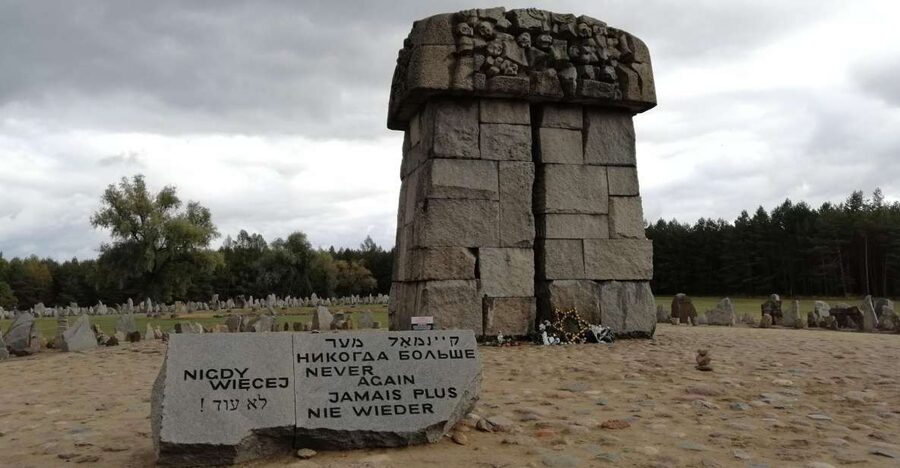
The extermination camp itself has no intact gas chambers or barracks for you to enter. Instead, reconstructed areas, memorial stones, ruins, and the arrangement of the ground point toward what stood there.
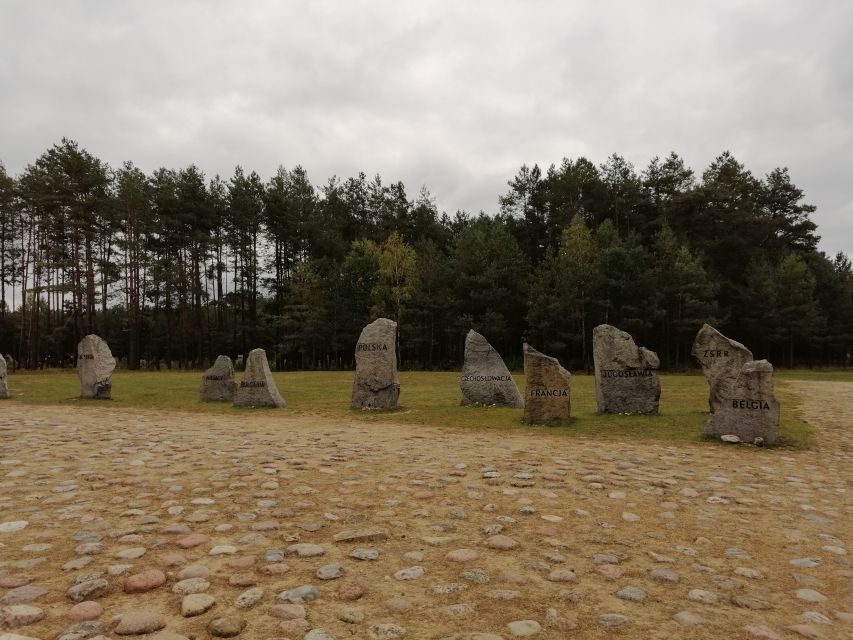
The famous field of stones can be difficult to process. Each stone represents a community connected with the people murdered at Treblinka. The scale turns a number that seems abstract into a long list of places and lives.
This is also where the guide’s skill becomes most important. Guides who use maps, memoirs, and testimony can help you understand what cannot be seen. Jan, for example, was praised for giving a group briefing that felt like a history seminar. That approach will suit you if you want detail and chronology rather than a short emotional speech.
You should expect a respectful tone. The site is not a place for casual chatter or rushing from marker to marker. Comfortable shoes matter because the visit involves walking outside, and weather can affect how long you want to linger.
Something quite different:
- Warsaw Concert: Chopin – Painted by Candlelights with Wine
★ 4.8 · 1,442 reviews - Warsaw: City Sightseeing Hop-On Hop-Off Bus Tour
★ 3.6 · 1,415 reviews - Warsaw: POLIN Museum of the History of Polish Jews Ticket
★ 4.7 · 1,142 reviews - #1 Pub Crawl Warsaw with Optional Premium 1 Hour Open Bar
★ 5.0 · 790 reviews
The August 1943 prisoner revolt
A central part of the visit is the story of the prisoner revolt in August 1943. About 840 prisoners of the death camp took part in an attempt to resist their planned murder.
The uprising did not end the camp’s killing system at once, and many prisoners were killed during or after the revolt. Still, it disrupted the camp and helped force the Nazis to close and destroy the site. Hearing this story at Treblinka gives you a more complete picture than focusing only on victim numbers.
The guide may also explain how prisoners tried to preserve evidence and how testimony later helped reconstruct the camp’s operation. Since the Nazis wanted to wipe away the physical proof, survivor accounts are especially important here.
This part of the tour can be emotionally heavy. You are dealing with mass murder, forced labour, resistance, and the deliberate destruction of evidence in a short period. I would avoid scheduling another demanding museum immediately afterward. The return to Warsaw gives you time to be quiet, talk with your group, or simply look out the window.
How much time do you really get at the site?
The total duration is six hours, including pickup, the drive, the visit, and the return to your accommodation. That makes it a half-day trip in practical terms, though the exact amount of time walking around Treblinka is not specified.
One useful warning comes from the itinerary balance. A previous participant preferred spending more time at Treblinka rather than visiting the Umschlagplatz in Warsaw. If your priority is the camp itself, ask at the beginning how the day will be divided.
The Warsaw stop can be worthwhile because it links the capital’s Jewish ghetto and deportation process with Treblinka. But time is limited. You cannot assume that every part of Warsaw connected with the story will receive equal attention.
A small group can make the experience more personal. One outing had seven participants plus the guide, but group size is not guaranteed. If you care about having time for questions, confirm the expected group arrangement before booking.
The guide and driver make the difference
The strongest part of this tour is the human guidance. The driver and guide may be separate people, and both affect the day.
Names praised on different departures include Leszek, Janusz, Jan, Marek, Kris, Maciej, Marzena, Mateusz, and Krzysztof. Do not assume you will receive a particular person, but these comments point to the kind of service the operator aims to provide: punctual pickup, friendly driving, clear English, and serious explanation at the memorial.
Janusz received especially warm praise for giving a broad account of the war, the events before the Holocaust, and the camp itself. Leszek was noted for answering questions fully and adding background about Warsaw and Polish history. Mark and Marek were also described as patient and clear during difficult questions.
The best guides do not simply recite dates. They explain how the camp worked, how people reached it, what the physical sections meant, and why the site looks so different from Auschwitz. They also leave room for silence.
The driver’s role is less visible but still important. A punctual pickup and a smooth return matter on a solemn day. Friendly conversation can make the journey easier, though the tone should remain respectful when discussing the destination.
Is $134 per person fair value?
At $134 per person, this is a premium half-day trip from Warsaw. You are paying for private or organized transport, hotel pickup and drop-off, an English-speaking driver, admission, and a guided visit rather than only for entry to the memorial.
For a solo visitor, the price may feel high. One person found the trip expensive when travelling alone, even while rating the actual tour highly. If you can share the cost with companions, the value improves because transport is already arranged and you avoid building the route yourself.
I think the price is easier to justify if you care about history, Holocaust education, or memorial sites and want a guide who can answer questions. It is less convincing if you only want to see the location quickly and take a few photographs.
The strongest value comes from interpretation. At Treblinka, the physical remains are limited. A ticket alone cannot explain the layout, the destruction of the camp, the penal labour site, or the prisoner revolt in enough detail. If the guide is as strong as Leszek, Janusz, or Jan was on previous departures, the added cost buys understanding, not just convenience.
Food and drinks are not included. Bring water and something to eat, especially if you prefer not to lose time looking for lunch. One departure included a restaurant stop on request, but that should not be treated as a standard part of the tour.
Who should book this Treblinka tour?
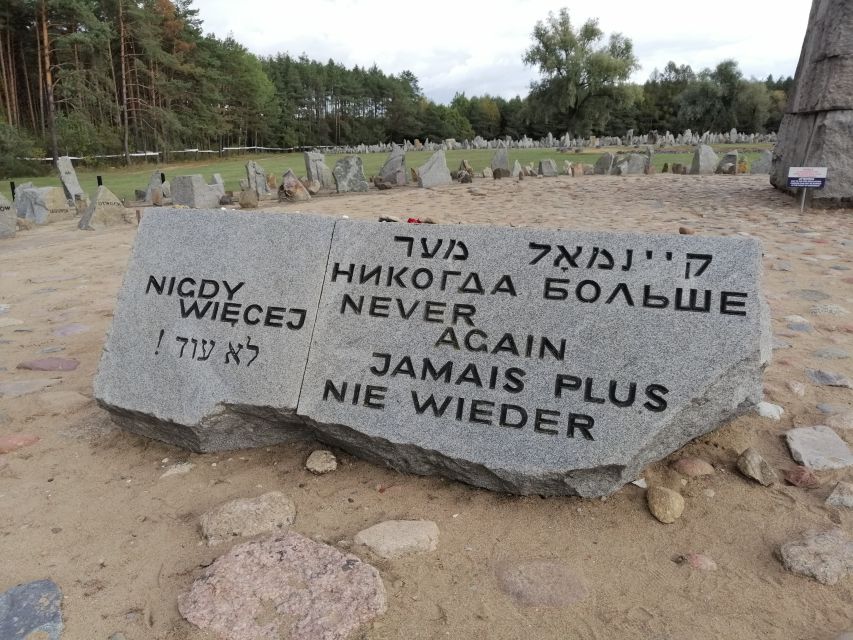
I would choose this tour if you are staying in Warsaw and want a serious introduction to Treblinka without dealing with the transport yourself. It suits adults, students, families with older children, and anyone studying the Holocaust or the politics of memorial sites.
It is particularly useful if you have never visited a destroyed extermination camp. The guide can explain what you are seeing and, just as importantly, what you are not seeing.
You should think twice if you want a light sightseeing day. Treblinka is emotionally demanding, and the subject is treated in detail. It is also not the right choice if you expect preserved buildings, indoor exhibits throughout the visit, or a large collection of original objects.
The activity is listed as wheelchair accessible, but the memorial includes outdoor areas. If mobility is important for your planning, ask the provider for current details about the exact route and ground conditions.
Free cancellation is available up to 24 hours before the start, and you can reserve now while paying later. Those options are useful when your Warsaw plans are still changing, but they do not alter the serious nature of the visit.
My verdict on the six-hour visit
I recommend this tour for you if the guide’s explanations matter as much as the destination. Pickup is easy, the vehicle is comfortable, the English support is useful, and the museum and model give you a solid base before you walk through the memorial grounds.
The key limitation is the site itself, not the operator. Treblinka was destroyed, so you must be ready for a place where stones, forest, reconstructed features, and testimony carry the story. Some people find that more powerful than preserved buildings. Others may prefer a museum with more objects and visible structures.
At $134, I would book it for the quality of guidance and transport, not because it is a bargain. If you want a thoughtful, well-organized visit from Warsaw and can give the subject your full attention, it is a strong choice. Bring comfortable shoes, water, and patience. Treblinka asks for all three.
FAQ
Where is Treblinka located?
Treblinka is in Poland’s Mazovia Province, in a forest north-east of Warsaw. The camp was located about four kilometres south of Treblinka railway station.
How long does the tour last?
The experience lasts six hours, including pickup from your accommodation, transport to Treblinka, the visit, and the return journey.
Is hotel pickup and drop-off included?
Yes. Pickup and drop-off at your accommodation are included.
Is transport provided in an air-conditioned vehicle?
Yes. The tour includes transport in a comfortable, air-conditioned vehicle.
Is the tour conducted in English?
Yes. The activity includes an English-speaking driver and a live English-speaking guide.
What is included in the ticket price?
The price includes hotel pickup and drop-off, an English-speaking driver, skip-the-line tickets to Treblinka, and a guided tour of the camp.
Are food and drinks included?
No. Food and drinks are not included. You should bring your own refreshments.
What should I wear or bring?
Bring comfortable shoes because the visit includes walking around outdoor memorial areas. You should also bring food and drinks.
Is the tour wheelchair accessible?
Yes. The activity is listed as wheelchair accessible.
Can I cancel the booking for a full refund?
Yes. You can cancel up to 24 hours in advance for a full refund. Reserve now and pay later is also available.
Just added in Warsaw
- Historical Walking Tour of Jewish Warsaw★ 5.0 · 68 reviews
- Deluxe Polish Food Tour Experience in Warsaw★ 5.0 · 19 reviews
- CO2-Offset Arrival Transfer from Warsaw Airport to Warsaw City★ 5.0 · 1 review
- Amazing photo walk through the Old town of Warsaw★ 5.0 · 32 reviews
- 8-day tour around Poland by private car★ 5.0 · 2 reviews
- 2h Rental of Motorboat for 10 in Warsaw no License Needed★ 5.0 · 1 review
- 2 Hour Super Segway City Tour of Warsaw★ 5.0 · 5 reviews
- Electric Scooter Tour: Full Tour – 3-Hours of Magic!★ 5.0 · 3 reviews
Warsaw Tours, compared.
Traditional Galar Cruise on The Vistula River
Read our review →
Warsaw Concert: Chopin – Painted by Candlelights with Wine
Read our review →
POLIN Museum of the History of Polish Jews Ticket
Read our review →
#1 Pub Crawl Warsaw with Optional Premium 1 Hour Open Bar
Read our review →
Browse the lists this tour appears in