
REVIEW · COMMUNISM TOURS
Communist Warsaw: private tour by retro minibus with hotel pickup
Warsaw wears its past openly. This private three-hour ride links the Palace of Culture, Muranów, Praga, and the government district, giving you a clear view of how communism changed the city. I like the retro minibus, which saves your feet without turning the outing into a sealed bus ride, and I like the private format, which gives your guide room to explain the awkward parts of Polish history. The main drawback is that hotel transfers count toward the three-hour tour, and the vintage vehicles may lack air conditioning and seat belts.
Tom, one of the guides, received special praise for explaining communist history and pointing out buildings and statues across central Warsaw. The tour is a good fit if you want context rather than a quick photo stop, but remember that the minibus carries you between locations while you still walk at each stop.
In This Review
- Key points to know before booking
- Why this tour makes communist Warsaw easier to read
- The retro minibus and the hotel pickup
- The Palace of Culture and Science: Warsaw’s uncomfortable gift
- Muranów and the attempt to redesign society
- The rebuilt Old Town and the route toward Praga
- Praga Północ and the everyday work of getting by
- Śródmieście and the curious government district
- How much history fits into three hours
- Who will get the most from this experience
- Should you book the communist Warsaw minibus tour?
- FAQ
- How long does the Communist Warsaw tour last?
- Is hotel pickup included?
- Is the tour private?
- What language is the tour offered in?
- Does the tour visit the Palace of Culture terrace?
- Can children join the tour?
- Are food, admission tickets, and tips included?
Key points to know before booking
- The Palace of Culture sets the tone: This Soviet-built landmark remains both a city symbol and a source of strong local feeling.
- A private minibus keeps the route easy: Groups of up to eight ride together, with hotel pickup and drop-off included.
- Muranów shows planned socialist housing: The district was built after the war on ruins, with the aim of creating a model neighborhood.
- Praga reveals the less polished side of communism: Neglect, informal trade, and shortages shaped daily life there.
- The three-hour schedule includes transfers: A distant hotel can reduce time spent at the main sights.
- Historic vehicles have limits: Some minibuses have no air conditioning or seat belts, though all have winter heating.
Why this tour makes communist Warsaw easier to read
Warsaw can be confusing at first glance. One block shows rebuilt Old Town facades, another presents broad socialist avenues, and then a courtyard or housing estate hints at decades of shortage and state control.
I like this tour because it connects those pieces. You are not simply shown a statue and told its date. You move through districts that represent different communist choices: monumental propaganda, planned housing, neglect, reconstruction, and the uneasy return of older architectural ideas.
The private setup matters here. With only your group in the minibus, you can ask why the Palace of Culture still bothers some residents, how people found Western music during the communist years, or why a new government building looked too much like a capitalist bank. A larger group would make those conversations harder.
The price is $134.43 per person. That is a serious amount for three hours, especially for one or two people. The value improves for a group sharing a private vehicle, or for anyone who would otherwise pay separately for transport and a private history guide. You are paying for the dedicated guide, the vehicle, pickup, drop-off, and a route that would be awkward to cover efficiently on foot.
The tour has a 5 out of 5 rating from 22 reviews, and 100 percent of recorded ratings recommend it. That is a small sample, but the praise is specific. Tom was singled out for his clear explanation of communism and for identifying buildings and statues around downtown Warsaw.
More Communism Tours in Warsaw
- Private Tour: Warsaw’s Communist History by Retro Fiat
★ 5.0 · 115 reviews - Warsaw: Communism Tour in an Original Socialist Van
★ 4.9 · 75 reviews - Warsaw: Communist History Self-Driving Tour
★ 4.8 · 52 reviews
The retro minibus and the hotel pickup
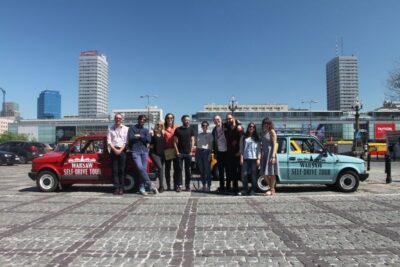
The vehicle is part of the appeal. Instead of moving through Warsaw in a modern coach, you ride in a classic communist-era minibus. It gives the experience a playful visual touch without making the subject matter feel like a theme-park show.
Each minibus holds up to eight passengers, and the operator has a fleet of five. Since this is a private activity, only your own group rides with your guide. That works especially well for families, couples who want to ask many questions, or small groups with different levels of interest in twentieth-century history.
The minibus is mainly used to transfer you between the stops. You will get out and walk for part of the visit, so comfortable clothing and sensible shoes matter. This is not a completely seated sightseeing ride.
There are also practical limitations. Classic vehicles are not equipped with air conditioning, and some do not have seat belts, a condition permitted for historic vehicles in Poland. All have heating for winter, but warm-weather comfort may depend on the day and the particular vehicle.
Pickup and drop-off at your hotel are included. Still, the transfer time is part of the three-hour total. If your hotel sits far from central Warsaw, you may get more sightseeing time by meeting the guide in the city center instead. If the hotel does not appear in the booking selection, you need to send the address to the operator.
The Palace of Culture and Science: Warsaw’s uncomfortable gift
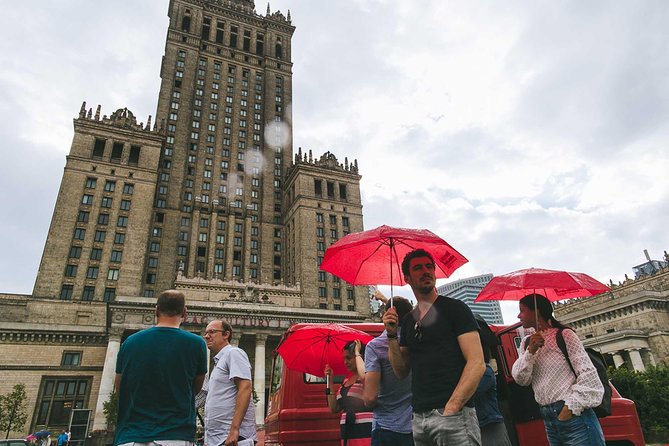
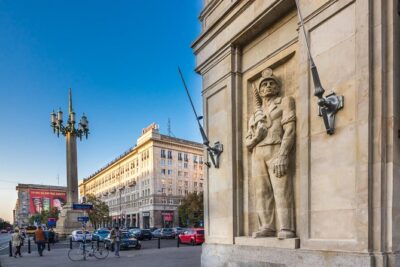
The tour begins at the Palace of Culture and Science, the city’s most recognizable communist building. The Soviet Union presented it to Poland, and construction took place from 1952 to 1955.
Its size was never meant to be modest. The building dominates the skyline and remains impossible to ignore from many parts of Warsaw. That visual power was the point. It announced Soviet influence in physical form, towering over a capital that had already suffered enormous wartime destruction.
You spend about 20 minutes here, with no admission charge. The tour does not include the terrace on the thirtieth floor, so you should not book this experience expecting a high viewpoint. The focus is the building’s political meaning and place in Warsaw, not an indoor visit or skyline panorama.
This is a useful opening stop because it gives your guide a strong reference point. You can look at the building as architecture, as propaganda, and as a reminder of the unequal relationship between Poland and the Soviet Union. Those ideas return throughout the rest of the route.
I would allow extra time before or after the tour if you want to explore the Palace area on your own, but the supplied tour details do not include a terrace visit. Keep your expectations fixed on the exterior and the surrounding central district.
Muranów and the attempt to redesign society
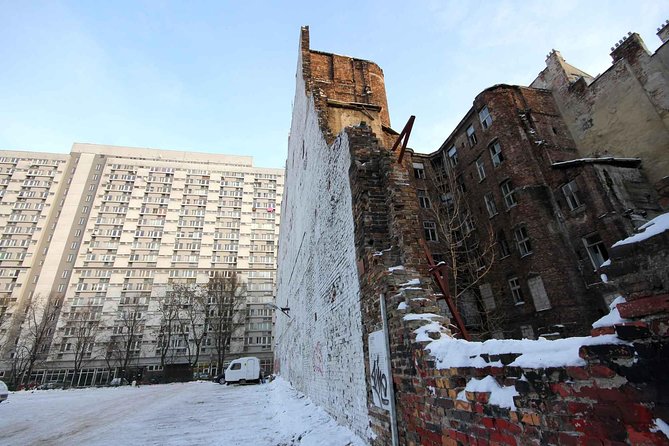
The next stop is Muranów, where you spend about 20 minutes. Before World War II, Warsaw was a capitalist European city filled with dense tenement blocks. After the war, communist authorities and modernist architects treated reconstruction as a chance to build a different kind of city.
Muranów became a green residential district built in the late 1940s on wartime ruins. It was not simply a housing project. It was intended as a model socialist neighborhood, with a planned setting that reflected the new political order.
That makes Muranów valuable as a stop because the buildings are part of a larger idea. You are looking at an attempt to shape daily life through planning, open space, and modern housing rather than restoring the prewar city exactly as it had been.
The short visit means you will need to listen closely. Twenty minutes is enough for an explanation and a look around, but not for a long architectural walk. The minibus helps by carrying you there quickly, though the hotel transfer may reduce the total time available at all four main stops.
Muranów also helps prevent a simplistic picture of communism. The period was not only grand monuments and political repression. It included practical rebuilding, new housing, and a serious effort to create a different urban order, even when that order came with strict state control.
Something quite different:
- Warsaw: Chopin Concert in the Old Town
★ 4.8 · 2,287 reviews - Warsaw: Traditional Galar Cruise on The Vistula River
★ 4.6 · 1,640 reviews - Warsaw: Old Town Highlights Walking Tour in English
★ 4.7 · 1,516 reviews - Warsaw Concert: Chopin – Painted by Candlelights with Wine
★ 4.8 · 1,442 reviews
The rebuilt Old Town and the route toward Praga
There is no separate stop in the Old Town, but you pass through its area on the way to Praga. This part of the route adds an important piece to the story.
Postwar authorities rebuilt Warsaw’s Old Town, while a major traffic route was constructed beneath it with assistance from Soviet engineers connected with the Moscow metro. The result combines historical reconstruction above ground with modern transport planning below.
That contrast is worth noticing from the minibus. The Old Town can look like a return to an earlier Warsaw, yet its postwar form is the result of a major reconstruction project. The road beneath it reminds you that the communist city was also designed for movement, industry, and a new public order.
Because this is a passing section rather than a scheduled stop, you should not expect time for a detailed walk or museum visit there. Think of it as a connecting chapter between Muranów and Praga. Your guide’s commentary is especially useful because the visual clues are easy to miss while the vehicle is moving.
Praga Północ and the everyday work of getting by
Praga Północ receives about 30 minutes, making it one of the longer stops. It offers a different picture of communist Warsaw from the official buildings and planned residential areas.
State investment largely passed Praga by. The district became associated with informal and illegal activity, particularly in its courtyards. People exchanged foreign currency, traded Western music, and looked for goods that were unavailable through official channels.
This is where the tour moves from architecture into daily life. A political system can be explained through leaders and monuments, but shortages and unofficial markets show how people actually managed. Foreign currency and Western records were not abstract symbols. They were objects people sought, traded, and used to keep some contact with life beyond the Iron Curtain.
I appreciate that Praga is included because it complicates the polished image of planned communist Warsaw. Muranów presents a controlled attempt at social improvement. Praga shows what happened when a neighborhood received less care and residents had to build their own networks.
The half-hour visit is long enough to get out, walk, and hear the story without turning the tour into a full neighborhood exploration. Wear proper shoes, since the vehicles do not eliminate walking. If you prefer only grand monuments and restored streets, this may be the least comfortable part of the route. If you want a more honest look at shortage and survival, it may be the most revealing.
Śródmieście and the curious government district
The final stop is Śródmieście, where you spend about 45 minutes. This is the longest scheduled visit and brings together two competing architectural languages: prewar modernism and monumental socialist realism.
The government district helps explain how communist Poland wanted power to look. Large, formal buildings projected order and authority, while modernist structures carried traces of the earlier city. The district is not just a collection of offices. It is a record of changing ideas about what the capital should represent.
One detail gives the stop a touch of irony. The leader of communist Poland reportedly refused to move into the new party headquarters because he thought it looked more like a capitalist bank than the office of a workers’ party. That story captures the contradictions of the period neatly. Even communist architecture could fail the political test if it looked too much like the system it claimed to replace.
You have 45 minutes here for your guide to explain the buildings, statues, and political setting. This is also where Tom’s strengths, as described in the tour information, are most relevant. He was praised for explaining the history and identifying notable structures throughout downtown Warsaw.
Since this is the final main stop, it works as a review of the whole route. The Palace of Culture showed Soviet power. Muranów showed planned reconstruction. Praga showed neglect and informal survival. Śródmieście brings the state’s public face into focus, with modernism and socialist realism sharing the same district.
How much history fits into three hours
Three hours is enough for a sharp introduction, not a complete study of communist Poland. The route includes four stops, a passing section through the Old Town area, driving time, and hotel transfers if you use them.
I would book this when you want a structured overview and a guide who can explain connections between places. The minibus prevents you from spending most of the afternoon walking between districts, which is a real advantage in cold weather, hot weather, or rainy conditions.
The schedule is less suited to you if you want long visits inside buildings, museums, or observation decks. There are no admission tickets included because the stops are outdoor sightseeing points, and the Palace terrace is specifically excluded.
The private format gives you more control over questions, but not necessarily a longer tour. A three-hour private experience is still a three-hour experience. If your hotel is far from the center, meeting downtown can protect more of that time for the actual route.
Who will get the most from this experience
I would recommend it to first-time visitors who want to understand why Warsaw looks so different from one district to the next. It also suits anyone interested in twentieth-century politics, urban planning, architecture, or the ordinary problems created by shortages.
It is a practical choice for people who do not want a long walking tour. You still walk at the stops, but the minibus handles the larger gaps between them. Families can book for children over 150 centimeters, while younger or shorter children require a booster seat arranged in advance. Polish law requires the appropriate booster, so contact the operator before booking for a child under that height.
The tour is also useful for small groups who want a private guide rather than a fixed public group. With room for up to eight people, a family or group of friends may find the per-person price easier to justify.
I would hesitate if air conditioning, seat belts, or modern vehicle comfort are important to you. The classic minibuses are part of the charm, but they are not modern coaches. You should also think carefully about the price if you are traveling alone or as a couple and do not plan to ask many questions.
The experience is offered in English, and confirmation arrives at booking. It is near public transportation, though hotel pickup is available. Free cancellation applies if you cancel at least 24 hours before the start time. Changes or cancellations inside that window are not accepted for a refund.
Should you book the communist Warsaw minibus tour?
Book it if you want a focused history lesson with wheels, especially if your time in Warsaw is short or you prefer private guiding. The route covers more than famous monuments. It shows how political power affected housing, roads, public buildings, trade, and everyday life.
The strongest reasons to choose it are the private format, the carefully connected districts, and the guide’s personal explanation. Tom’s praise for explaining buildings and statues suggests the tour is at its best when you ask questions and pay attention to the city around you.
Skip it if you want a long walking visit, interior sightseeing, a Palace of Culture terrace view, or the comfort of a fully modern vehicle. Also consider meeting downtown rather than using hotel transfers if your accommodation is well outside central Warsaw.
For the right visitor, the $134.43 price buys a useful three-hour orientation that would be difficult to arrange alone. I would choose it early in a Warsaw stay, then use what you learn to look at the city with sharper eyes afterward.
FAQ
How long does the Communist Warsaw tour last?
The tour lasts approximately three hours. Hotel pickup and drop-off are included, and the transfer time counts toward the total duration.
Is hotel pickup included?
Yes. Hotel pickup and drop-off are included. If your location is not available in the booking selection, send the address to the tour operator.
Is the tour private?
Yes. Only your group participates in the activity. Each minibus accommodates up to eight passengers.
What language is the tour offered in?
The tour is offered in English with a professional English-speaking local guide.
Does the tour visit the Palace of Culture terrace?
No. The tour visits the Palace of Culture and Science, but it does not include the terrace on the thirtieth floor.
Can children join the tour?
Adults and children over 150 centimeters can book online. Children under 150 centimeters need a mandatory booster seat under Polish law, so contact the operator in advance to check availability.
Are food, admission tickets, and tips included?
All fees and taxes, transport, the guide, and hotel transfers are included. The listed stops have no admission charge. Tips and gratuities are not included.
Just added in Warsaw
- Wroclaw Small-Group Tour with Lunch from Warsaw★ 5.0 · 2 reviews
- World War II Warsaw Old Town, Military Cemetery Walking Tour★ 4.7 · 3 reviews
- Warsaw: Wolf’s Lair & Swieta Lipka Small-Group Tour + Lunch★ 5.0 · 3 reviews
- Wilanów Palace: 2-Hour Guided Tour with Entrance Tickets★ 4.8 · 8 reviews
- Warsaw Zoo Skip-the-Line Entry Ticket with Private Transport★ 4.8 · 3 reviews
- Warsaw: Private Vodka Tasting Night with Snacks and Pickup★ 5.0 · 7 reviews
- Warsaw Private Wilanow Palace & Garden Tour★ 4.6 · 30 reviews
- Warsaw Wolf’s Lair with St. Lipka and Mamerki Private Guided★ 4.2 · 3 reviews
Communism Tours, compared.
Legendary Private Nowa Huta Communism Tour with Crazy Guides
Read our review →
Private Tour: Warsaw’s Communist History by Retro Fiat
Read our review →
Private Nowa Huta Adventure Tour in Communist Cars
Read our review →
Communist Krakow – Nowa Huta Walking Tour in English
Read our review →Browse the lists this tour appears in