
REVIEW · JEWISH QUARTER TOURS
Krakow: Jewish Quarter and Ghetto Electric Golf Cart Tour
History comes alive around every corner. This 90-minute electric golf cart tour gives you an efficient introduction to Kazimierz, Krakow’s old Jewish district, then continues into the former Jewish ghetto, where fragments of wartime history remain part of the modern city. I like the way it covers more than 20 monuments without asking you to walk the whole area, and I also like the mix of recorded commentary and extra explanations from the driver.
The cart is especially useful in winter, rain, or for anyone with mobility concerns. It is covered, and one January group stayed warm despite heavy snow and temperatures of minus 7 degrees. The main drawback is time: 90 minutes can only introduce these places, not explain every story in depth. At some stops, several golf carts may gather together, so nearby commentary can become distracting.
In This Review
- Key points to know before booking
- Why Kazimierz deserves more than a quick walk
- The electric cart experience and what it changes
- The audio guide, drivers, and extra commentary
- Exploring Kazimierz’s streets and monuments
- Crossing into the former Jewish ghetto
- Ghetto Heroes Square and the weight of the route
- How much can you really see in 90 minutes?
- Is $34 good value?
- Who should book this Krakow tour?
- Practical tips for a better ride
- Should you book it?
- FAQ
- How long is the Krakow Jewish Quarter and Ghetto tour?
- What areas does the tour visit?
- How many monuments can I see?
- Is a live guide included?
- Which languages are available for the audio guide?
- Is the electric cart wheelchair accessible?
- What is included in the price?
- Are entrance tickets, food, or hotel transfers included?
- Where is the meeting point?
Key points to know before booking
- More than 20 sights in 90 minutes: A practical first look at Kazimierz and the former ghetto.
- Both audio and human commentary: The multilingual audio guide is included, while drivers often add their own stories and answers.
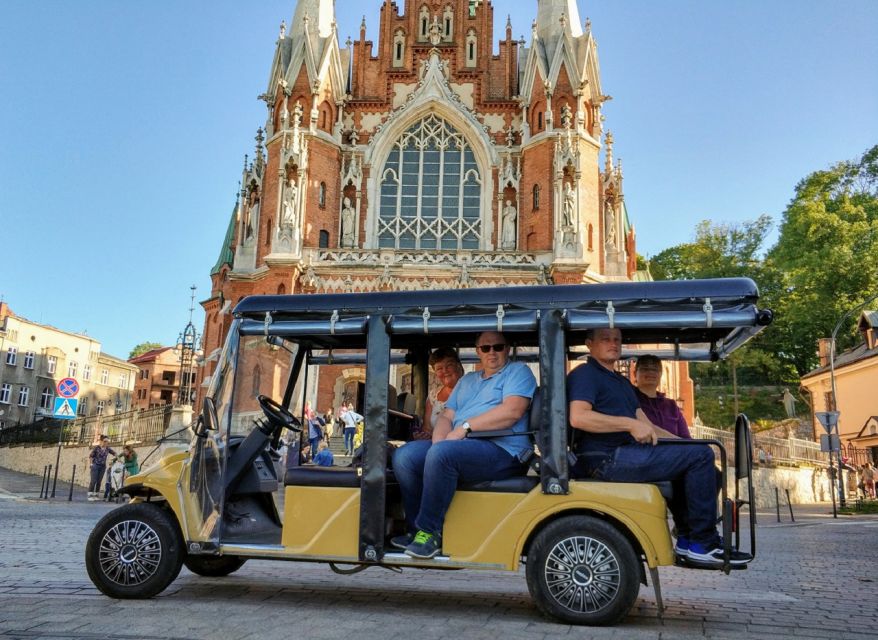
- A covered electric cart: Helpful in rain, snow, cold weather, or for visitors who cannot comfortably walk long distances.
- Important wartime locations: The route includes a section of the former ghetto wall, displaced Jewish homes, Pod Orłem Pharmacy, and Ghetto Heroes Square.
- Short stops make photos possible: You may get time to leave the cart, look inside churches, and take pictures.
- Meet at a precise city-center point: Find the cart marked excursions.city outside the Żabka store at 2 Mikołaja Zyblikiewicza Street.
Why Kazimierz deserves more than a quick walk
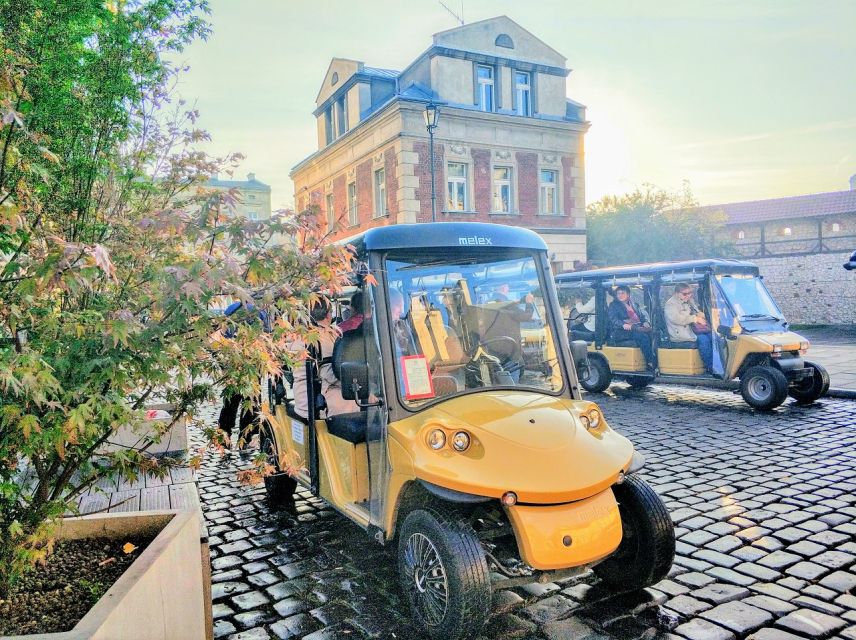
Kazimierz is not simply a collection of old buildings. It is the part of Krakow where Jewish and Christian traditions developed side by side, and the tour uses that setting to explain how the district changed over time.
You ride through narrow streets lined with shops, cafés, and restaurants, but the important point is not just the atmosphere. Your guide connects the streets to the people who lived here, the religious buildings that shaped community life, and the events that later transformed the district.
I find a golf cart useful here because Kazimierz is easy to underestimate on a map. The streets may look close together, yet walking from one end to another, stopping to read plaques, finding a church, and then reaching the former ghetto takes time. The cart gives you a broad view first. You can return later to the places that catch your attention.
This approach also suits a first morning or afternoon in Krakow. You get the basic geography of the district before setting out on foot. One passenger described the tour as a useful introduction, followed by a calmer stroll through the area later. That is exactly how I would use it.
More Golf Cart Tours in Kraków
- Krakow: City Sightseeing Tour by Electric Golf Cart
★ 4.5 · 3,264 reviews - Krakow: City Sightseeing Tour Eco Electric Buggy Golf Cart
★ 4.7 · 3,143 reviews - Krakow: Extended City Sightseeing Tour – Eco Buggy Golf Cart
★ 4.7 · 794 reviews
The electric cart experience and what it changes
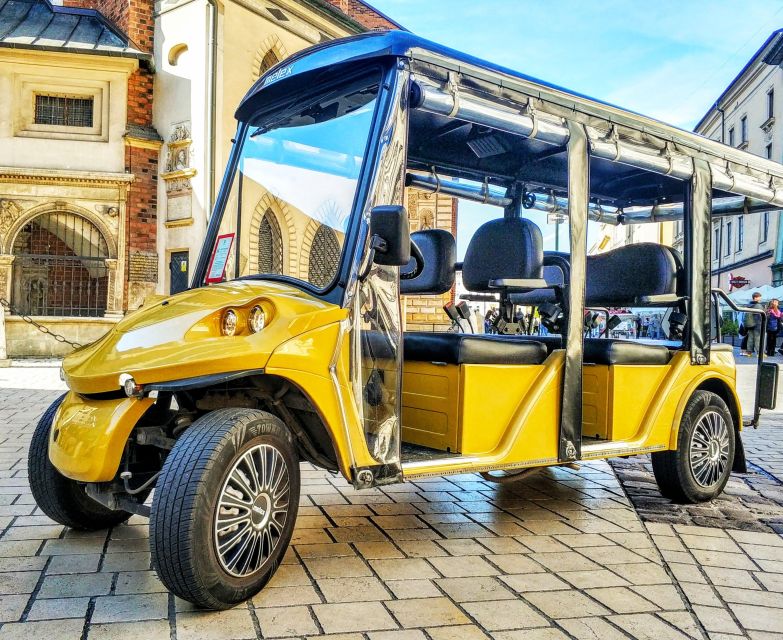
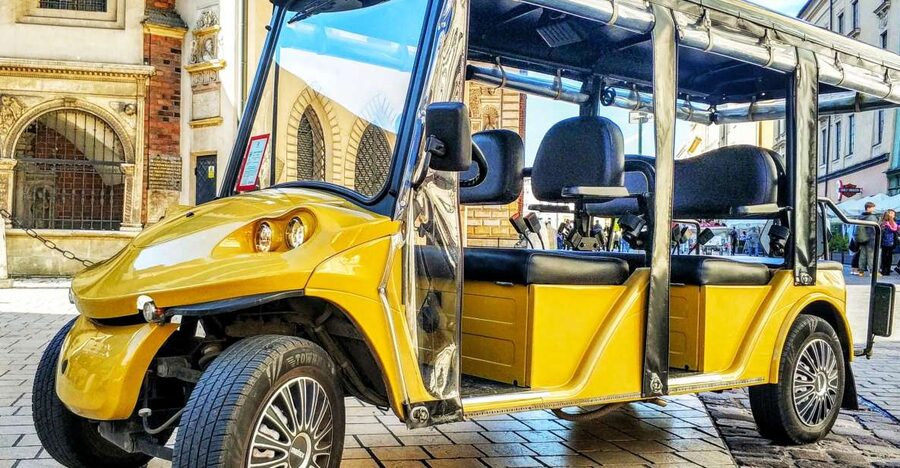
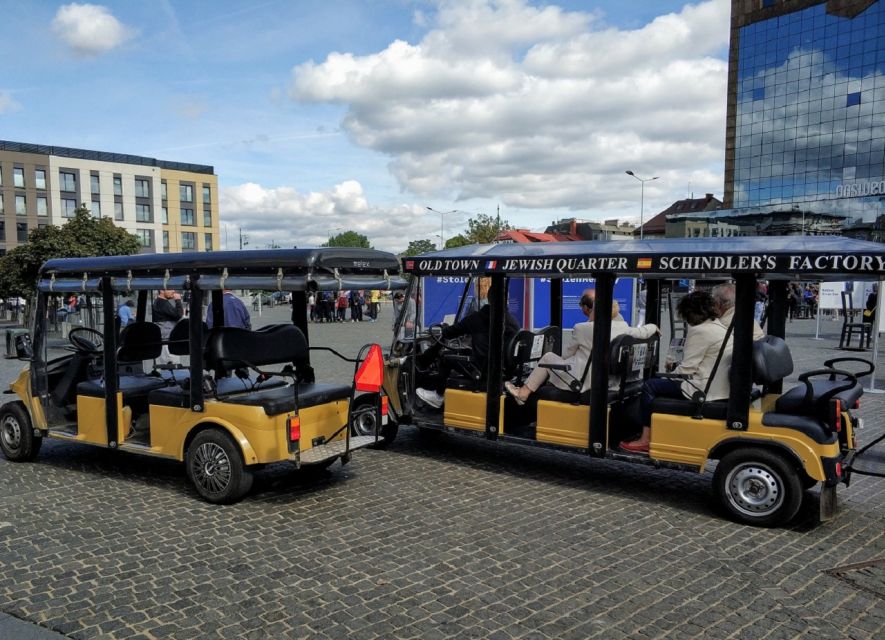
The vehicle is an eco-friendly group electric cart rather than a private car or a full-size sightseeing bus. That matters in Kazimierz, where smaller streets and frequent turns make a compact vehicle more suitable.
The ride is designed to be comfortable, with a covered cabin. The clear side panels can help in poor weather, though you should still dress for the season. A covered cart is not the same as sitting indoors, and Krakow’s winter conditions can be severe.
The cart also reduces the physical effort of the tour. Several people valued it because the Jewish district and former ghetto are large areas to cover on foot. The activity is wheelchair accessible, making it a practical choice for visitors who want to see the district without committing to a long walk.
There is one seating tip worth remembering. A passenger found that the rear-facing seats made it easy to miss sights because the explanation sometimes came before the monument was directly in view. If you have a choice, try to sit facing the direction of travel, with a clear view to both sides.
The tour is a group outing, and it begins at a fixed time. Arrive early at the meeting point, since a late arrival could mean missing the departure. The vehicle carries the excursions.city label, which helps you identify it among other carts.
The audio guide, drivers, and extra commentary
The audio guide is available in a remarkably long list of languages, including English, Polish, German, French, Spanish, Italian, Hebrew, Dutch, Czech, Slovak, Ukrainian, Romanian, Hungarian, Japanese, Korean, Chinese, Turkish, Greek, Portuguese, Swedish, Danish, Finnish, Norwegian, Croatian, Serbian, Lithuanian, Russian, and others listed by the operator.
That range is useful for mixed-language groups. The official driver language is English, but the recorded guide gives you a choice of listening language. You should check how the audio equipment is handed out and used when you board, then make sure you can hear before the cart leaves.
The strongest part of the experience appears to be the added human commentary. Drivers named Natalie, Martina, Olivia, Radek, Oscar, Roch, Conrad, Andrew, Philip, Mark, and Konrad were praised for being friendly, clear, amusing, and well prepared. Several drivers did more than press play. They added local details, answered questions, and used photographs to help explain places that have changed over time.
That personal input can make a real difference. One passenger felt Olivia’s extra commentary was better than the recorded narration. Another appreciated a driver who explained events rather than leaving everything to the audio guide.
The quality of a live guide can vary from departure to departure, of course. But the pattern is encouraging: the most praised guides combine serious historical information with a relaxed manner. This is valuable on a subject that includes persecution, displacement, and mass murder. A good tone matters. The tour needs to be clear and respectful without turning the past into a performance.
Exploring Kazimierz’s streets and monuments
The first part focuses on Kazimierz, Krakow’s oldest district. The cart winds through streets where Jewish and Christian life once met closely, then passes historic buildings, religious sites, shops, and places to eat.
You will see more than 20 monuments during the full route. The exact experience depends on traffic, timing, and the guide, but the plan is clearly designed as a moving overview rather than a sequence of long museum visits.
The stops are important because they break up the ride. You may leave the cart for photographs, and several passengers appreciated being able to enter churches during the tour. That is a useful bonus, but do not treat it as a guaranteed substitute for a church tour or museum visit. Entrance tickets are not included, and the 90-minute schedule leaves limited time for extended visits.
Szeroka Street deserves special attention. One passenger wished for a 10-minute stop there, describing it as particularly beautiful. If your route pauses in the area, use the time for photographs and a quick look around. If it does not, note the location so you can return on foot.
The cart is also good at revealing details you might otherwise pass without understanding. A doorway, wall, or building may seem ordinary until the guide explains who lived there or how the street fitted into the district’s past. That is the real value of the ride: not simply seeing places, but learning why they matter.
More Jewish heritage tours in Krakow:
- Krakow: Schindler’s Factory & Ghetto Guided Tour
★ 4.7 · 1,694 reviews - Krakow: Jewish Quarter and Former Ghetto Tour
★ 4.9 · 1,441 reviews - Krakow: Bike Tour of Old Town, Jewish Quarter and the Ghetto
★ 4.9 · 1,155 reviews - Krakow: Kazimierz Jewish Quarter Walking Tour
★ 4.8 · 571 reviews
Crossing into the former Jewish ghetto
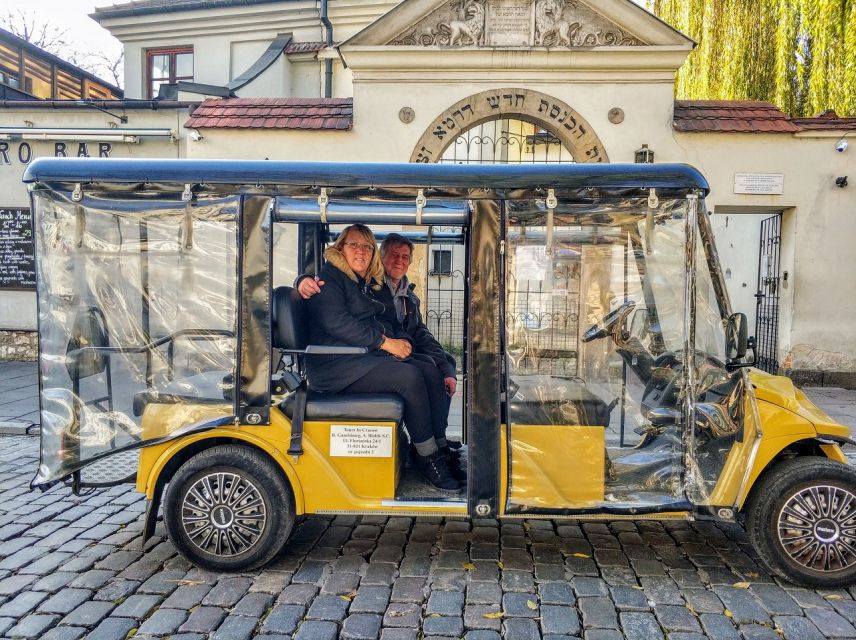
The second part moves into the former Jewish ghetto, created during the Second World War. The mood changes. The lively streets of Kazimierz give way to sites connected with forced removal, confinement, and the destruction of Jewish life in Krakow.
This part should be taken slowly in your mind, even though the cart keeps moving. The route points out traces of the period, including a remaining fragment of the ghetto wall and houses connected with Jewish residents who were displaced.
The wall fragment is particularly powerful because it turns a broad historical subject into something physical. You can see the surviving structure and understand that the ghetto was not only an idea on a map. It had boundaries, controlled movement, and separated families from the rest of the city.
The former homes are also meaningful. They remind you that the people affected were not abstract figures in a history lesson. They had apartments, neighbors, routines, and ordinary connections to the streets around them. The guide’s job here is to place those human details into the wider story without rushing past them.
Pod Orłem Pharmacy is another major stop. It is linked with the wartime ghetto and offers an important reminder of the help and resistance that existed under terrible conditions. The tour does not include entrance tickets, so you should not assume you will visit the interior. You will still learn why the site matters from the guide or audio program.
Ghetto Heroes Square and the weight of the route
The tour also reaches Ghetto Heroes Square, one of the most striking memorial spaces in this part of Krakow. It is a place to pause and consider the scale of the forced displacement and the fate of the people who passed through the ghetto.
The square is not just another photo stop. Its memorial character calls for quiet attention, especially after seeing the wall fragment and former homes. I appreciate that the route includes several connected locations instead of mentioning wartime events only in passing.
The subject matter can be difficult. You should choose this tour because you want historical context, not because the cart sounds like a light sightseeing ride. The vehicle is comfortable and some guides use humor in the less serious portions, but the ghetto section deals with painful events and deserves respect.
The benefit of seeing these locations in sequence is that the story becomes easier to follow. You first learn about the district as a place of community and faith, then see how war destroyed that way of life. The route gives you a framework for a later visit to museums or memorial sites.
How much can you really see in 90 minutes?
Ninety minutes is enough for orientation, not mastery. You can pass through both Kazimierz and the former ghetto, hear the key background, stop for selected photos, and perhaps enter a church. You cannot inspect every monument, browse every street, or spend long periods inside historical sites.
That limit is not necessarily a flaw. I would rather use the cart to see the shape of the district, then return to two or three places that interest me most. The tour helps you decide where to spend your own time.
The pace may feel quick if you want detailed architecture or long explanations at every stop. A moving vehicle also means you need to watch carefully. If you are seated facing backward, a building may pass before the commentary catches up.
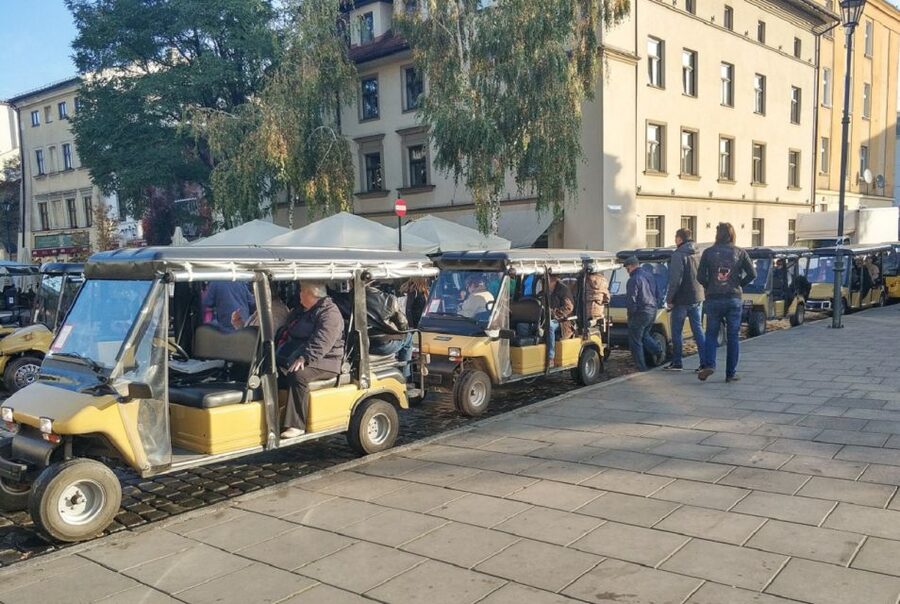
There can also be other golf carts on the same streets. One passenger found it annoying when another cart stopped nearby and its commentary could be heard. This is a minor but real issue in a busy sightseeing area. You should expect some street noise and the possibility of overlapping narration.
Is $34 good value?
At $34 per person, the tour is reasonably priced if your priority is seeing a wide area with minimal walking. You are paying for transport, route planning, and an audio guide, not for museum admission, food, drinks, or hotel pickup.
The value improves if you are visiting in poor weather, traveling with someone who has mobility issues, or have only a short time in Krakow. A taxi would not give you the same historical commentary, and walking the entire route takes more energy and planning.
The value is less clear if you already know Kazimierz well or prefer slow, specialist tours. In that case, you may want to spend your money on a focused walking tour or an entrance ticket to a museum. This cart ride works best as a broad introduction.
The free cancellation until 24 hours before departure and the option to reserve now and pay later also reduce the planning risk. Still, check the starting time and arrive promptly. The group leaves at the specified time.
Who should book this Krakow tour?
I would recommend it to first-time visitors who want to understand how Kazimierz and the former ghetto relate to one another. It is also a strong choice for older visitors, anyone with limited stamina, and people visiting during cold or wet weather.
Families may appreciate the vehicle and the steady movement, though parents should decide if the wartime subject matter suits younger children. History-minded visitors will get the most from the stops at the wall, Pod Orłem Pharmacy, former Jewish homes, and Ghetto Heroes Square.
It is less suitable if you want a private experience, a long stop at each monument, or guaranteed entry into churches and other buildings. There is no live guide included as a formal feature, even though many drivers add their own commentary. You should see the experience as a guided overview supported by audio, not as a private historical seminar.
Practical tips for a better ride
- Arrive at Parking Kiss&Ride at 2 Mikołaja Zyblikiewicza Street, in front of the Żabka store.
- Look for the golf cart marked excursions.city.
- Arrive before the scheduled start because this is a group tour.
- Sit facing forward if possible, especially if you want to photograph sights as they are explained.
- Bring warm clothing in winter. The cart is covered, but January conditions can be severe.
- Keep your camera ready for the wall fragment, former ghetto homes, Pod Orłem Pharmacy, Ghetto Heroes Square, churches, and Szeroka Street.
- Plan a separate walk afterward if you want more time in Kazimierz.
- Treat the ghetto section as a memorial visit, not simply a sightseeing loop.
The experience currently carries a 4.6 rating from 348 bookings, with especially strong praise for the guides’ warmth, clear English, historical detail, and willingness to answer questions. Names such as Natalie, Martina, Olivia, Radek, Roch, and Conrad appear repeatedly in the positive feedback, but guide assignments can change.
Should you book it?
Book this tour if you want an efficient, comfortable introduction to two of Krakow’s most important historic districts. The combination of a covered electric cart, multilingual audio, photo stops, and frequent extra commentary makes $34 fair value for a first look.
Skip it if your ideal day means walking slowly, spending long periods inside museums, or having one specialist guide to yourself. For most first-time visitors, though, the cart solves a practical problem: it helps you see a large area, understand the basic story, and choose where to return on foot. That makes it a useful beginning, especially in winter or when your legs need a little help.
FAQ
How long is the Krakow Jewish Quarter and Ghetto tour?
The tour lasts 90 minutes.
What areas does the tour visit?
It visits Kazimierz, Krakow’s oldest district, and the former Jewish ghetto.
How many monuments can I see?
The route passes more than 20 monuments in Kazimierz and the former Jewish ghetto.
Is a live guide included?
A live guide is not included as a listed feature. An audio guide is included, and the English-speaking driver may also provide additional commentary and answer questions.
Which languages are available for the audio guide?
The audio guide is available in Chinese, Croatian, Czech, Danish, Dutch, English, Finnish, French, German, Greek, Hebrew, Hungarian, Italian, Japanese, Korean, Lithuanian, Norwegian, Polish, Portuguese, Romanian, Russian, Slovak, Spanish, Swedish, Turkish, Ukrainian, and Serbian.
Is the electric cart wheelchair accessible?
Yes, the activity is wheelchair accessible.
What is included in the price?
Transport by electric golf cart and the audio guide are included.
Are entrance tickets, food, or hotel transfers included?
No. Entrance tickets, food and drinks, hotel pickup, and hotel drop-off are not included.
Where is the meeting point?
Meet at Parking Kiss&Ride, 2 Mikołaja Zyblikiewicza Street, in front of the Żabka store. Look for a golf cart labeled excursions.city.
Just added in Krakow
- Auschwitz-Birkenau – Skip the Line Tickets★ 3.5 · 29 reviews
- Auschwitz-Birkenau: Fast-Track Ticket & Guided Tour No Transfers★ 3.5 · 17 reviews
- Zakopane & Sleigh Ride with Bonfire – Group Tour from Kraków★ 5.0 · 2 reviews
- Sleigh Ride & Bonfire in Zakopane with Funicular – Private Trip★ 5.0 · 48 reviews
- Thermal Baths & Zakopane – Private Trip from Krakow★ 5.0 · 1 review
- Zakopane & Gubalowka Funicular – Private Winter Tour from Krakow★ 5.0 · 10 reviews
- Divine Mercy Sanctuary – Private Tour from Krakow★ 5.0 · 4 reviews
- stag dog chase Krakow prank★ 5.0 · 4 reviews