
REVIEW · JEWISH QUARTER TOURS
Krakow: Jewish Ghetto Walking Tour
History still lives in these streets. This one-hour walk through Podgórze brings Kraków’s wartime story down to human scale, with Ghetto Heroes Square and the remaining wall fragment as its emotional center. I like the way the tour uses real streets and surviving buildings rather than relying only on museum displays. I also like the guides’ clear, compassionate storytelling, especially when they explain daily life, deportations, and small acts of courage. The main drawback is time: one hour feels tight for a subject this large, and a particularly detailed guide could easily use several more hours.
At $11 per person, this is an easy tour to add to a Kraków stay. It is short, flat, and practical, though you should arrive 10 minutes early and dress for the weather. The walk goes ahead in rain or shine, and late arrivals cannot join once the group has left.
In This Review
- Key points before you book
- Why Podgórze matters to this tour
- Starting the walk near Schindler’s Factory
- Reading the remaining Ghetto Wall
- Ghetto Heroes Square and the empty chairs
- Under the Eagle Pharmacy and its story of courage
- How much walking and listening to expect
- The guide makes or breaks the experience
- Is $11 good value?
- Who should book this Krakow Ghetto walk?
- Should you book the Jewish Ghetto Walking Tour?
- FAQ
- How long does the Krakow Jewish Ghetto Walking Tour last?
- How much does the tour cost?
- What places does the walking tour visit?
- Is Under the Eagle Pharmacy included?
- What languages are available?
- Is the tour private?
- What should I know about arriving and the weather?
Key points before you book
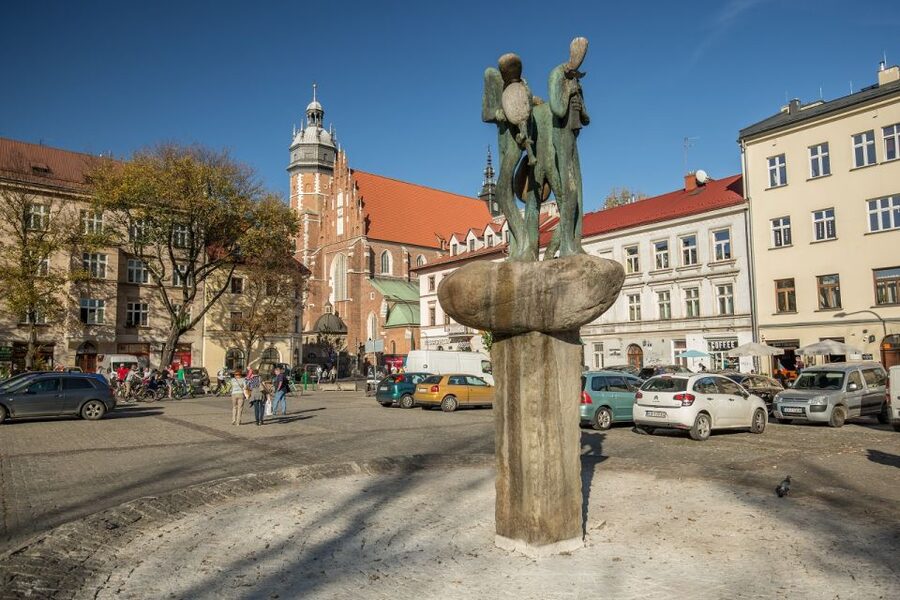
- The surviving Ghetto Wall gives you a rare physical link to the boundaries that confined more than 15,000 people.
- The empty chairs at Ghetto Heroes Square create a stark memorial to lives disrupted and lost during the Holocaust.
- Under the Eagle Pharmacy introduces the courage of Tadeusz Pankiewicz and his staff, who helped people inside the ghetto.
- A live guide makes the difference, adding stories, photographs, and context that are easy to miss when walking alone.
- The tour lasts one hour, making it a good companion to Schindler’s Factory or a useful introduction before a longer Holocaust-history visit.
- Languages are broad, with group tours available in English, French, German, Italian, Spanish, Russian, Portuguese, Swedish, and Slovak.
Why Podgórze matters to this tour
The former Kraków Ghetto is in Podgórze, across the river from the city’s Old Town. Today, it is a functioning district with ordinary streets, homes, businesses, and traffic. That contrast can feel unsettling. You are not walking through a preserved film set or a fenced historical park. You are moving through a living neighborhood where the wartime street plan still helps you understand what happened.
Your guide points out places that can look unremarkable at first glance. That is the value of joining a local expert. Without context, a section of wall may look like old masonry, and an open square may look like any other urban space. With the story attached, the same locations become evidence of how the ghetto was built, controlled, and eventually emptied.
The walk focuses on the Kraków Ghetto during Nazi occupation. You hear how Jewish residents were forced into a small area, how they managed daily life under severe restrictions, and how deportations changed the neighborhood. The subject is painful, but the tour also gives space to courage, mutual aid, and individual choices.
Several guides receive especially warm praise for their delivery. Olga is described as friendly and ready to answer questions. Joanna is noted for a steady pace and clear explanations. Ewa is praised for sensitive storytelling, while Phil uses photographs to help you compare the present streets with wartime scenes. Those details matter because the tour depends less on grand monuments than on how well the guide helps you picture the past.
More Walking Tours in Kraków
- Old Town Krakow & Wawel Castle Walking Tour
★ 5.0 · 1,508 reviews - Creepy Krakow: 2-Hour City Walking Tour
★ 4.7 · 1,131 reviews - Krakow: The Old Town Walking Tour
★ 4.8 · 794 reviews
Starting the walk near Schindler’s Factory
The exact meeting point can change with the option you book. Some departures begin outside Oskar Schindler’s Factory, a convenient starting place if you are already visiting that museum. One particularly practical plan is to visit Schindler’s Factory first and then take the walking tour, though you should check the timing so you are not rushing between activities.
The meeting process appears straightforward. Signage may identify the company, language, and departure time, and a group coordinator helps gather people before the guide arrives. In cold weather, the group may be invited to wait indoors. One January group was grateful for this, with temperatures around minus 9 degrees Celsius.
Arrive early. The stated requirement is 10 minutes before departure, and it is not merely a suggestion. Once the group has gone, latecomers cannot join and the ticket cannot be refunded.
Some tours provide headphones and an audio headset. This helps when the group gathers on a pavement or near a busy street, though one person found that a guide’s voice could still be hard to follow in the cold. If you have trouble hearing, stay near the guide and ask for a slower pace of speaking when needed.
Reading the remaining Ghetto Wall
One of the first major stops is a surviving fragment of the original ghetto wall. The wall once enclosed more than 15,000 people within only a few city blocks. That figure is difficult to grasp until you see how limited the area feels on foot.
The wall is important partly because so little of the original ghetto structure remains. You are not seeing a complete boundary, but a physical remnant that helps explain how confinement worked. Your guide can point out the old limits and show photographs that make the vanished barriers easier to imagine.
This is also where the tour moves from general wartime history to the mechanics of daily life. You learn about crowding, restrictions, fear, and the effort required to find food, medicine, and shelter. The stories of solidarity are equally important. They show that people inside the ghetto were not simply passive figures in a tragic story. They made difficult decisions, cared for relatives and neighbors, and tried to preserve dignity under brutal conditions.
The stop does not require a long walk or difficult terrain. The route is generally flat, and one person described the walking distance as manageable. Still, you are on city streets, not inside a purpose-built attraction, so comfortable shoes remain a good idea.
Ghetto Heroes Square and the empty chairs
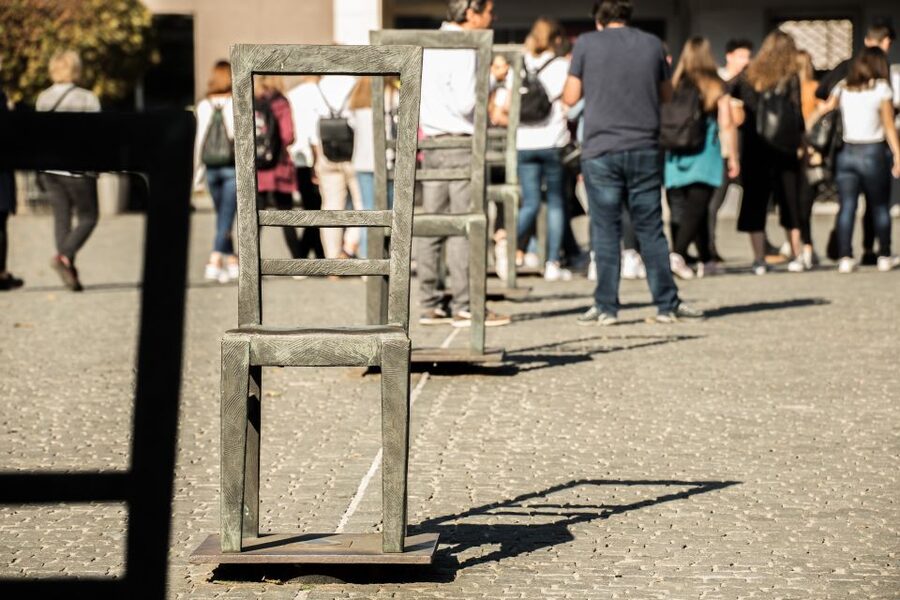
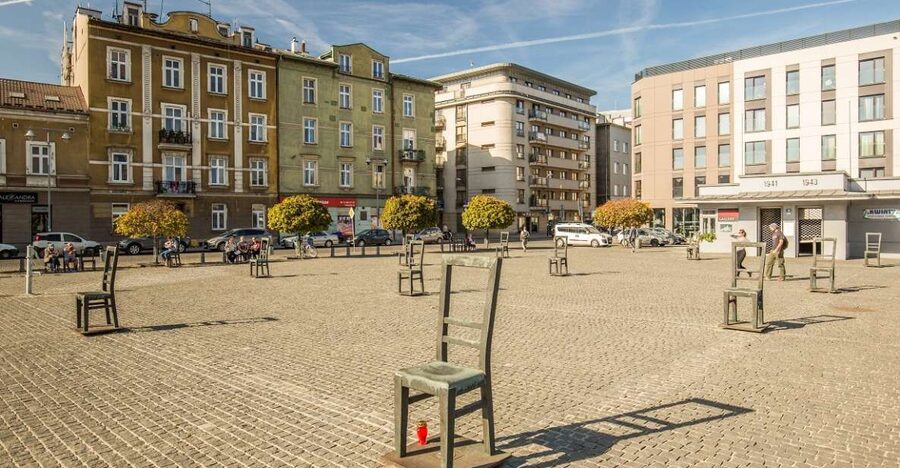
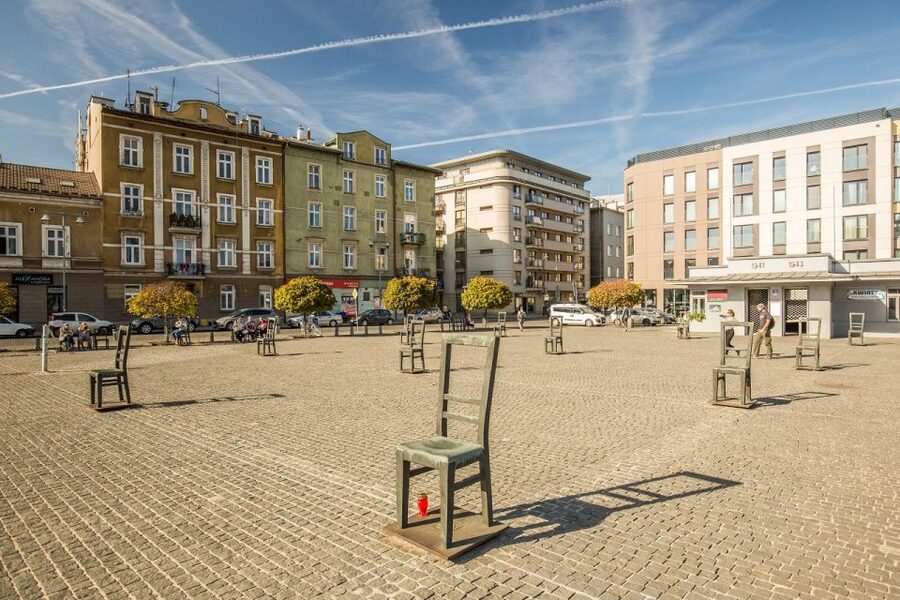
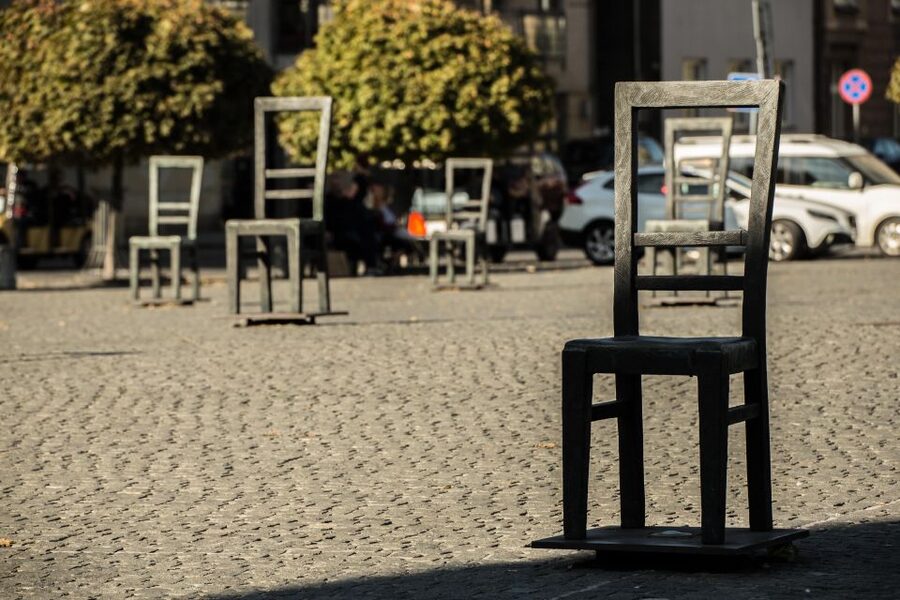
Ghetto Heroes Square is the tour’s most powerful visual stop. During the war, it was connected with the forced removal and deportation of Jewish residents. Today, dozens of empty metal chairs occupy the square.
The chairs are deliberately plain. They suggest belongings left behind, homes suddenly emptied, and people who never returned. The memorial does not need elaborate decoration to make its point. A row of empty seats in an ordinary public space can be more disturbing than a large monument.
Your guide explains what happened here and places the square within the wider story of the ghetto’s destruction. This is often the moment when the walk becomes quiet. You may want time to look rather than listen, and a good guide allows that pause.
The square is also a useful reminder that memorials can work through absence. There are no reconstructed ghetto buildings here to create a false sense that the past has been restored. Instead, the chairs mark what is missing. The surrounding city continues its daily routine, which makes the memorial feel even more direct.
One practical point is worth noting: the route may end at a different place from where it begins. A departure near Schindler’s Factory may finish around the memorial square, so do not assume you will return to the starting point. Check the ending location before planning your next reservation.
More Jewish heritage tours in Krakow:
- Krakow: Schindler’s Factory & Ghetto Guided Tour
★ 4.7 · 1,694 reviews - Krakow: Jewish Quarter and Former Ghetto Tour
★ 4.9 · 1,441 reviews - Krakow: Bike Tour of Old Town, Jewish Quarter and the Ghetto
★ 4.9 · 1,155 reviews - Krakow: Kazimierz Jewish Quarter Walking Tour
★ 4.8 · 571 reviews
Under the Eagle Pharmacy and its story of courage
The historic Under the Eagle Pharmacy adds a personal story to the tour. Tadeusz Pankiewicz, the pharmacist, and his staff risked their safety to help people in the ghetto. They supplied medicine and provided shelter, offering assistance when even basic acts of kindness could carry serious danger.
The pharmacy matters because it shifts the focus from institutions and military events to choices made by individuals. You hear what help could look like in practice: medicine, information, a place to hide, and a human connection in a system designed to strip people of their identity.
The pharmacy is also described as a museum and can be a valuable follow-up visit. However, interior access is not guaranteed as part of the walk. One person found it closed on the day of the tour, so you should treat the exterior and guide’s explanation as certain, while viewing the inside as dependent on opening conditions and the option booked.
If the pharmacy is open, allow separate time to see it properly rather than assuming the one-hour walk includes a full museum visit. The tour’s purpose is to place the pharmacy in its setting and tell its story. It is not designed as a long indoor visit.
How much walking and listening to expect
The route is short in distance but full of explanation. You will walk between several sites while the guide talks, then stop for more detailed accounts at the wall, square, and pharmacy. The pace is generally steady and manageable. Joanna, in particular, was praised for keeping slower walkers comfortable, and another person described the walk as leisurely.
The tour is not physically demanding, but weather can change how it feels. In winter, the open streets and stops can be bitterly cold. In rain, the route continues, so waterproof clothing and shoes are sensible. In summer, the one-hour length can be an advantage because you are not outside all day.
The audio equipment helps, but group conditions can still affect how clearly you hear. If your group is large or the street is noisy, position yourself close to the guide. The company says group tours operate in one language only, so choose carefully when booking.
Private groups are available. That option may suit families or small parties who want more room for questions, a slower pace, or a discussion shaped around their interests. The shared tour is the better value if you simply want a clear introduction at the lowest price.
The guide makes or breaks the experience
This is a guide-led history walk, and the human element is its strongest feature. The best guides do more than recite dates. They explain how the neighborhood changed, bring in individual stories, and help you understand the difference between seeing a place today and knowing what happened there.
Aga was praised for connecting the Nazi occupation of Poland with wider questions about how the past affects the present. Ewa’s approach was described as heartfelt and respectful. Helen was valued for clear facts and compassion, while Fil kept the group engaged with a lively mix of information and humor.
That does not mean every moment will be perfect. One person felt a guide assumed the whole group had already visited Schindler’s Factory, which caused some confusion. Another wanted a microphone and slower speech. These are small but useful warnings: guide quality is generally a strength, yet communication can depend on the group, street noise, weather, and the individual leading your departure.
You should also expect a serious tone. This is not a casual sightseeing stroll, though a good guide can keep the presentation warm and approachable. If you have just visited Auschwitz, you may find the subject emotionally heavy. At the same time, the shorter route and focus on daily life can add a different layer to your understanding.
Is $11 good value?
At $11, the tour offers strong value if you want historical context without committing to a long excursion. The price covers the expert guide and the walking route, while food and drinks are not included. There is no major attraction ticket built into the cost, so the value comes from interpretation.
That interpretation is exactly what you would miss walking alone. You can locate the wall fragment, Heroes Square, and the pharmacy yourself, but the meaning of those places is not always obvious. A guide connects them into one story and may use photographs to show what the neighborhood looked like before and during the war.
The one-hour limit keeps the cost and time commitment low, but it also limits depth. One guide had so much material that an hour could not contain it all. If you want a full study of Kraków’s Jewish community, the Nazi occupation, or the Holocaust, add a museum visit or a longer historical tour.
Free cancellation up to 24 hours before departure and the reserve-now, pay-later option make this easy to fit into a changing Kraków schedule. Those terms are useful, but remember the strict late-arrival rule on the day itself.
Who should book this Krakow Ghetto walk?
I would recommend it to first-time Kraków visitors who want to understand more than the city’s medieval center. It also suits anyone visiting Schindler’s Factory and looking for a short outdoor companion experience.
You will get the most from it if you:
- Want a concise introduction to the Kraków Ghetto
- Prefer real places and local stories to a lecture indoors
- Appreciate a serious subject handled with care
- Have only one hour available
- Want help noticing surviving traces that are easy to miss alone
- Can walk outdoors in changing weather
You may want something longer if you already know the basic story or want extensive detail about Jewish life before the war. The route is informative, but one hour cannot cover every part of Kraków’s Jewish history.
Should you book the Jewish Ghetto Walking Tour?
Yes, if you want a short, respectful, low-cost way to understand Podgórze and the Kraków Ghetto. I especially like it as a partner to Schindler’s Factory: the museum gives you an interior collection and broader setting, while the walk shows you the streets, boundaries, memorial, and places connected with ordinary life.
Book it for the guide’s context, not for a large number of preserved buildings. Much of the original neighborhood is gone, and some stops may be viewed only from outside. But the remaining wall, the empty chairs, and the pharmacy story give the walk real weight.
At $11, the risk is small. Arrive early, wear proper shoes, choose your language carefully, and leave room afterward if you need time to think. For a one-hour Kraków experience, this is a worthwhile and sobering choice.
FAQ
How long does the Krakow Jewish Ghetto Walking Tour last?
The tour lasts one hour. The route includes several outdoor stops and a series of explanations from a live guide.
How much does the tour cost?
The listed price is $11 per person.
What places does the walking tour visit?
The walk includes the remains of the original Ghetto Wall, Ghetto Heroes Square, the Chair Memorial, Under the Eagle Pharmacy, and authentic wartime buildings and street layouts in Podgórze.
Is Under the Eagle Pharmacy included?
The pharmacy is included as a stop on the walking route. Entry inside may depend on opening conditions and the option booked, and one departure found it closed.
What languages are available?
Live guided tours are available in English, French, German, Italian, Spanish, Russian, Portuguese, Swedish, and Slovak. Group tours operate in one language, so select your preferred language when booking.
Is the tour private?
A private group option is available. Shared group tours are also offered.
What should I know about arriving and the weather?
Arrive 10 minutes before the start. Latecomers cannot join after the group has departed, and tickets cannot be refunded in that situation. The tour runs in all weather, so bring suitable clothing and comfortable footwear.
Just added in Krakow
- Auschwitz-Birkenau – Skip the Line Tickets★ 3.5 · 29 reviews
- Auschwitz-Birkenau: Fast-Track Ticket & Guided Tour No Transfers★ 3.5 · 17 reviews
- Zakopane & Sleigh Ride with Bonfire – Group Tour from Kraków★ 5.0 · 2 reviews
- Sleigh Ride & Bonfire in Zakopane with Funicular – Private Trip★ 5.0 · 48 reviews
- Thermal Baths & Zakopane – Private Trip from Krakow★ 5.0 · 1 review
- Zakopane & Gubalowka Funicular – Private Winter Tour from Krakow★ 5.0 · 10 reviews
- Divine Mercy Sanctuary – Private Tour from Krakow★ 5.0 · 4 reviews
- stag dog chase Krakow prank★ 5.0 · 4 reviews