
REVIEW · JEWISH QUARTER TOURS
Krakow Jewish District and Ghetto Guided Tour in a Small Group
Krakow’s Jewish story is best read on foot. This two-hour walk links Kazimierz Jewish Quarter with the former ghetto, giving you a clear route through synagogues, memorials, streets, and surviving wall fragments. I like the small group, capped at 10 people, and the way the tour connects religious life with the darker wartime story. The main consideration is that many stops are viewed from outside, so you should not expect a full synagogue or museum visit.
The tour costs $60.21 per person and is offered in English with a mobile ticket. I like the practical start-to-finish route, from Szeroka Street to Plac Bohaterów Getta, because you do not waste time finding scattered sites yourself. The two-hour schedule is focused, but it also means some stops receive only five or 10 minutes.
In This Review
- Key points to know before booking
- Starting on Szeroka Street in Kazimierz
- Five synagogues, but mostly from the street
- Remuh Synagogue
- The Old Synagogue
- Wolf Popper Synagogue
- The 19th-century synagogue and the High Synagogue
- Izzak Synagogue
- Jan Karski and the human cost of the story
- Plac Nowy and the everyday center of Kazimierz
- JCC Krakow and the continuing community
- Crossing into the former Krakow Ghetto
- Eagle Pharmacy from outside
- Plac Bohaterów Getta and the empty chairs
- The remaining ghetto wall
- What $60.21 buys you
- Group size, pace, and practical planning
- Who should choose this Krakow Jewish District tour?
- Should you book it?
- FAQ
- How long does the Krakow Jewish District and Ghetto Guided Tour last?
- What language is the tour offered in?
- How large is the tour group?
- Where does the tour begin?
- Where does the tour end?
- Are synagogue admission tickets included?
- Can I cancel for a full refund?
Key points to know before booking
- Szeroka Street begins the story: You start in the oldest part of Krakow’s Jewish Quarter, where the tour sets the cultural and religious context.
- Ten people is the group limit: A small group makes it easier to hear the guide and ask questions than on a large city walk.
- Several synagogues are exterior visits: Remuh, the Old Synagogue, Wolf Popper, the High Synagogue, and Izzak Synagogue appear on the route, but entry is not included.
- The route ends in the former ghetto: You visit Plac Bohaterów Getta, Eagle Pharmacy from outside, and a remaining piece of the ghetto wall.
- Jan Karski adds a personal focus: His statue recalls the Polish resistance figure who tried to alert the world to the Holocaust.
- The tour moves between two connected but different stories: You see Jewish religious life in Kazimierz, then the forced wartime separation represented by the ghetto sites.
Starting on Szeroka Street in Kazimierz
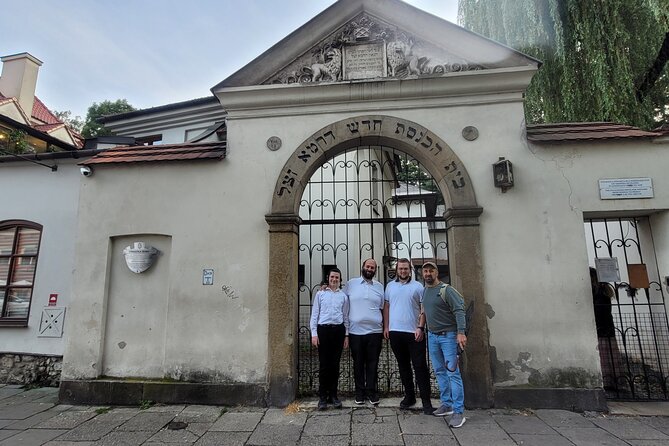
The walk begins at Szeroka 6, in the heart of Kazimierz. This street is identified as the oldest part of Krakow’s Jewish Quarter, making it a sensible place to begin rather than starting with the wartime story.
Your guide can give shape to what may otherwise look like a collection of attractive old buildings. The important point is that Kazimierz was not simply a scenic neighborhood. Its synagogues and meeting places reflect Jewish religious and community life over many centuries.
You spend about 10 minutes on Szeroka Street. That is enough for an introduction and orientation, but not enough for a long lecture. I see this as a strength if you want a brisk walking tour, though you may want extra time in the quarter before or after the experience.
The starting point is in central Kazimierz and close to public transportation. You should arrive ready to walk, since the tour does not return to its starting point. It finishes across the river in the former ghetto area.
More Jewish heritage tours in Krakow:
- Krakow: Schindler’s Factory & Ghetto Guided Tour
★ 4.7 · 1,694 reviews - Krakow: Jewish Quarter and Former Ghetto Tour
★ 4.9 · 1,441 reviews - Krakow: Bike Tour of Old Town, Jewish Quarter and the Ghetto
★ 4.9 · 1,155 reviews
Five synagogues, but mostly from the street
The first part of the route concentrates on synagogues. This gives you a useful sense of how tightly religious buildings are grouped in Kazimierz, while also making clear what the tour does and does not include.
Remuh Synagogue
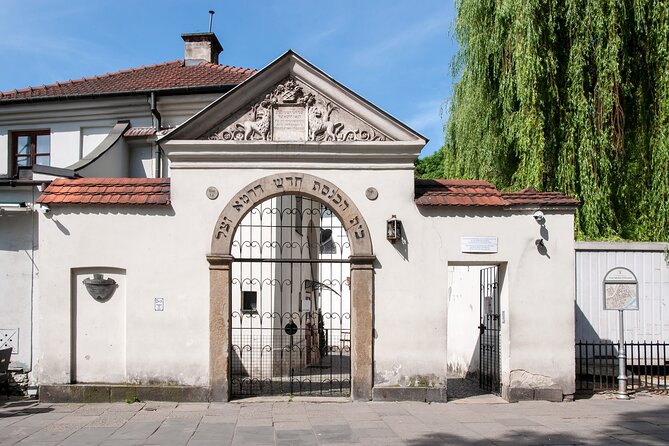
The 16th-century Remuh Synagogue receives about 15 minutes, viewed from outside. Its age makes it one of the key stops on the walk, and the guide’s explanation is the main reason to pause here.
Do not book this experience expecting an interior visit. Admission is not listed as part of the tour, and the itinerary specifically describes the synagogue from outside. If entering a synagogue is important to you, plan a separate visit and check opening arrangements before you go.
The Old Synagogue
The Old Synagogue also appears as an exterior stop, with about 10 minutes set aside. Its place on the route helps show the scale and variety of Jewish religious life in the quarter.
The short visit works well as part of a larger walking story. It is less useful if you want detailed architectural study, extended quiet time, or a museum-style explanation inside the building.
A few more in Krakow
- From Krakow: Auschwitz-Birkenau Guided Tour & Hotel Pickup
★ 4.5 · 33,358 reviews - From Krakow: Auschwitz-Birkenau Guided Tour & Hotel Pickup
★ 4.5 · 29,340 reviews - Krakow: Auschwitz Guided Tour with Optional Hotel Pickup
★ 4.5 · 15,280 reviews - Krakow–Zakopane: Cable Car, Chocholow Baths, Cheese & Vodka
★ 5.0 · 10,720 reviews
Wolf Popper Synagogue
The 16th-century Wolf Popper Synagogue is given about five minutes. That is a quick look, but it keeps the tour moving and lets you compare several religious buildings within a small area.
The 19th-century synagogue and the High Synagogue
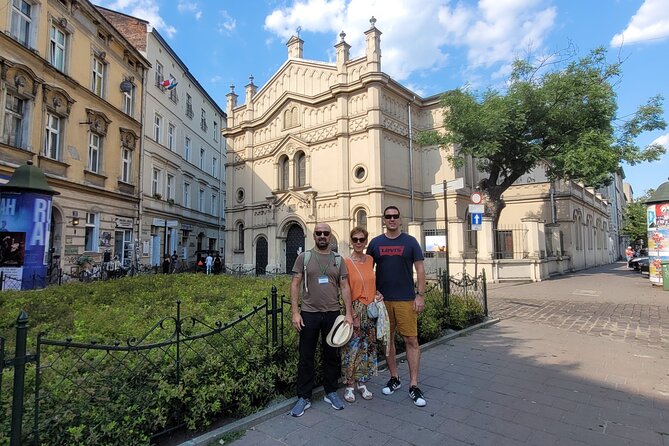
The route also pauses outside a 19th-century synagogue for 10 minutes, followed by about five minutes at the High Synagogue. The supplied details do not identify the 19th-century building by name, so you should not expect a tightly focused architectural tour of one single monument.
The High Synagogue is another exterior stop. Together, these visits give you a broad introduction rather than a long examination of individual interiors.
Izzak Synagogue
The 17th-century Izzak Synagogue receives about five minutes. By this point, the repeated exterior visits may feel fast, but the pattern helps you understand how many places of worship once served the local community.
I like this concentration of stops because it prevents the tour from becoming only a Holocaust memorial walk. You see evidence of Jewish life before the war, which matters when you later reach the ghetto. The drawback is simple: people seeking full access to the buildings will need more time on their own.
Jan Karski and the human cost of the story
A statue of Jan Karski receives about five minutes. He is remembered here as the man who tried to stop the Holocaust, a description that gives the stop a clear moral and human focus.
The statue is not treated as a decorative pause. It points toward the choices, warnings, and limits faced by people who knew what was happening and tried to respond. Five minutes will not cover every detail of Karski’s life, but it gives your guide a chance to connect one individual with the larger wartime story.
This is one of the more useful stops for anyone who wants the tour to move beyond buildings. The synagogues show community life. Karski’s statue brings the story down to one person.
Plac Nowy and the everyday center of Kazimierz
The walk continues to Plac Nowy, described as a former center of trade for Krakow’s Jewish community. You spend about 10 minutes here.
A market square can be easy to treat as scenery, but this stop helps you picture the quarter as a working neighborhood. Trade, food, daily errands, and social contact all belonged to community life, just as worship did.
The information provided does not promise a food tasting or market activity, so you should think of Plac Nowy as a historical stop, not a separate culinary experience. The guide’s commentary is what turns the square into part of the story.
This is also a good point to notice the contrast within Kazimierz. The area can feel lively and modern today, but the tour asks you to look for the older Jewish community that shaped it.
JCC Krakow and the continuing community
The route pauses for about five minutes at JCC Krakow, the Krakow Jewish Community Center. This stop brings the story into the present.
After several historic synagogues and wartime sites, the community center reminds you that Jewish life in Krakow is not only a subject from the past. The stop is brief, so it will not provide a full visit or program at the center, but it adds an important modern reference point.
I appreciate this inclusion because a tour focused only on destruction can leave you with an incomplete picture. A current community center signals continuity, even within a walk that also deals with loss.
Crossing into the former Krakow Ghetto
The second part of the tour shifts from Kazimierz to the former Krakow Ghetto. The end point is Plac Bohaterów Getta, also called Ghetto Heroes Square, at Plac Bohaterów Getta 30-527 Krakow.
This change in setting matters. The earlier stops concern community institutions and daily life. The ghetto sites show the system of forced confinement and persecution imposed during the Nazi occupation.
The tour does not present these places as isolated memorials. It links the ghetto to the neighborhood you have just walked through, helping you understand the change from an established community to a controlled and persecuted population.
Eagle Pharmacy from outside
The Eagle Pharmacy in the Krakow Ghetto receives about 10 minutes, viewed from outside. This is one of the more specific wartime stops on the route.
Because the visit is exterior only, you should not assume that an interior museum admission is included. One review connected with this experience gives a practical warning about a museum where queues can extend around the block, so if you plan a separate museum visit, book ahead rather than relying on a spare hour.
That advice is especially important because the walking tour itself lasts only about two hours. You may have time to add another visit, but you should plan it as a separate activity and allow for lines.
Plac Bohaterów Getta and the empty chairs
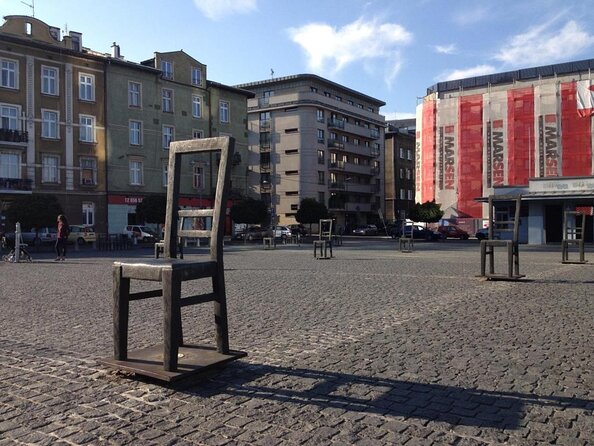
The tour ends at Plac Bohaterów Getta, the main square of the Krakow Ghetto, with about 10 minutes at the site. This is the emotional center of the second half of the walk.
The square is a place for slowing down and listening. Your guide’s explanation can help you understand why this location mattered, rather than leaving you to guess from the memorial alone.
Ending here is practical as well as meaningful. You do not have to retrace the route to Kazimierz, and the square is connected to public transportation. If you want to continue exploring afterward, you can make your own plans from this point.
The remaining ghetto wall
The final listed stop is a fragment of the Krakow Ghetto wall, visited for about five minutes. It is a small physical remnant, but that is precisely why it can be effective. A surviving section makes the former boundary concrete.
Five minutes is enough to see the fragment and hear its significance. It is not enough for a long discussion, so your guide will need to keep the explanation focused.
This stop also reinforces the value of having a guide. Without context, a section of wall can look like an ordinary old structure. With context, it becomes evidence of how the ghetto was marked and contained.
What $60.21 buys you
At $60.21 per person, this is not the cheapest way to walk around Kazimierz. The value rests in the guide service, the compact route, and the small group limit of 10 people.
You are paying for a planned connection between sites that are easy to visit separately but harder to understand as one story. You also avoid the uncertainty of finding each synagogue, memorial, and ghetto remnant on your own.
The price is easier to justify if you want commentary in English and prefer a structured introduction. It is harder to justify if you are happy to read signs, use a map, and visit interiors independently.
Admission tickets are not included, and gratuities are optional. Since nearly all listed stops are free or exterior visits, the cost is mainly for the guide rather than entry fees.
The experience has a rating of 5 out of 5 from 12 reviews, with 100 percent recommending it. That is a strong result, though the sample is small. I would treat it as encouraging evidence of a well-received walk, not a reason to skip checking the route and exterior-only details.
Group size, pace, and practical planning
A maximum of 10 people is one of the tour’s best features. A guide can usually keep a small group together more easily, and you have a better chance to hear explanations and ask a short question.
The tour lasts about two hours. That makes it a useful first introduction, especially if your Krakow schedule is full. It also means you should not expect every stop to receive equal attention. Five-minute pauses are designed for orientation, not extended study.
Wear comfortable shoes and plan for a city walk, though the supplied details do not give a precise distance or terrain description. The tour starts at Szeroka 6 and ends at Plac Bohaterów Getta, so arrange your day around a one-way route.
Confirmation arrives at booking, and a mobile ticket is provided. The experience is offered in English. Most people can participate, and the meeting area is near public transportation.
Free cancellation is available until 24 hours before the start time. Cancellations or changes made less than 24 hours ahead are not accepted for a refund. The experience also requires a minimum number of participants, and if that minimum is not met, you are offered another date or experience, or a full refund.
Who should choose this Krakow Jewish District tour?
I would choose this walk if you want a clear introduction to Kazimierz and the former ghetto without spending a full day on museums. It suits anyone who values context, prefers a small group, and wants an English-speaking guide to connect the sites.
It is also a good fit if you have limited time in Krakow. The route covers many significant places in two hours, then leaves you at a useful location for continuing your sightseeing.
You may want a different plan if your main goal is entering historic synagogues or spending long periods inside museums. The tour includes several buildings only from outside, and the listed price does not include admissions.
The experience is also best for people prepared for a serious subject. The route moves from religious community life to Holocaust history, so it is not a light sightseeing stroll. The guide commentary is central to making that transition understandable.
Should you book it?
Book this tour if you want a focused, small-group introduction to Krakow’s Jewish Quarter and former ghetto, especially if you are visiting the city for the first time. The route is thoughtfully arranged, the group is capped at 10, and the ending at Plac Bohaterów Getta saves you from walking back.
I would book it with realistic expectations. You are buying a guided outdoor walk, not a package of synagogue and museum admissions. If you pair it with a separately planned interior visit, especially one with possible queues, the experience can give you both a useful overview and time for deeper study.
FAQ
How long does the Krakow Jewish District and Ghetto Guided Tour last?
The tour lasts approximately two hours.
What language is the tour offered in?
The tour is offered in English.
How large is the tour group?
The group has a maximum of 10 participants.
Where does the tour begin?
The tour begins at Szeroka 6, 31-053 Krakow, Poland.
Where does the tour end?
The tour ends at Plac Bohaterów Getta, also called Square of Ghetto Heroes, at Plac Bohaterów Getta, 30-527 Krakow.
Are synagogue admission tickets included?
No. The listed synagogue stops are described as visits from outside, and admission tickets are not included.
Can I cancel for a full refund?
Yes. You can cancel up to 24 hours before the experience start time for a full refund. Changes or cancellations made less than 24 hours before the start time are not accepted for a refund.
Just added in Krakow
- Auschwitz-Birkenau – Skip the Line Tickets★ 3.5 · 29 reviews
- Auschwitz-Birkenau: Fast-Track Ticket & Guided Tour No Transfers★ 3.5 · 17 reviews
- Zakopane & Sleigh Ride with Bonfire – Group Tour from Kraków★ 5.0 · 2 reviews
- Sleigh Ride & Bonfire in Zakopane with Funicular – Private Trip★ 5.0 · 48 reviews
- Thermal Baths & Zakopane – Private Trip from Krakow★ 5.0 · 1 review
- Zakopane & Gubalowka Funicular – Private Winter Tour from Krakow★ 5.0 · 10 reviews
- Divine Mercy Sanctuary – Private Tour from Krakow★ 5.0 · 4 reviews
- stag dog chase Krakow prank★ 5.0 · 4 reviews