
REVIEW · JEWISH QUARTER TOURS
Krakow: Guided Tour of the Jewish Ghetto
The chairs tell the story. This one-hour walk through Kraków’s former Jewish Ghetto turns quiet streets into a clear, human account of wartime fear, courage, and loss. I like the surviving ghetto wall and the powerful Chair Memorial at Ghetto Heroes Square. The main drawback is the short length, since this serious subject can feel compressed.
I also like the low $15 price, which makes a guided introduction easy to fit into a Kraków visit. The meeting point at Schindler Factory Museum is useful if you are already exploring Podgórze, but you should allow time to find the guide holding an excursions.city sign.
In This Review
- Key points to know before you go
- Why Podgórze changes the way you see Kraków
- Following the ghetto streets in Podgórze
- The surviving section of the original ghetto wall
- Ghetto Heroes Square and the empty chairs
- Under the Eagle Pharmacy and Tadeusz Pankiewicz
- What a one-hour tour can and cannot do
- Guide languages and the value of a live explanation
- Is $15 a fair price for this Kraków walk?
- Who should book this experience?
- Practical tips for a more meaningful visit
- Should you book the Jewish Ghetto tour?
- FAQ
- Where does the tour meet?
- How long does the tour last?
- How much does the tour cost?
- Which languages are available?
- What sites are included?
- Is a professional guide included?
- Is food or drink included?
- Can I cancel for a full refund?
- Do I have to pay when I reserve?
- Is the tour focused on World War II history?
Key points to know before you go
- The original ghetto wall survives in fragments, giving you a direct link to the boundaries that confined more than 15,000 people.
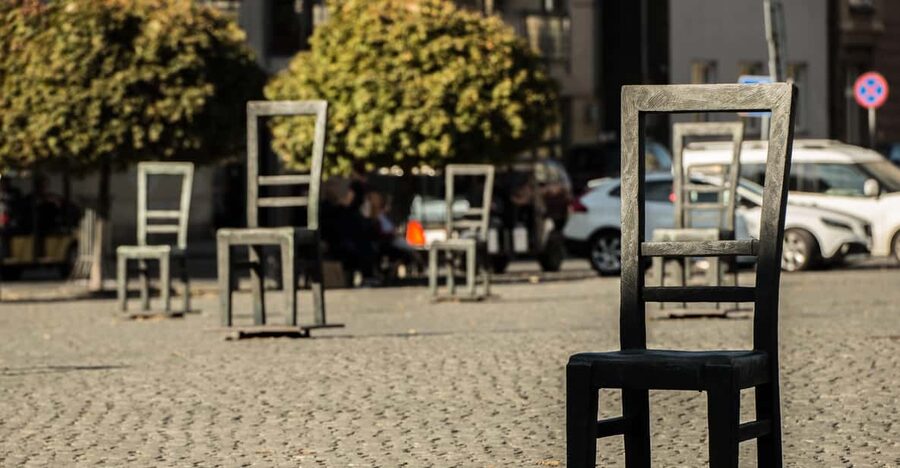
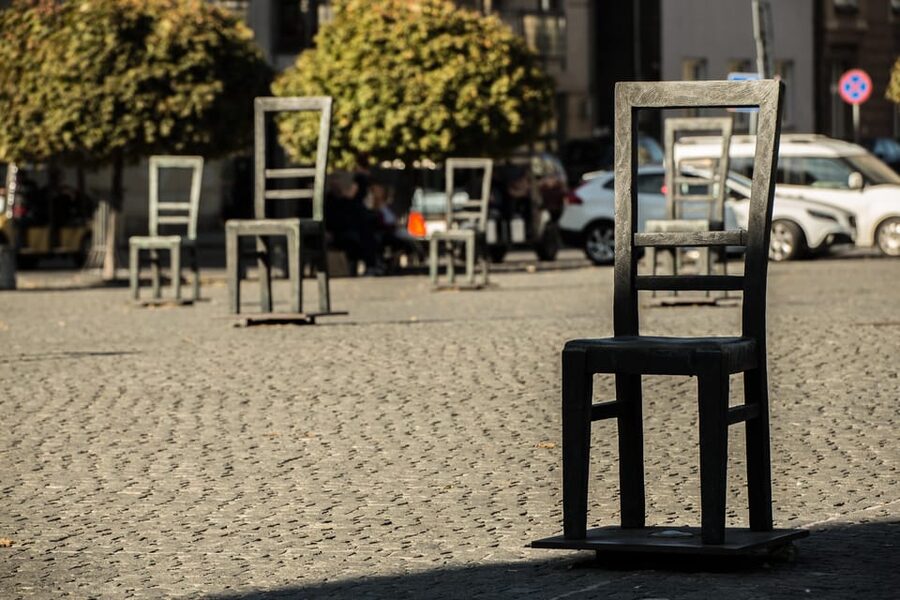
- Ghetto Heroes Square is the emotional center, with empty metal chairs representing people lost during the Holocaust.
- Under the Eagle Pharmacy recalls practical acts of courage, including the work of pharmacist Tadeusz Pankiewicz and his staff.
- The tour uses real streets and wartime buildings, so the setting itself helps explain daily life inside the ghetto.
- A professional live guide leads the walk in English, German, Italian, French, or Spanish.
- At $15 for one hour, this is a good-value orientation, though you may want more time afterward for museums and further reflection.
Why Podgórze changes the way you see Kraków
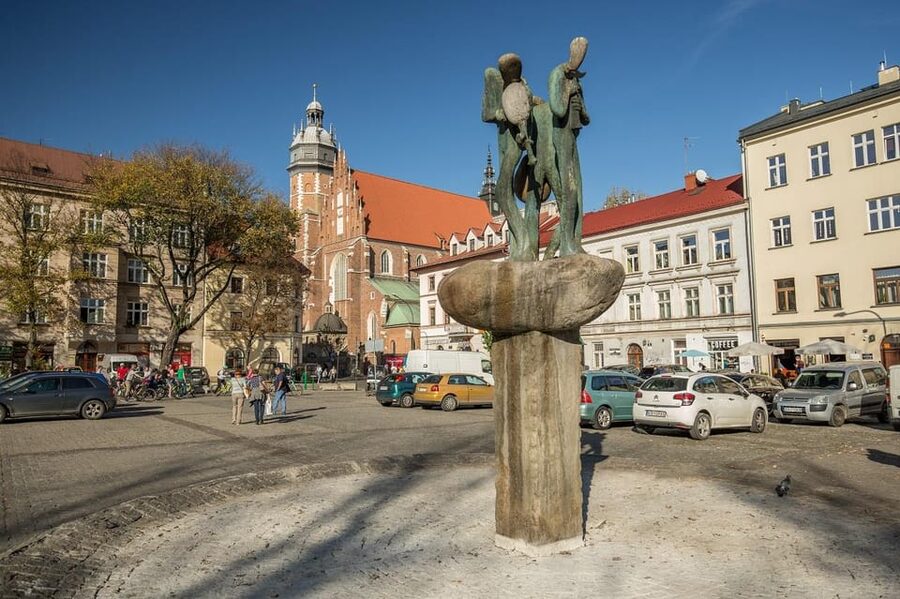
Many first-time visitors focus on Kraków’s Old Town, Wawel Castle, and the former Jewish district of Kazimierz. Those places matter, but the former ghetto lies across the river in Podgórze, where the wartime story becomes more immediate.
You are not simply hearing about distant events in a display case. You are walking along the streets where people were forced to live, work, wait, hide, and face deportation. The streets are quiet now, which can make the subject feel even heavier. Your guide helps connect the present-day setting with the fear and uncertainty of the years under Nazi occupation.
The walk is especially useful if you want a clear introduction before visiting other Kraków sites connected with World War II. It gives you the basic geography and human story without requiring a long museum visit. At the same time, the hour moves quickly. I would treat it as a focused historical walk, not a complete study of the Kraków Ghetto.
The tour begins at the entrance to Schindler Factory Museum. Look for a guide with an excursions.city sign. This detail matters because the museum entrance can be a busy meeting area, and you do not want to lose part of a one-hour tour searching for the group.
More Jewish heritage tours in Krakow:
- Krakow: Schindler’s Factory & Ghetto Guided Tour
★ 4.7 · 1,694 reviews - Krakow: Jewish Quarter and Former Ghetto Tour
★ 4.9 · 1,441 reviews - Krakow: Bike Tour of Old Town, Jewish Quarter and the Ghetto
★ 4.9 · 1,155 reviews
Following the ghetto streets in Podgórze
The first part of the walk introduces Podgórze as the area chosen for the Kraków Ghetto during World War II. Your guide explains how the ghetto’s boundaries shaped daily life and how thousands of people were confined within only a few city blocks.
The value of this section is its use of place. A map can show a boundary, but walking through the streets gives you a better sense of how close and restricted the area was. You can look at the street layout and wartime buildings while listening to the stories of those who lived there.
The guide also covers more than dates and official decisions. You learn about daily hardship, fear, hope, and survival. The tour’s strongest feature is this human scale. It asks you to consider what it meant to live under constant pressure, with family life and ordinary routines disrupted by persecution and deportation.
You may find this part emotionally demanding. That is not a flaw, but it is worth knowing before you book. This is not a light sightseeing stroll with a few historical facts added. The subject includes displacement, deportation, concentration camps, and the loss of lives. Go at a pace that allows you to listen rather than rush from stop to stop.
The surviving section of the original ghetto wall
One of the most important stops is a remaining fragment of the original Ghetto Wall. Only parts of the wall survive, which makes the site especially significant. The fragment is not grand or polished. Its power comes from what it represents.
The wall once enclosed more than 15,000 people in a small area. Your guide explains the hardship created by that confinement and the acts of solidarity that took place within the ghetto. This is where the physical setting and the historical account work together best.
I appreciate that the stop does not rely only on a dramatic monument. An ordinary-looking piece of masonry can carry a great deal of meaning when you understand its purpose. You can see how a boundary was used to control people, separate families from the rest of the city, and turn a neighborhood into a place of enforced confinement.
Because the wall is only a surviving fragment, your expectations should be realistic. You are not visiting a complete preserved fortification. The guide’s explanation supplies the missing context, so this stop is much more meaningful with the tour than it would be as an independent photo stop.
Ghetto Heroes Square and the empty chairs
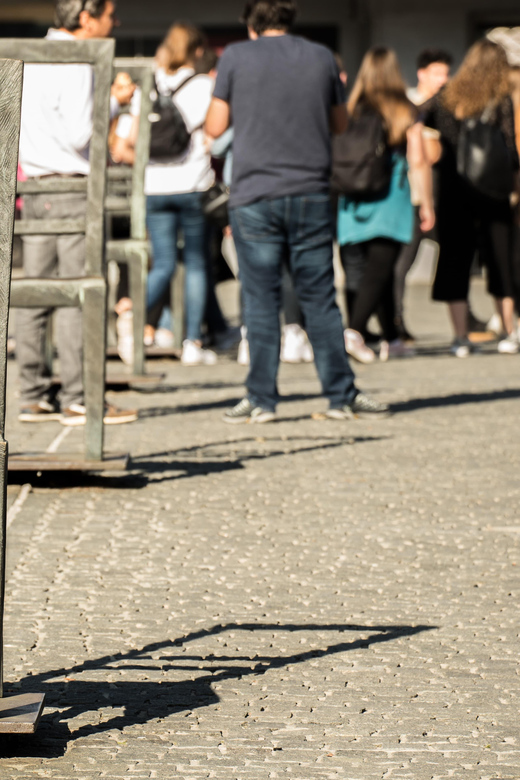
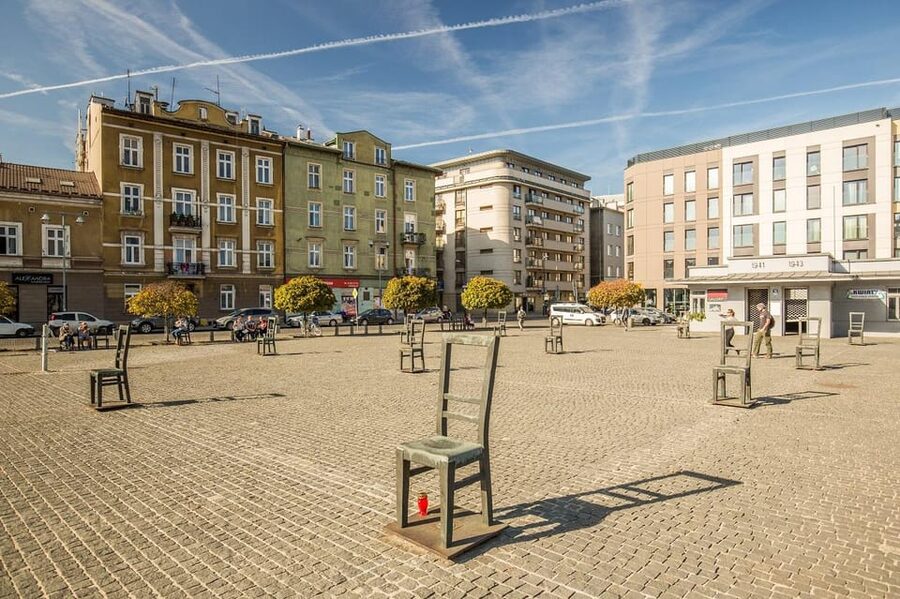
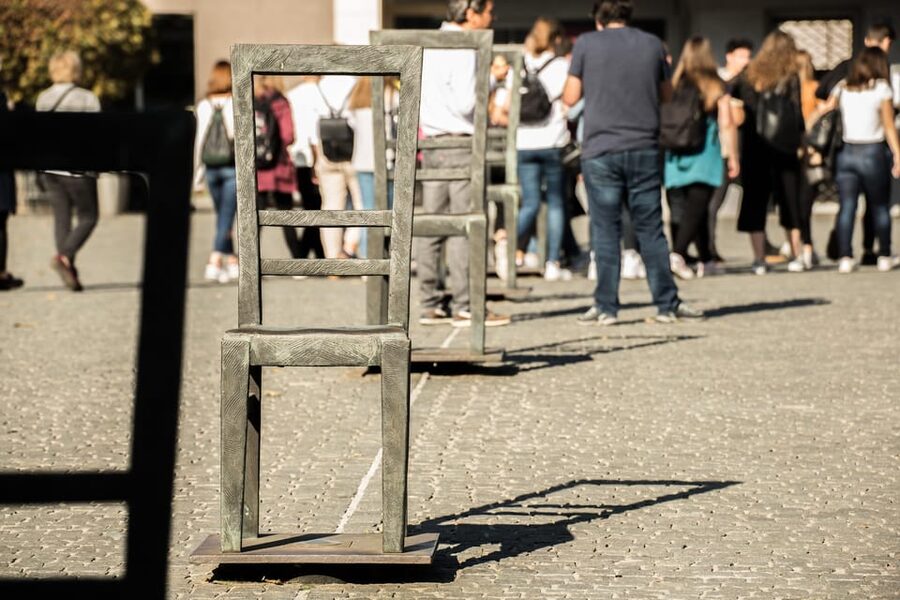
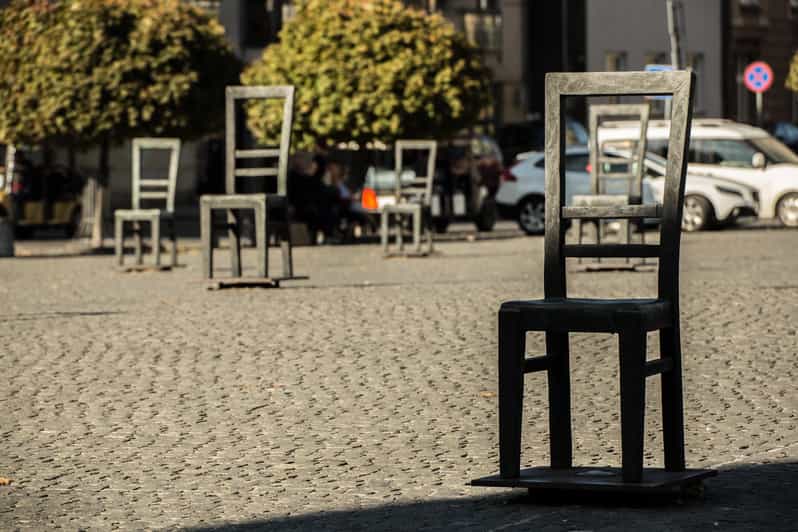
The walk then reaches Ghetto Heroes Square, the emotional center of the route. During the war, the square was linked with deportations to concentration camps. Today, it is marked by rows of empty metal chairs.
The chairs are simple, but the idea is hard to forget. They represent the people who were taken from the ghetto and the belongings left behind. Instead of filling the square with a large statue or a long inscription, the memorial uses absence. The empty seats make you think about homes emptied, families separated, and lives interrupted.
This is likely the tour’s most memorable stop. Your guide gives the square its historical meaning, then allows time for reflection. You should not expect a long formal ceremony, but the layout invites you to pause and take in what happened here.
The square also helps explain why a guided walk is worthwhile. Without context, the chairs might look like an unusual piece of public art. With the story of the deportations, they become a direct reminder of the people who once occupied this place.
Bring a respectful attitude. Photography may be possible, but this is a memorial rather than a casual sightseeing backdrop. A quiet pause is often more appropriate than trying to rush through for a quick picture.
A few more in Krakow
- From Krakow: Auschwitz-Birkenau Guided Tour & Hotel Pickup
★ 4.5 · 33,358 reviews - From Krakow: Auschwitz-Birkenau Guided Tour & Hotel Pickup
★ 4.5 · 29,340 reviews - Krakow: Auschwitz Guided Tour with Optional Hotel Pickup
★ 4.5 · 15,280 reviews - Krakow–Zakopane: Cable Car, Chocholow Baths, Cheese & Vodka
★ 5.0 · 10,720 reviews
Under the Eagle Pharmacy and Tadeusz Pankiewicz
Across from the square is the historic Under the Eagle Pharmacy. Its story adds an important layer to the tour because it focuses on help and courage amid terrible conditions.
Tadeusz Pankiewicz and his staff risked their lives to assist people in the ghetto. The pharmacy provided medicine and shelter, and it became a place where compassion had practical value. This was not abstract sympathy. It involved helping people when doing so could bring serious danger.
I like this stop because it keeps the history from becoming only a record of suffering. The ghetto story includes cruelty and loss, but it also includes people who chose to help others. The pharmacy gives your guide a way to discuss courage through specific actions: providing medicine, offering refuge, and supporting people trapped by the occupation.
The tour does not include food or drink, and the pharmacy is presented as a historical stop within the walk. If you want a fuller visit to the museum spaces connected with this story, check what is included in your separate plans. This one-hour experience focuses on the outside route, the local setting, and the guide’s explanation.
What a one-hour tour can and cannot do
One hour is enough to cover the main landmarks at a steady pace. You will see the surviving wall, Ghetto Heroes Square, the Chair Memorial, Under the Eagle Pharmacy, and authentic wartime buildings and street layouts. You will also receive an outline of daily life, deportations, survival, and acts of courage.
The tradeoff is depth. A longer tour could spend more time on individual stories, questions, and the wider history of Kraków’s Jewish community. Here, the guide must keep moving so the main stops fit into the schedule.
That short format can be an advantage. If you are fitting several Kraków sights into one day, this walk gives you a focused experience without taking half a day. It also works well as a first visit to Podgórze. You can decide afterward if you want to return for more time at the area’s museums and memorials.
I would avoid booking this as a rushed activity between unrelated appointments. The route deals with painful events, and you will get more from it if you have a little breathing room before and after. The final moment of reflection is part of the experience, not wasted time.
Guide languages and the value of a live explanation
A professional live guide leads the tour in English, German, Italian, French, or Spanish. That choice is important on a historical walk because the meaning depends on more than seeing the sites.
The guide explains why the wall mattered, what happened in the square, and how the pharmacy became a place of assistance. A good explanation can also help you read the present-day streets, which otherwise might look like ordinary parts of Kraków.
The available feedback points to strong guide performance. One person specifically praised a guide as fantastic and noted that he offered a useful recommendation for a rugby bar during a tournament visit. That small detail suggests a guide willing to respond to the person in front of him, not simply recite a fixed script. Another five-star comment praised the personal nature of the tour, while a four-star rating offered no useful written detail.
There is no guide name provided, so you should not expect to request a particular person. The experience may feel different depending on the guide and language, but the supplied feedback gives the strongest praise to the personal, friendly delivery.
Is $15 a fair price for this Kraków walk?
At $15 per person, the tour offers good value if you want orientation and historical context. You are paying for a professional guide who links several important Podgórze sites in a compact route. The cost is modest compared with a longer museum visit or private tour.
The price is especially fair for first-time visitors who might otherwise walk past the wall or misunderstand the memorial chairs. The guide turns separate locations into one connected story. That connection is the main thing you are buying.
Still, value depends on your goals. If you already know the history of the Kraków Ghetto and plan to spend several hours studying the area, this may feel basic. If you want a detailed museum experience, the short route cannot provide it.
The best approach is to see the walk as a starting point. Pay $15 to understand the geography and main stories, then decide if you want to spend more time at related sites. For many visitors, that is a sensible use of one hour in Kraków.
Who should book this experience?
I recommend this tour for first-time visitors to Kraków who want to understand Podgórze without arranging a complicated route on their own. It also suits anyone interested in World War II history, Holocaust memorials, or the way ordinary streets can preserve difficult memories.
The tour is a good fit if you prefer a guide’s explanation to reading signs on your own. It can also work well for couples, families with older children, and visitors who want a serious activity that does not fill an entire day.
You may want to skip it if you are looking for entertainment, shopping, food, or a relaxed scenic walk. The subject is painful, and the experience asks for attention and respect. The short length also means you should not book it expecting a full tour of every wartime site in Kraków.
The free cancellation option until 24 hours before the start gives you some flexibility, and you can reserve now and pay later. Those terms are useful if your Kraków schedule is still changing, but the historical content remains the main reason to book.
Practical tips for a more meaningful visit
Arrive at the entrance to Schindler Factory Museum with enough time to identify the guide holding the excursions.city sign. The meeting point is specific, but a few extra minutes can prevent a stressful start.
Choose the language that lets you follow emotional and historical detail most easily. English, German, Italian, French, and Spanish are available, so listen for the option that suits you when checking times.
Wear comfortable shoes suitable for a one-hour city walk. The route uses streets and public spaces rather than a single indoor venue, and you will get more from it if you are not distracted by discomfort.
Keep the schedule open for a short pause afterward. The tour finishes with reflection, and Ghetto Heroes Square is not a place you will necessarily want to leave in a hurry. You may also want time to visit another site in Podgórze, though no additional admission is included in this activity.
Should you book the Jewish Ghetto tour?
Book it if you want a clear, affordable introduction to Kraków’s former Jewish Ghetto and prefer to learn through real streets, memorials, and personal stories. The wall, the empty chairs in Ghetto Heroes Square, and Under the Eagle Pharmacy give the hour a strong structure.
Do not book it expecting a long museum program or an exhaustive account of wartime Kraków. This is a compact walking tour. Its value comes from the guide’s ability to connect a few powerful places and help you understand what you are seeing.
For $15, that is a worthwhile trade. You get a focused route, a live guide, and a respectful look at one of Kraków’s most important historical areas. Plan to listen carefully, leave room for reflection, and consider adding more time in Podgórze if the subject calls for it.
FAQ
Where does the tour meet?
The meeting point is at the entrance to the Schindler Factory Museum in Podgórze. Look for a guide holding an excursions.city sign.
How long does the tour last?
The tour lasts one hour.
How much does the tour cost?
The listed price is $15 per person.
Which languages are available?
The live tour guide can lead the experience in English, German, Italian, French, or Spanish.
What sites are included?
The route includes the remains of the original Ghetto Wall, Ghetto Heroes Square, the Chair Memorial, Under the Eagle Pharmacy, and authentic wartime buildings and street layouts.
Is a professional guide included?
Yes. A professional guide is included.
Is food or drink included?
No. Food and drink are not included.
Can I cancel for a full refund?
Yes. You can cancel up to 24 hours in advance for a full refund.
Do I have to pay when I reserve?
No. The reserve now and pay later option lets you book your place without paying at the time of reservation.
Is the tour focused on World War II history?
Yes. The tour explains daily life in the Kraków Ghetto, deportations, survival, acts of solidarity, and the bravery connected with Under the Eagle Pharmacy.
Just added in Krakow
- Auschwitz-Birkenau – Skip the Line Tickets★ 3.5 · 29 reviews
- Auschwitz-Birkenau: Fast-Track Ticket & Guided Tour No Transfers★ 3.5 · 17 reviews
- Zakopane & Sleigh Ride with Bonfire – Group Tour from Kraków★ 5.0 · 2 reviews
- Sleigh Ride & Bonfire in Zakopane with Funicular – Private Trip★ 5.0 · 48 reviews
- Thermal Baths & Zakopane – Private Trip from Krakow★ 5.0 · 1 review
- Zakopane & Gubalowka Funicular – Private Winter Tour from Krakow★ 5.0 · 10 reviews
- Divine Mercy Sanctuary – Private Tour from Krakow★ 5.0 · 4 reviews
- stag dog chase Krakow prank★ 5.0 · 4 reviews