
REVIEW · JEWISH QUARTER TOURS
Golf Cart Group Tour via Old Town, Jewish Kazimierz and Ghetto
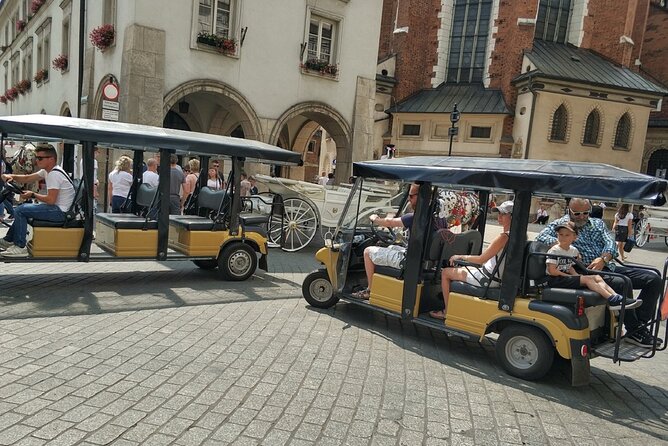
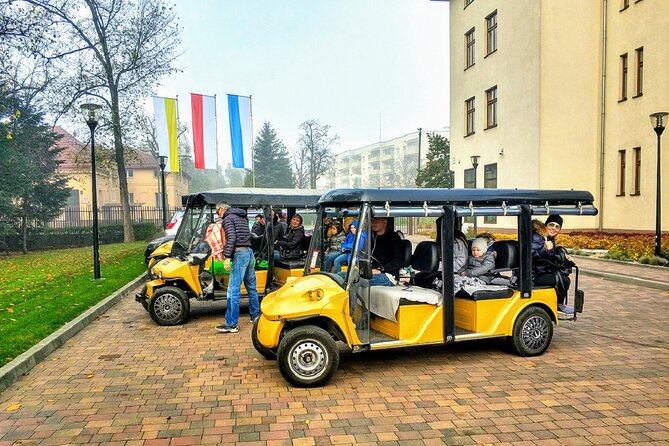
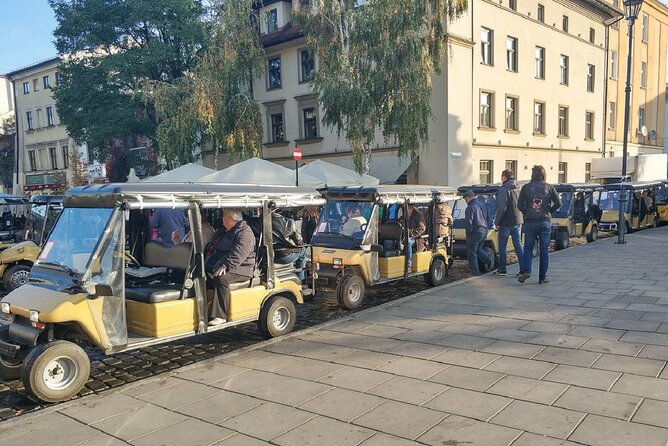
See Krakow’s hardest-to-cover sights quickly. This 2.5-hour electric golf cart tour links the Old Town, Jewish Kazimierz, and the former Krakow Ghetto, using narrow streets that larger vehicles cannot reach. I like the efficient route and the chance to rest your feet while an audio system and guide provide historical context. The main drawback is that a group of up to 50 people can feel less personal than a walking tour.
I also like the thoughtful mix of grand landmarks and difficult places, from St. Mary’s Basilica and the Cloth Hall to the ghetto wall and Pharmacy Under the Eagle. At $52.14 per person, it offers fair value if you want a broad first look at Krakow, but it is less suitable if you want long, quiet visits inside museums or synagogues.
In This Review
- Key points to know before booking
- Why an electric cart works well in Krakow
- The Main Market Square gives you Krakow at a glance
- The Cloth Hall and Town Hall Tower
- St. Mary’s Basilica and the bugle call
- From the Słowacki Theatre to the Barbican
- Jewish Kazimierz, where several centuries meet
- Tempel Synagogue and Szeroka Street
- The Old Synagogue and Remuh Synagogue
- Crossing into Podgórze and the former ghetto
- The remaining ghetto wall
- Ghetto Heroes Square
- Pharmacy Under the Eagle and Schindler’s Factory
- What the $52.14 price really buys you
- Group size, timing, and comfort
- Who should choose this Krakow tour?
- Should you book the electric cart tour?
- FAQ
- How long does the golf cart tour last?
- Where does the tour begin?
- Where does the tour end?
- Is this a private tour?
- What kind of vehicle is used?
- Can children join the tour?
- Can I bring large luggage?
- What is the cancellation policy?
Key points to know before booking
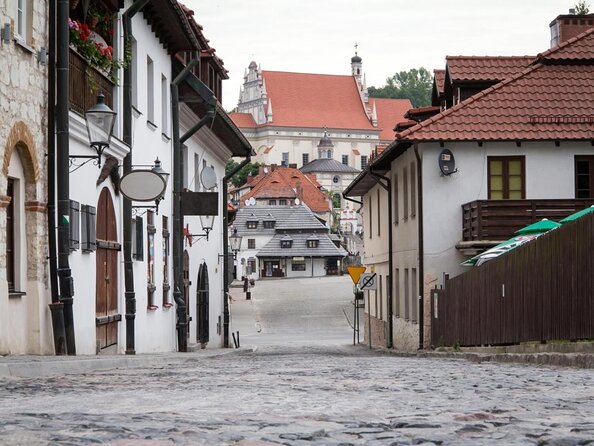
- Three major Krakow districts in one ride: See the medieval Old Town, Jewish Kazimierz, and Podgórze, the district that became the Krakow Ghetto in 1941.
- A practical answer to Krakow’s narrow streets: The small electric vehicle can move through areas where public transport is restricted or unavailable.
- History with an audio system and live staff: The ride combines recorded information with drivers and guides who received especially warm praise for their help.
- A serious final section: The route reaches the former ghetto wall, Ghetto Heroes Square, Pharmacy Under the Eagle, and Oskar Schindler’s Factory area.
- Group size matters: The vehicle can carry up to 50 people, so expect a shared outing rather than a private tour.
- Pack light and arrive on time: There is room for passengers to sit, but not for large baggage, and the tour leaves at its scheduled time.
Why an electric cart works well in Krakow
Krakow rewards walking, but its most interesting sights are spread across several districts. The Old Town sits north of Wawel, Kazimierz lies south of the historic center, and Podgórze is across the river. Covering that ground on foot takes time and energy, especially if you want to fit the former ghetto into the same outing.
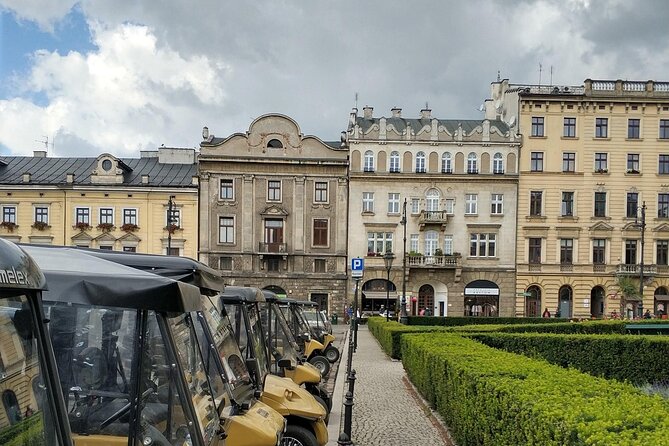
This quiet, ecological vehicle gives you a useful middle ground. You are not sealed inside a large bus, and you do not have to keep pace with a walking group. The cart can handle small streets and a closed public transport zone, which makes it practical for a first orientation.
You should think of the ride as a moving introduction, not a series of long site visits. The route lets you see many important places and hear why they matter. You may have time to look around at certain stops, but the strongest value comes from the connections between them.
The audio system is important because the cart moves through several districts in a short time. You can listen while watching the streets pass by, then return later to the places that deserve more time.
More Golf Cart Tours in Kraków
- Krakow: City Sightseeing Tour by Electric Golf Cart
★ 4.5 · 3,264 reviews - Krakow: City Sightseeing Tour Eco Electric Buggy Golf Cart
★ 4.7 · 3,143 reviews - Krakow: Extended City Sightseeing Tour – Eco Buggy Golf Cart
★ 4.7 · 794 reviews
The Main Market Square gives you Krakow at a glance
The tour begins with Krakow’s Main Market Square, the city’s great central stage. It is one of the largest medieval market squares in Europe, and it gathers several of Krakow’s best-known buildings in one open space.
This is a smart opening stop because the square helps you understand the city’s layout. The scale is impressive, but the details are what reward a slower look: churches, arcades, historic facades, cafés, and the Cloth Hall at the center.
The cart offers a useful overview, though the square is also one place where you should plan to return on foot. A vehicle cannot give you the same freedom to pause, inspect a facade, or cross the entire space at your own speed.
The Cloth Hall and Town Hall Tower
The Cloth Hall, or Sukiennice, recalls Krakow’s role as a trading center. Its Renaissance form is one of the city’s clearest visual symbols, and its position in the middle of the square makes it hard to miss.
The nearby Town Hall Tower is the only remaining part of the original city authorities’ seat. Its 70-meter height, 110 stone steps, and old executioner’s dungeons give it a darker edge than its elegant exterior suggests.
You will hear these details during the route, which helps turn familiar-looking stonework into something more meaningful. If you later visit the tower, be ready for a narrow climb rather than an easy elevator ride.
St. Mary’s Basilica and the bugle call
St. Mary’s Basilica brings together several elements of Krakow’s identity: more than eight centuries of history, a high altar by Veit Stoss, murals by Jan Matejko, and the hourly bugle call associated with the city.
The interior is not simply another grand church. The star-covered ceiling and large altar give it a strong visual focus, while the bugle tradition connects the building to daily city life.
A cart tour cannot replace time inside the basilica, but it gives you the reason to put it on your short list. If you have only one free morning in the Old Town, this is one of the places I would revisit after the ride.
More Old Town walks in Krakow:
- Old Town Krakow & Wawel Castle Walking Tour
★ 5.0 · 1,508 reviews - Krakow: Bike Tour of Old Town, Jewish Quarter and the Ghetto
★ 4.9 · 1,155 reviews - Krakow: The Old Town Walking Tour
★ 4.8 · 794 reviews - Krakow: Old Town Guided Segway Tour
★ 4.7 · 756 reviews
From the Słowacki Theatre to the Barbican
The route then moves toward the Juliusz Słowacki Theatre, one of Poland’s best-known stages. It has operated continuously since 1893, and its building is regarded as one of Europe’s finest examples of theatre architecture.
Even if you are not planning to attend a performance, the exterior adds variety to the route. Krakow is not only medieval churches and royal buildings. Its later cultural life also has a place in the city center.
The Barbican provides a sharp change of mood. This round defensive structure is one of Krakow’s most striking pieces of medieval military architecture. It was never captured during a siege, and local legend credits its defenders with repelling an attacking force with a single shot.
The tour is especially useful here because it shows how the Barbican related to the old defenses. You get the broad picture without having to work out the city walls by yourself.
Jewish Kazimierz, where several centuries meet
Kazimierz was once an independent town south of Wawel and later became the center of Jewish life in Krakow. Today, it is one of the city’s best-known districts, but its importance is not just about restaurants, film locations, or nightlife.
The route helps you see Kazimierz as a historic Jewish quarter with surviving religious buildings and public spaces. I like this portion because it adds human scale to the grand opening in the Main Market Square.
The district deserves time on foot later. From the cart, you will get the structure and main landmarks. Walking afterward lets you notice smaller details along Szeroka Street and compare the different synagogue buildings.
Tempel Synagogue and Szeroka Street
Tempel Synagogue is noted for its well-preserved stained-glass windows and its non-Orthodox character. Those points matter because they show that Jewish life in Krakow was not one uniform tradition.
Szeroka Street forms the heart of Jewish Kazimierz. Four synagogues once stood along the street, an unusual concentration in Europe. The street also hosts the final concert of the Jewish Culture Festival, linking its older religious role with its continuing cultural life.
You should not expect the cart to provide a long interior visit at every synagogue. Its strength is placing these buildings within the wider story of the district. If a synagogue interior is a priority, use the tour to choose where to return.
The Old Synagogue and Remuh Synagogue
The Old Synagogue on Szeroka Street is among Poland’s oldest preserved synagogues. Its good condition makes it an important stop, not only for its age but also for what it tells you about the long Jewish presence in Kazimierz.
Remuh Synagogue is the smallest of Krakow’s seven synagogues. Its decoration is more modest than the others, and after restoration completed in April 2016 it became the main prayer site for Krakow’s Jewish community.
These stops reward careful listening. The point is not to count buildings, but to understand that Kazimierz once had a dense network of worship, community, and daily life.
Crossing into Podgórze and the former ghetto
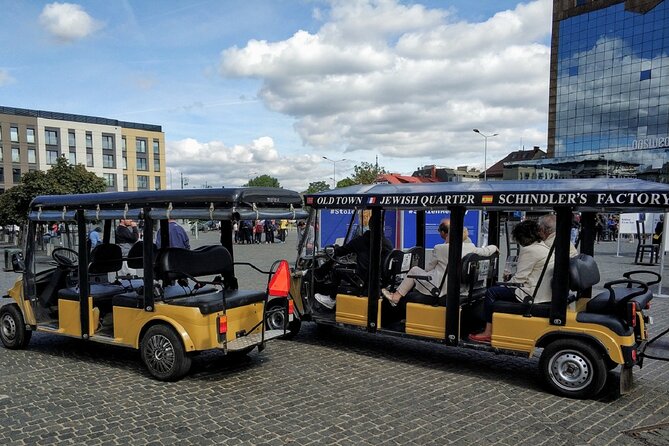
The route next reaches Podgórze, a district that was incorporated into Krakow only in the 20th century. Its parish church, St. Joseph’s, dominates Podgórze Market Square and gives the area a clear visual center.
This is where the tour becomes more solemn. In 1941, the Nazi occupation turned Podgórze into the Krakow Ghetto. The vehicle takes you from the older Jewish quarter into places connected with forced relocation, deportation, and the Holocaust.
That shift is one of the strongest reasons to choose this particular route. You are not seeing Kazimierz and the ghetto as interchangeable attractions. They are separate districts with different histories, and the journey between them helps make that distinction clear.
The remaining ghetto wall
A small piece of the original wall around the former ghetto survives, with a plaque commemorating the fate of the people who were confined there. It is a modest physical remnant, but that is part of its power. You are looking at an actual fragment of the boundary that controlled daily life.
The stop may be brief, so do not expect a full museum explanation on site. The audio commentary and guide help provide context, but you may want to return later if you need more time with the memorial.
Ghetto Heroes Square
The former Plac Zgody, now Ghetto Heroes Square, was the ghetto’s Umschlagplatz under Nazi occupation. It was the place where Jewish residents were forced to gather before deportation.
This is a difficult stop, and the route’s tone should change here. The square is not just another photo opportunity. Give yourself a quiet moment, listen carefully, and avoid rushing through it as if it were a normal sightseeing stop.
The value of arriving by cart is practical. You can reach this area without spending much of your limited Krakow time walking between districts. The tradeoff is that a shared group schedule may not allow as much personal reflection as you would prefer.
Pharmacy Under the Eagle and Schindler’s Factory
Tadeusz Pankiewicz’s pharmacy, now known as Pharmacy Under the Eagle, is closely tied to the story of Krakow’s ghetto. Pankiewicz took over his father’s pharmacy and became part of the history of the occupation in ways he could not have predicted.
This stop brings the period into everyday focus. A pharmacy is a familiar place, but here it became connected with the survival and suffering of people living under Nazi rule.
The tour also reaches the area associated with Oskar Schindler’s Factory. Its importance comes from the meeting of wartime industry, private lives, and the wider tragedy of the Second World War.
You should check what you want from this part before booking. If you want a serious museum visit at Schindler’s Factory, the cart tour is only the introduction. It can get you to the area and explain why it matters, but the museum itself requires more time than this route allows.
What the $52.14 price really buys you
At $52.14 per person, this is not the cheapest way to see Krakow. A self-guided walk costs little beyond your own time, and the Old Town is easy to explore independently.
The value improves if you want three things at once: transport between districts, live guidance, and an audio system that keeps the story moving. You are paying for convenience as much as for sightseeing.
The route also solves a practical problem. Walking from the Main Market Square through Kazimierz and into Podgórze can take a large part of a day, especially if you stop often. The cart lets you cover that ground in about two and a half hours.
The price is harder to justify if you already know Krakow well or want extended visits inside religious buildings and museums. In that case, a focused walking tour or separate museum visit may give you more depth.
Group size, timing, and comfort
This is a group tour, and the maximum group size is 50 people. That is a sizeable number for a small vehicle, so you should expect a shared experience rather than a private conversation with the guide.
The strongest practical praise goes to the drivers and guides. Their role matters because the route covers sensitive subjects as well as famous monuments. Clear explanations and careful handling of the ghetto section can make a major difference.
The tour starts at Mikołaja Zyblikiewicza 2 and ends at Mikołaja Kopernika 3. Both points are in central Krakow and near public transportation, but the start and end are different, so check your onward plans before setting out.
Arrive on time. The tour begins at a specified hour, and other people will be joining you. Bring only what you need because the vehicle has space for seated passengers, not large baggage.
Children aged 0 to 6 using the free ticket must sit on an adult’s lap while the vehicle is moving. Most people can participate, and the mobile ticket makes entry simple.
You can cancel for a full refund up to 24 hours before the start time. Cancellations or changes made within 24 hours are not accepted for a refund.
Who should choose this Krakow tour?
I would choose this ride for a first visit, a short stay, or a day when your feet need a break. It is also useful if you want to connect Krakow’s major districts before deciding where to spend more time.
Families may appreciate the seated format, though parents should remember the lap rule for children aged 0 to 6. Older visitors and anyone who finds long walks tiring may also find the route convenient.
History-minded visitors will get the most from the complete route, especially the transition from Kazimierz to Podgórze. The final section is not light sightseeing, so prepare for a serious and emotional subject.
I would hesitate to book it if your main goal is a slow synagogue tour, a detailed museum visit, or a private guide. The group can be large, and the two-and-a-half-hour schedule means the experience must keep moving.
Should you book the electric cart tour?
Book it if you want a well-planned overview of Krakow without walking every mile. The mix of Old Town landmarks, Jewish Kazimierz, and former ghetto sites gives you more range than a standard city-center ride.
The best plan is to use this tour as your orientation, then return on foot to the places that catch your attention. Keep your bag small, arrive early, and set realistic expectations about group size and visit length.
At $52.14, I consider it fair value for convenience, coverage, and historical guidance. It is not a substitute for Krakow’s museums or a thoughtful walking visit, but it is a practical way to understand how the city’s most important districts fit together.
FAQ
How long does the golf cart tour last?
The tour lasts approximately 2 hours and 30 minutes.
Where does the tour begin?
It begins at Mikołaja Zyblikiewicza 2, 31-029 Kraków, Poland.
Where does the tour end?
The tour ends at Mikołaja Kopernika 3, 31-034 Kraków, Poland.
Is this a private tour?
No. It is a group tour, and other people will participate. The maximum group size is 50 people.
What kind of vehicle is used?
The tour uses a quiet, electric vehicle with an audio system. It is designed to move through Krakow’s narrow streets and areas closed to public transport.
Can children join the tour?
Yes. Children aged 0 to 6 using the free ticket must sit on an adult’s lap while the vehicle is moving.
Can I bring large luggage?
No. Large baggage should not be brought because the vehicle has enough room for passengers to sit but not for large bags.
What is the cancellation policy?
You can cancel at least 24 hours before the start time for a full refund. Cancellations or changes made less than 24 hours before the start time are not refunded.
More Jewish Heritage Tours in Krakow
- Krakow: Schindler’s Factory & Ghetto Guided Tour
★ 4.7 · 1,694 reviews - Krakow: Jewish Quarter and Former Ghetto Tour
★ 4.9 · 1,441 reviews - Krakow: Kazimierz Jewish Quarter Walking Tour
★ 4.8 · 571 reviews - Krakow: Kazimierz, Schindler’s Factory & Ghetto Guided Tour
★ 4.8 · 460 reviews
Just added in Krakow
- Auschwitz-Birkenau – Skip the Line Tickets★ 3.5 · 29 reviews
- Auschwitz-Birkenau: Fast-Track Ticket & Guided Tour No Transfers★ 3.5 · 17 reviews
- Zakopane & Sleigh Ride with Bonfire – Group Tour from Kraków★ 5.0 · 2 reviews
- Thermal Baths & Zakopane – Private Trip from Krakow★ 5.0 · 1 review
- Zakopane & Gubalowka Funicular – Private Winter Tour from Krakow★ 5.0 · 10 reviews
- Sleigh Ride & Bonfire in Zakopane with Funicular – Private Trip★ 5.0 · 48 reviews
- Divine Mercy Sanctuary – Private Tour from Krakow★ 5.0 · 4 reviews
- stag dog chase Krakow prank★ 5.0 · 4 reviews