
REVIEW · CITY TOURS
Undercover City Games: Gdansk
Gdansk turns into your mission map. Undercover City Games makes sightseeing active, playful, and a little mischievous as you follow clues through Old Town. I like the way the game brings you to major sights such as Neptune’s Fountain and the Green Gate while also sending you toward places you might otherwise walk past. I also like the freedom to move at your own pace after the opening briefing, rather than staying beside a guide for the full 1 hour 45 minutes.
The main drawback is the clock. Some groups enjoy the competition, but others find that racing between clues can pull attention away from the architecture. You will also need to be comfortable walking on cobbled streets, and Google Maps can be very useful if your navigation skills are not sharp.
In This Review
- The key facts at a glance
- Your mission begins at the Four Quarters Fountain
- Neptune’s Fountain starts the sightseeing with a classic view
- Swan Tower adds a quieter stop to the route
- The Great Armoury makes history part of the puzzle
- The Jan III Sobieski Monument changes the pace
- The Green Gate brings the route back to a major landmark
- How the puzzles work in practice
- Who will enjoy the Gdansk game most?
- Is $26.02 per person good value?
- Practical tips for a smoother mission
- Should you book Undercover City Games: Gdansk?
- FAQ
- How long does Undercover City Games: Gdansk take?
- Where does the game start and finish?
- Which Gdansk sights are included?
- Is the game suitable for families?
- Is the experience offered in English?
- Can I cancel for a full refund?
The key facts at a glance
- You play secret agents: Your team is trapped in Gdansk and must work with a local intelligence agency to escape.
- The route covers Old Town: The game includes Neptune’s Fountain, Swan Tower, the Great Armoury, the Jan III Sobieski Monument, and the Green Gate.
- The tasks make you look closer: Clues, codes, observation challenges, and unusual details turn familiar streets into part of the puzzle.
- The game lasts about 1 hour 45 minutes: The activity begins and ends at the Four Quarters Fountain.
- It suits mixed groups: Families, friends, corporate teams, and bachelorette parties can all take part.
- The price is $26.02 per person: That is reasonable for an organized city activity with a host, a planned route, and a game built around Gdansk.
Your mission begins at the Four Quarters Fountain
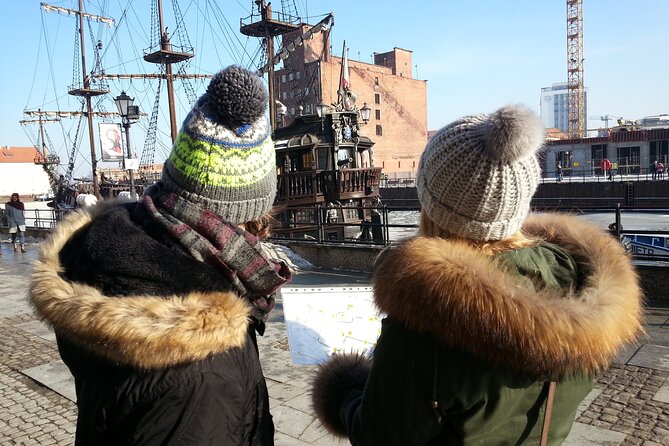
Meet at the Four Quarters Fountain on Grobla I, number 8. The opening is part briefing, part theatrical setup. You are introduced to the idea that your team is stuck in Gdansk and needs help escaping through a local intelligence agency.
The spy theme gives the group an immediate job to do. You are not simply told to admire buildings. You are given a purpose, a map, and a series of tasks. That small change matters, especially for families with children or groups who lose interest during a standard walking tour.
The host remains important at the beginning and end, but the middle of the experience is largely yours. You receive instructions and then go from point to point, solving tasks as a team. Hosts such as Alasdair, Aly, and Damian have been praised for being friendly, energetic, and quick to help when a group gets stuck.
Groups can also turn the game into a friendly contest. A party of eight can split into two teams, while a larger group of 11 can divide into three. That works well for corporate outings or groups of friends who enjoy comparing scores.
A few more in Gdansk
- Gdansk: City Cruise on Historical Polish Boat
★ 4.8 · 2,913 reviews - Gdańsk: Sunset Cruise on a Historic Polish Boat
★ 4.9 · 977 reviews - Gdańsk City Sights & History Guided Walking Tour in English
★ 4.8 · 876 reviews
Neptune’s Fountain starts the sightseeing with a classic view
Neptune’s Fountain is one of the natural starting points for a Gdansk city game. It sits in a part of Old Town filled with important buildings and plenty of visual detail, so your first task begins with an attraction that rewards close attention.
The fountain is more than a photo stop here. You need to examine your surroundings and work out what the clue is asking. That means the group starts learning the basic rhythm of the game: read, observe, discuss, and act.
This is also a useful point for getting your bearings. If Gdansk is new to you, the route gives you a quick orientation around central Old Town. Several people found that the activity helped them recognize places later during the rest of their stay. I think that is one of the strongest reasons to schedule the game early in your visit.
The only caution is that the puzzle can make you focus so hard on the assignment that you forget to look up. Give yourself a moment at each stop. Admire the fountain and surrounding façades before turning back to the clue.
Swan Tower adds a quieter stop to the route
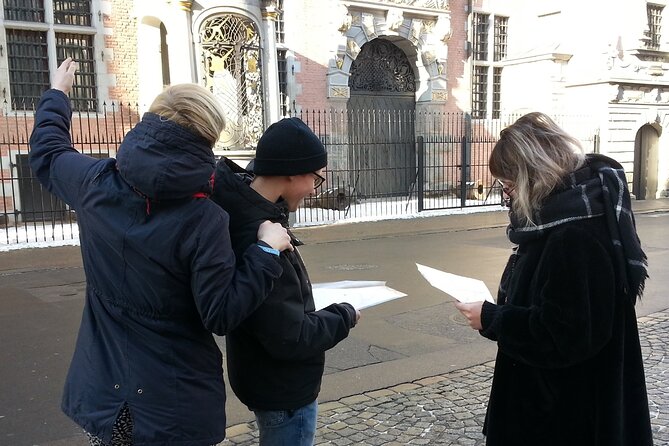
Swan Tower brings a different feel from the busier central sights. The stop helps break up the route and shows that the game is not limited to the most obvious postcard locations.
The instructions are designed to make you inspect the city. You may need to notice an architectural feature, find a particular detail, or interpret information placed around the location. The activity does not depend only on walking from one famous monument to the next. It asks you to pay attention to the spaces between them.
That is where the game has real value. A normal sightseeing route can leave you looking only at the headline attractions. Here, the small details become useful. They are part of your mission, not background decoration.
If you are playing after dark, take extra care. One group had difficulty finding some of the required points in the evening and felt daylight would have been better. The experience can be done after dark, but daytime gives you a clearer view of signs, façades, and visual clues.
The Great Armoury makes history part of the puzzle
The Great Armoury, or Wielka Zbrojownia, gives the route one of its most striking architectural stops. Its elaborate exterior is easy to appreciate, but the game gives you another reason to study it.
At this stage, your team has usually settled into its roles. One person may handle the map, another may read the clue, and someone else may notice the detail everyone else missed. The tasks are different from one another, which keeps the game from feeling like the same riddle repeated five times.
I like this combination of light history and problem solving. You learn enough about the places to become curious, but the activity does not try to replace a full historical tour. Think of it as a lively introduction. If a building catches your attention, you can return later for a slower look or further reading.
Families should keep expectations realistic. A nine-year-old may find some clues too difficult, while still enjoying bonus-point tasks and the excitement of helping the team. Teenagers tend to have more fun when they are allowed to take charge of the map or code work.
Something quite different:
- Gdansk: Firearm Shooting Experience with Instructor
★ 4.8 · 866 reviews - Gdansk: Guided Round-Trip Cruise to Westerplatte
★ 4.3 · 865 reviews - Gdańsk: Sightseeing EcoCruise around the Old Town of Gdansk
★ 4.6 · 719 reviews - Main Town Gdańsk Walking Tour
★ 5.0 · 644 reviews
The Jan III Sobieski Monument changes the pace
The Jan III Sobieski Monument provides another clear landmark and another chance to test your observation skills. By this point, the route has introduced you to several corners of central Gdansk, and the monument works as a practical navigation point.
The game is not a lecture. The historical information arrives through the clues and the places you visit. That approach is useful if you want a quick introduction without spending nearly two hours listening to a formal presentation.
Still, you should not expect detailed historical interpretation at every stop. The focus is the mission. The history supports the tasks rather than taking center stage. I see that as a strength for families and mixed groups, but a limitation if your main goal is a serious study of Gdansk’s past.
The timed format also becomes more noticeable here. Some teams love earning points and trying to finish near the top. Others prefer a relaxed walk and may find the time pressure slightly distracting. Before you begin, decide what kind of outing you want. You can enjoy the story without treating the score like a national emergency.
The Green Gate brings the route back to a major landmark
The Green Gate, or Brama Zielona, is the final listed stop and a fitting place to finish the Old Town circuit. Its size and position make it easy to recognize, and the route lets you see another major piece of Gdansk before returning to the meeting point.
By the final task, the group has had to combine navigation, observation, and teamwork. You may have found a person connected to the game, delivered a code, or worked out a clue that sent you to the next location. One especially memorable task involved finding a person reading a book about Kazakhstan and giving the correct secret code to collect something needed for the mission.
That sort of interaction gives the game a more active feel than a self-guided checklist. You are not only reading facts from a phone. You are looking for clues in the real city and occasionally interacting with elements placed into the story.
The game ends back at the Four Quarters Fountain. The host can answer questions about the route and what you saw. That final meeting is useful if you want to clarify a clue, discuss the sights, or get a suggestion for where to eat afterward. One host even pointed a group toward a good area for food and a chance to warm up.
How the puzzles work in practice
The game combines a map, a storyline, and varied spy tasks. You move between set points, decode information, and complete challenges designed to make you examine Gdansk more closely.
The clues are not all the same. That is important. A scavenger hunt becomes dull when every stop asks you to find one more plaque or answer one more basic question. Here, the variety keeps the team talking and gives different people a chance to contribute.
You should bring a phone with a map app. The game itself provides the route, but several teams found Google Maps helpful when they took a wrong turn or struggled to locate a destination. The city streets can be confusing when you are watching the clock and looking for a clue at the same time.
Do not assume that the fastest walker will be the best player. Success depends on noticing details and working together. A calm navigator, a sharp observer, and someone willing to read the instructions aloud can be just as useful as someone who runs ahead.
Who will enjoy the Gdansk game most?
I think this is a particularly good choice for:
- Families with school-age children and teenagers
- Friends who enjoy puzzles and light competition
- Corporate groups that want an activity outside a conference room
- Bachelorette parties seeking something more active than a bar crawl
- Couples who want a structured way to explore Old Town
- People visiting Gdansk for the first time who want quick orientation
It is less suitable if you want a slow architectural walk or a detailed guide-led history lesson. It is also not recommended for anyone with serious walking problems. The route takes place outdoors, and the cobbled streets can make supportive shoes a smart choice.
An older relative can still enjoy it. One 84-year-old participant completed the route with a companion, although the pace was a challenge. If your group includes someone who walks slowly, allow for that from the start and do not treat the score as the main goal.
The maximum group size is 24 people. For a large party, splitting into smaller teams can make the clues easier to manage and add a fun competitive edge.
Is $26.02 per person good value?
At $26.02 per person, the game costs more than simply walking through Old Town with a free map. You are paying for a planned route, an opening briefing, a themed story, prepared tasks, and access to a host who can help before and after the activity.
The value is strongest when you would otherwise book a conventional walking tour or struggle to keep a mixed-age group interested. You get sightseeing, teamwork, entertainment, and a basic introduction to Gdansk in one compact outing.
The value is weaker if your group dislikes puzzles or wants to stop frequently for photographs. The timed format is part of the product, so you should not expect complete freedom to linger at every building.
At about 1 hour 45 minutes, the activity also fits neatly into a busy city break. It is long enough to cover several central sights but short enough to leave room for lunch, museums, or an evening walk. I would book it near the beginning of your stay, then use the route as a first look at places you can revisit later.
Practical tips for a smoother mission
Arrive ready to walk. Supportive shoes matter on Gdansk’s cobbled streets, especially when you are moving between points and trying to finish within the allotted time.
Use daylight if you can. The route can be played after dark, but small clues and visual details may be harder to spot. Daytime also lets you appreciate the façades instead of staring at your phone.
Keep your group organized. Decide who will hold the map, who will read each clue, and who will check the surroundings. Rotate these jobs so one person does not carry the whole mission.
If you are visiting from a cruise ship, plan your journey to the meeting point carefully. One cruise-related group had trouble after a shuttle bus dropped them at a parking lot rather than the actual train terminal. A taxi or Uber directly from the cruise pier may be simpler.
The activity is offered in English and includes a mobile ticket. Service animals are allowed, and the meeting point is near public transportation. Confirmation arrives at booking. Free cancellation is available up to 24 hours before the start time, but poor weather can lead to a rescheduled date or full refund.
Should you book Undercover City Games: Gdansk?
Book it if you want sightseeing with a job to do. The route covers major Old Town sights, adds lesser-known corners, and gives families and friends a reason to work together instead of drifting apart.
I would especially recommend it for a first day in Gdansk, for groups with teenagers, or for anyone who finds ordinary walking tours too passive. Choose daylight, wear good shoes, bring Google Maps, and agree beforehand that having fun matters more than winning.
Skip it if you want a quiet, unhurried look at the city or if walking and timed puzzles sound tiring. For the right group, though, $26.02 buys a lively orientation, a few surprising tasks, and a memorable way to see Gdansk.
FAQ
How long does Undercover City Games: Gdansk take?
The experience lasts approximately 1 hour 45 minutes.
Where does the game start and finish?
It starts at the Four Quarters Fountain, Grobla I 8, 80-834 Gdańsk, Poland, and ends back at the same meeting point.
Which Gdansk sights are included?
The route includes Neptune’s Fountain, Swan Tower, the Great Armoury, the Jan III Sobieski Monument, and the Green Gate. It also includes lesser-known spots along the way.
Is the game suitable for families?
Yes. The activity is designed for families, although some younger children may find the main clues difficult. Bonus-point tasks can give them a way to take part.
Is the experience offered in English?
Yes. The game is offered in English and includes a mobile ticket.
Can I cancel for a full refund?
You can cancel up to 24 hours before the experience start time for a full refund. Changes or cancellations made less than 24 hours before the start time are not accepted, and poor weather may lead to a new date or full refund.
Just added in Gdansk
- Wolf’s Lair private tour from Gdansk★ 5.0 · 1 review
- Whisky Tasting in Gdańsk★ 5.0 · 3 reviews
- Transfer from Gdańsk or Airport Gdańsk (GDN) to Kościerzyna★ 5.0 · 1 review
- Westerplatte – 2h private trip by luxury car|★ 5.0 · 4 reviews
- Westerplatte private tour led by Expert-Guide (door to door)★ 5.0 · 5 reviews
- Gdansk EVERYDAY Vodka Tasting Tour★ 5.0 · 6 reviews
- Undercover City Games: Gdynia★ 5.0 · 34 reviews
- VIP transfer from airport Gdansk (GDN) to Hotel in Gdansk / Sopot★ 5.0 · 2 reviews
City Tours, compared.

City Sightseeing Tour Eco Electric Buggy Golf Cart
Read our review →

Gdańsk City Sights & History Guided Walking Tour in English
Read our review →
Extended City Sightseeing Tour – Eco Buggy Golf Cart
Read our review →
Browse the lists this tour appears in