
REVIEW · JEWISH QUARTER TOURS
Jewish Heritage Group Tour by Golf Cart with Audio Guide in Krakow
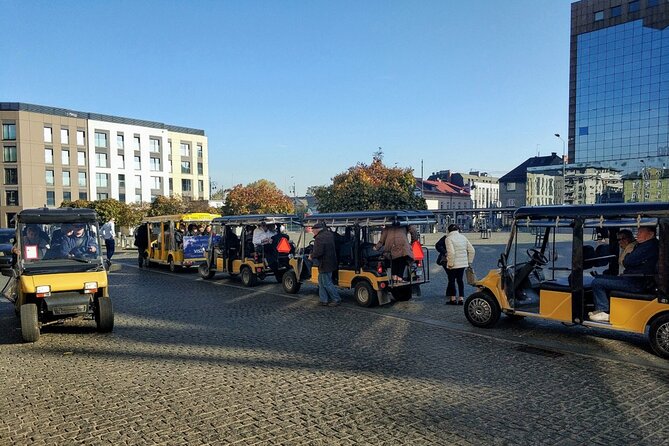
Krakow’s past comes into focus quickly here. This 90-minute electric golf cart tour links Kazimierz’s Jewish landmarks with the former Krakow Ghetto, giving you a practical way to cover more ground than you could on foot in the same time. The audio guide is available in 11 languages, and the covered vehicle helps keep the tour manageable in poor weather.
I like the route’s range: you see synagogues, old streets, ghetto remains, the Pharmacy Under the Eagle, and the famous chair memorial in one compact outing. I also like that the golf cart suits people who want a low-effort introduction to Krakow’s Jewish heritage. The main drawback is the short running time. You pass many important places, but this is an overview rather than a slow, inside-every-building history lesson.
In This Review
- Key points at a glance
- Why this short golf cart tour works in Krakow
- Kazimierz begins with a story of two communities
- Szeroka Street and the heart of Jewish Kazimierz
- Crossing into Podgórze and the former ghetto
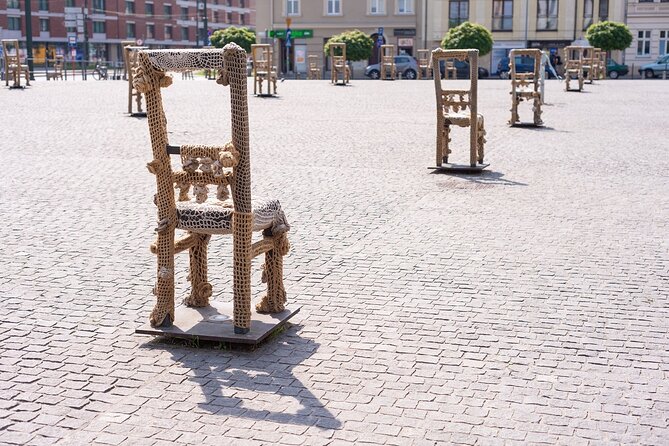
- Ghetto Heroes Square and the chairs
- The Pharmacy Under the Eagle
- What the audio guide adds
- Is $33.60 a fair price?
- Practical details before you book
- Who should choose this tour?
- Should you book the Krakow Jewish Heritage Golf Cart Tour?
- FAQ
- Where does the tour start?
- Where does the tour end?
- How long is the golf cart tour?
- How much does the tour cost?
- Which languages are available for the audio guide?
- How many landmarks does the route cover?
- What major former ghetto sites are included?
- Can I cancel for a full refund?
Key points at a glance
- More than 20 landmarks in about 90 minutes: The route covers both Kazimierz and the former ghetto area.
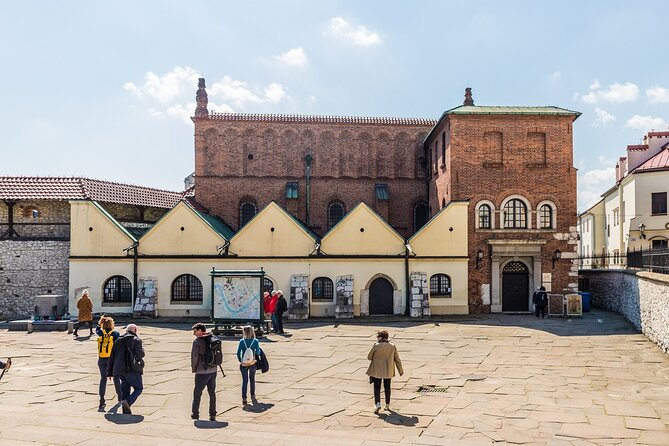
- Kazimierz’s four-synagogue street: Szeroka Street was once home to four synagogues, an unusual concentration in Europe.
- Electric transport for easy sightseeing: The golf cart helps you cover longer distances with little walking and offers some protection from the weather.
- A serious look at the Krakow Ghetto: The route includes the ghetto wall, Ghetto Heroes Square, the Pharmacy Under the Eagle, and the former deportation point.
- Audio commentary in 11 languages: Options include Danish, English, French, German, Hebrew, Italian, Norwegian, Polish, Russian, Spanish, and Swedish.
- A useful first orientation: The tour can help you decide which synagogues, museums, or streets deserve a second visit on foot.
Why this short golf cart tour works in Krakow
Kazimierz is not just one stop on a city sightseeing route. It was once an independent town south of Wawel, separated from Krakow by a branch of the Vistula River. For centuries, it was a major center of Jewish life in the city. Christian and Jewish communities lived close together, and that shared past is still visible in the district’s churches, synagogues, squares, and street plan.
The tour makes sense because the key locations are spread across more than one part of Krakow. Kazimierz sits across the river from Podgórze, the district used for the Krakow Ghetto during Nazi occupation. A golf cart connects these areas without asking you to spend the whole afternoon walking between them.
I see this as a strong orientation tour. You get a first look at the district’s main sights, hear why they matter, and mark the places you want to explore in greater detail. The tradeoff is simple: a vehicle is efficient, but it does not give you the same freedom to stop, linger, or study a doorway that you would have on a private walking tour.
The audio guide also shapes the experience. You are not relying on a guide’s live storytelling or questions from the group. Instead, you receive recorded information in your chosen language. That is useful for a group with mixed language needs, though you should expect a more set presentation.
More Audio Tours in Kraków
- Krakow: Vistula River Sightseeing Cruise with Audio Guide
★ 4.4 · 820 reviews - Krakow: Sightseeing Cruise on Vistula River with Audio Guide
★ 4.4 · 480 reviews - Krakow: Vistula River Sightseeing Cruise with Audio Guide
★ 3.9 · 270 reviews
Kazimierz begins with a story of two communities
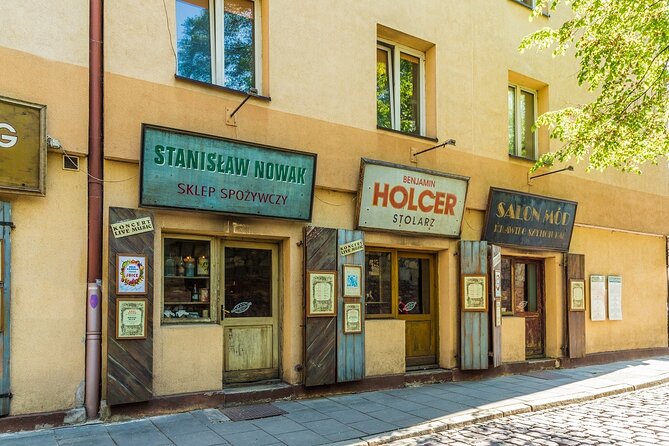
The first part of the route introduces Kazimierz as the historic center of Jewish Krakow. Its importance is not limited to one synagogue or one square. The district shows how religious, social, and daily life developed side by side over many centuries.
The electric vehicle is particularly useful here because you can see several streets and monuments in a short period. You may not get long pauses at each location, but the steady movement helps you understand how the district fits together.
The route includes the Tempel Synagogue, known for its striking stained-glass windows and its non-Orthodox character. Those details matter because Jewish religious life in Krakow was not one single tradition. The synagogue offers a reminder of the variety within the city’s Jewish community.
The tour information identifies the stained glass as among the best preserved of its kind in Poland. If synagogue interiors are important to you, check how much time the stop allows and confirm whether entry is part of your booking. The route clearly brings you to the site, but a short vehicle tour should not be treated as a full synagogue visit unless admission is specifically stated.
Szeroka Street and the heart of Jewish Kazimierz
Szeroka Street is one of the most meaningful stops. It is known as the center of Jewish life in Kazimierz and also serves as the setting for the closing concert of the Jewish Culture Festival. The street’s size and layout make more sense once you know what stood here in the past.
Four synagogues once stood along Szeroka Street. That concentration was highly unusual in Europe, and it helps explain why this street became such an important religious and social center. You can look beyond the individual buildings and read the street as a record of a whole community.
One of the oldest synagogues in Poland, preserved in notably good condition, is also found here. The route gives you a chance to connect the synagogue with the wider setting rather than seeing it as an isolated monument.
I like this part of the tour because it puts names and buildings into a shared setting. You might later return on foot, especially if you want photographs, a closer look at architectural details, or time inside the synagogues. The golf cart gives you the outline, then your own walking time can fill in the details.
Crossing into Podgórze and the former ghetto
The move from Kazimierz to Podgórze changes the tone of the tour. Podgórze was once a separate town, with St. Joseph’s Church dominating the market square. It was incorporated into Krakow only in the 20th century.
St. Joseph’s is included as a recognizable landmark of Podgórze. Its presence helps place the former ghetto within an ordinary urban setting. This is important because the ghetto was not an abstract site away from city life. It occupied streets, squares, and homes that had already served local residents.
The route then reaches a surviving fragment of the original ghetto wall. A plaque recalls the fate of the people confined there. The wall fragment is small, and that can be startling. You are not looking at a vast preserved structure, but at a remaining piece of a boundary that once controlled where people could live and move.
This is one of the places where the audio commentary earns its keep. Without context, a short section of wall can look easy to miss. With the explanation, the fragment becomes part of the larger story of forced displacement and confinement.
More Golf Cart Tours in Kraków
- Krakow: City Sightseeing Tour by Electric Golf Cart
★ 4.5 · 3,264 reviews - Krakow: City Sightseeing Tour Eco Electric Buggy Golf Cart
★ 4.7 · 3,143 reviews - Krakow: Extended City Sightseeing Tour – Eco Buggy Golf Cart
★ 4.7 · 794 reviews - Krakow: Jewish Quarter and Ghetto Electric Golf Cart Tour
★ 4.6 · 348 reviews
Ghetto Heroes Square and the chairs
The former Plac Zgody, now Ghetto Heroes Square, is among the most powerful stops on the route. During the Nazi occupation, the square became an Umschlagplatz, a gathering and deportation point for Jewish residents of the ghetto.
The square is marked by a memorial made of chairs. The empty chairs refer to the possessions left behind when people were forced from their homes and deported. The design is direct and restrained, which makes it easier to contemplate than a monument crowded with words and symbols.
You should allow yourself a quiet moment here, even on a short tour. A golf cart route can feel fast, but this stop deserves attention. If the schedule moves along quickly, note the location and return later on foot. It is one of the places where a second visit can be more valuable than trying to absorb everything from the vehicle.
The square also helps connect the district’s past to its present. It is a functioning part of Krakow, not a sealed memorial site, and that contrast can make the history feel especially close.
The Pharmacy Under the Eagle
The historic Pharmacy Under the Eagle is another major stop in the former ghetto. The Polish pharmacy operated inside the ghetto and became a place of help during deportations.
It provided shelter, carried messages, and helped move packages into and out of the ghetto. The tour presents it as a small point of relief in a setting marked by fear and loss. That human scale is valuable. Instead of hearing only about military actions or official decisions, you learn about a place where practical acts of assistance took place.
If this stop affects you most, plan to return for a closer visit if your schedule allows. The tour gives you the location and its role, but the 90-minute format limits how much time you can spend examining the site.
The same applies to the nearby Schindler Factory, which is included among the places highlighted by the route. The factory connects the wartime story to the life of Oskar Schindler and the people he helped. The golf cart tour can point you toward it, but it is not a substitute for setting aside separate museum time.
What the audio guide adds
The language choice is a real advantage. You can book commentary in Danish, English, French, German, Hebrew, Italian, Norwegian, Polish, Russian, Spanish, or Swedish. That makes the experience practical for many international visitors and avoids the pressure of following a live explanation in a second language.
The audio format also lets you focus on the scenery while receiving a consistent account of each stop. You do not have to stand beside a guide and compete with street noise or a large group.
Still, an audio guide has limits. It cannot answer a personal question, adjust the pace to your interests, or explain a detail you notice along the way. If you prefer conversation and extended discussion, a private guide or small walking tour may suit you better.
For me, the audio guide works best when I treat the tour as a first layer. Listen carefully, make a short note of the places that interest you, then return to one or two sites with more time.
Is $33.60 a fair price?
At $33.60 per person, the tour is priced as a convenient city orientation rather than a bargain transport ride. You are paying for the vehicle, the organized route, the multilingual audio system, and the ability to cover Kazimierz and Podgórze in about an hour and a half.
The value is strongest if you have limited time, mobility concerns, or unfavorable weather. Most people can participate, the route is near public transportation, and the electric vehicle avoids the effort of walking between districts. It also lets you see more than a short Kazimierz-only stroll.
The value is weaker if you already plan to spend a full day exploring Kazimierz and the former ghetto on foot. In that case, you may prefer to put the money toward individual museum or synagogue visits, depending on your interests.
A maximum group size of 50 people means this is not an intimate private experience. The cart may feel busy, and the vehicle format can limit how freely you move around. On the other hand, the group setting keeps the price lower than a private tour and makes the route easy to book for a couple, family, or larger party.
Practical details before you book
The listed starting point is Mikołaja Zyblikiewicza 2, 31-029 Kraków. The tour ends at Mikołaja Kopernika 3, 31-034 Kraków, so you should note that the finish is not the same as the meeting point.
A mobile ticket is provided, and booking confirmation is issued at the time of booking. The tour is near public transportation, which helps with reaching the start and continuing your sightseeing after the finish.
The advertised duration is about 1 hour and 30 minutes. Keep your expectations aligned with that length. You will see more than 20 monuments and locations, but some stops will be viewed briefly rather than explored in detail.
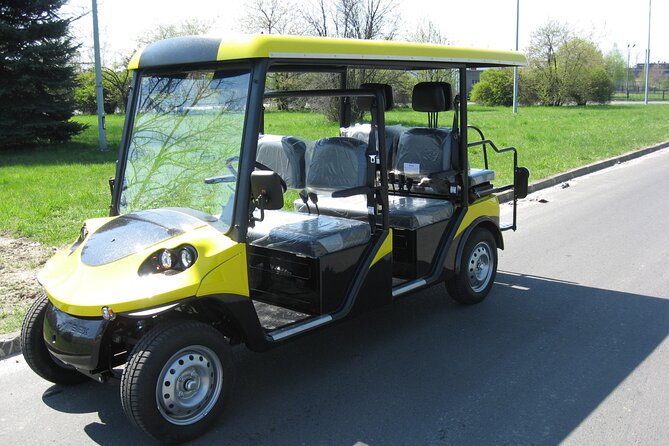
The vehicle is described as ecological and suitable in different weather conditions. That does not mean every day will feel equally comfortable, so dress for Krakow’s conditions and choose practical footwear for any short walks around stops.
Free cancellation is available if you cancel at least 24 hours before the start time. Cancellations made within 24 hours are not refunded, and changes inside that period are not accepted.
Who should choose this tour?
I would recommend it to you if you want a clear first look at Jewish Krakow without committing to a long walking tour. It is also a sensible choice if you have limited energy, limited time, or a group with different physical abilities.
It suits visitors who want to connect Kazimierz with Podgórze in one outing. The route covers the key memorial sites, including the ghetto wall, Ghetto Heroes Square, the Pharmacy Under the Eagle, and the Schindler Factory area.
Families and multigenerational groups may appreciate the short duration and electric transport. The language range is another practical strength for international groups.
I would choose a different format if you want long conversations, detailed architectural study, or extended time inside synagogues and museums. In that case, use this tour only as an introduction, or choose a slower walking experience instead.
Should you book the Krakow Jewish Heritage Golf Cart Tour?
Book it if your priority is seeing the main Jewish heritage sites efficiently. The strongest features are the wide route, the comfortable electric vehicle, the 11 audio languages, and the inclusion of both Kazimierz and the former ghetto.
Do not book it expecting a complete study of Krakow’s Jewish past. Ninety minutes can introduce the places, but it cannot give every synagogue, memorial, and wartime site the time it deserves.
My practical advice is to take this tour early in your Krakow stay. Use the audio commentary to get your bearings, then return to Szeroka Street, the Pharmacy Under the Eagle, or Ghetto Heroes Square if one of those places calls for more time. At $33.60, it offers fair value for a broad, low-effort introduction, especially when walking conditions or schedules are not on your side.
FAQ
Where does the tour start?
The tour starts at Mikołaja Zyblikiewicza 2, 31-029 Kraków, Poland.
Where does the tour end?
The tour ends at Mikołaja Kopernika 3, 31-034 Kraków, Poland.
How long is the golf cart tour?
The tour lasts approximately 1 hour and 30 minutes.
How much does the tour cost?
The listed price is $33.60 per person.
Which languages are available for the audio guide?
The available languages are Danish, English, French, German, Hebrew, Italian, Norwegian, Polish, Russian, Spanish, and Swedish.
How many landmarks does the route cover?
The tour includes more than 20 monuments and places in Kazimierz and the former ghetto area.
What major former ghetto sites are included?
The route includes part of the original ghetto wall, Ghetto Heroes Square, the historic Pharmacy Under the Eagle, and the area connected with the Schindler Factory.
Can I cancel for a full refund?
Yes. You can receive a full refund if you cancel at least 24 hours before the experience start time. Cancellations within 24 hours are not refunded.
More Self-Guided Tours in Kraków
- From Krakow: Auschwitz-Birkenau and Self-Guided Day Tour
★ 4.1 · 576 reviews - Krakow: Vistula Night Cruise by Gondola w/ Audio Commentary
★ 4.5 · 72 reviews - From Krakow: Auschwitz Birkenau Self-Guided Tour
★ 3.6 · 67 reviews - Wawel Hill Audio-Guided Tour
★ 3.5 · 19 reviews
More History Tours in Kraków
- Krakow: Vistula River Cruise with Historical Views
★ 3.5 · 357 reviews - Historic Krakow : Old Town & Wawel Castle Walking tour
★ 5.0 · 318 reviews - Krakow: Kościuszko Mound Ticket – History & Views!
★ 4.4 · 303 reviews - Krakow: Pope John Paul II History: Guided Tour – Home & Sanctuary
★ 5.0 · 46 reviews
Just added in Krakow
- Auschwitz-Birkenau – Skip the Line Tickets★ 3.5 · 29 reviews
- Auschwitz-Birkenau: Fast-Track Ticket & Guided Tour No Transfers★ 3.5 · 17 reviews
- Zakopane & Sleigh Ride with Bonfire – Group Tour from Kraków★ 5.0 · 2 reviews
- Sleigh Ride & Bonfire in Zakopane with Funicular – Private Trip★ 5.0 · 48 reviews
- Thermal Baths & Zakopane – Private Trip from Krakow★ 5.0 · 1 review
- Zakopane & Gubalowka Funicular – Private Winter Tour from Krakow★ 5.0 · 10 reviews
- Divine Mercy Sanctuary – Private Tour from Krakow★ 5.0 · 4 reviews
- stag dog chase Krakow prank★ 5.0 · 4 reviews