
REVIEW · GOLF CART TOURS
Gdansk: 2H City Sightseeing Tour LIVE GUIDED by Buggy/Golf cart
Gdansk reveals its layers quickly. This electric buggy tour links the old city, medieval churches, shipyard, and Solidarity landmarks in about two hours, making it a smart first look when your time is short. I especially like the chance to cover places that would take much longer on foot, and the live English-speaking guide adds stories and local context that a sightseeing loop cannot provide.
I also like the included drink, which can be water, coffee, or beer, and the option to be picked up within two kilometers of Neptune’s Fountain. The main consideration is that this is a fast overview, not a series of long museum visits. You will see many places from the buggy, with only selected stops allowing more time outside.
In This Review
- The essential points at a glance
- Why a buggy is useful in Gdansk
- Neptune’s Fountain and the Royal Road
- Gates, towers, and old city defenses
- Old Town churches and the Amber Altar
- Polish history at the Post Office and shipyard
- The riverfront and Gdansk’s famous symbols
- Guides, language, and the pace
- Price, comfort, and practical value
- Who should book this Gdansk tour?
- FAQ
- How long does the Gdansk buggy tour last?
- Where does the tour begin and end?
- Is pickup available from my hotel?
- What drink is included?
- Is the tour conducted in English?
- Is entry to any attraction included?
- What happens if the weather is poor?
The essential points at a glance
- A lot of Gdansk in two hours: The route reaches the Royal Road, Old Town, historic churches, the shipyard, and the Second World War Museum area.
- A useful ride for longer distances: The electric buggy reaches sights you may not want to walk between, including the European Solidarity Centre and Gdansk Shipyard.
- The amber altar gets real time: St. Bridget’s Church receives about 15 minutes, and entry to see its famous amber altar is included.
- Local guides shape the experience: Guides such as Michael, Maciej, Mariana, and Noris have received praise for their stories, humor, and city knowledge.
- Pickup is limited but handy: Hotel or lodging pickup is available within a two-kilometer radius of Neptune’s Fountain, but not from the ports.
- Weather matters: The open buggy can feel chilly in autumn, and poor weather can lead to a rescheduled tour or refund.
Why a buggy is useful in Gdansk
Gdansk’s main sights are not all packed into one small square. The grand center around Długi Targ is easy to walk, but the city’s modern political history begins farther west, around the shipyard and Solidarity Square. A walking tour focused on the old center may never reach those places.
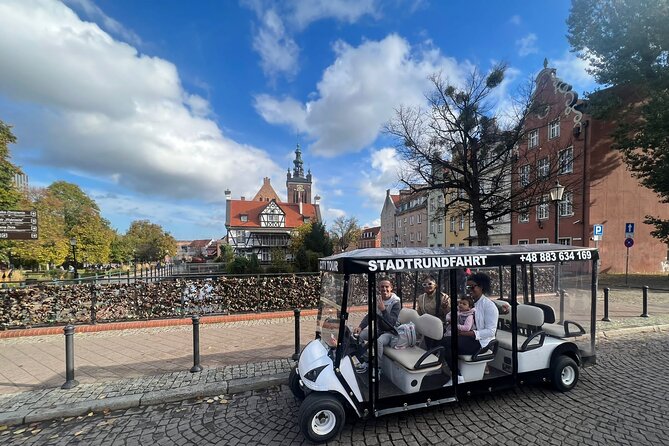
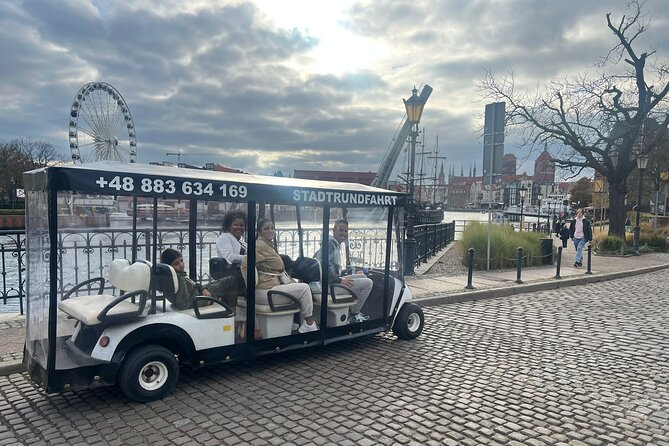
The buggy solves that problem. You ride in an electric golf cart through the historic center and along connecting streets, saving your legs for the places where you want to stop. The small vehicle is also suited to narrower streets and gives you a better sense of how the old center connects with the newer parts of town.
This is not a silent audio ride. The guide speaks throughout the route and explains what you are seeing. The strongest part of the experience appears to be the human commentary, especially when guides connect major events with family memories and changes they have seen in Gdansk themselves.
The ride is capped at 30 people, although the exact number of people in your buggy may vary. Some experiences can feel almost private when bookings are light. One solo booking was still operated rather than canceled, which is a useful sign for people traveling alone, though the stated minimum-number policy means a cancellation remains possible.
More Golf Cart Tours in Gdańsk
- Gdansk: City Sightseeing Tour by Golf Cart/Buggy Guided Tour
★ 4.9 · 510 reviews - Gdansk: Shared or Private City Tour Sightseeing By Golf Cart
★ 4.8 · 233 reviews - Gdańsk: City Sightseeing Tour by Buggy/Golf Cart LIVE GUIDED 1H
★ 5.0 · 208 reviews
Neptune’s Fountain and the Royal Road
The tour begins at Neptune’s Fountain on Długi Targ, the central meeting point in Gdansk’s historic center. The fountain is one of the city’s best-known symbols. Neptune’s connection to the sea fits Gdansk perfectly, since the city’s identity has long been tied to its port and maritime trade.
You get only a few minutes here, so treat this as an orientation stop and photo opportunity. If you want a quiet picture without other people in the frame, you may need to return later on your own. The fountain can be crowded, and people regularly queue for photos.
From here, the route passes the old Main Town Hall and Arthur’s Court. The Main Town Hall dates from the 14th century and now forms part of the Museum of Gdansk after reconstruction following the Second World War. Arthur’s Court began as a meeting place for merchants and later served as the city’s stock exchange.
Długi Targ, or Long Market, is the main square of the historic center. The Green Gate closes the grand route toward the river. Built in the Renaissance period between 1564 and 1568 as a royal residence, it is now also part of the Museum of Gdansk.
The quick timing here tells you how to use the tour. You will hear what each building is and why it matters, then continue moving. If a particular museum catches your interest, note it down for a later visit.
Gates, towers, and old city defenses
The Gdansk Shakespeare Theatre brings a more unusual architectural detail. Its folding roof is described as unique in the world, making this a memorable modern stop among the older buildings.
The buggy then reaches Katownia, or the old prison and torture complex. The Prison Tower, Neck, and Torture Chamber occupy the area once known as the Coal Market. These buildings now form part of the Museum of Gdansk. The stop is brief, so you should not expect an interior visit, but the guide can place the grim structure within the city’s former defenses and criminal justice system.
The Golden Gate marked the ceremonial entrance to Długa Street for royal arrivals. The Highland Gate, part of the 16th-century Gatehouse Complex, formally began the Royal Road. Today it also serves as a tourist information point.
The Great Armoury follows, with its Dutch Mannerist design from the 16th and 17th centuries. It now belongs to the city’s art academy. This stretch works well from a buggy because you can take in the facades without stopping at every doorway.
A polished stainless-steel Millennium Tree provides a change of mood. The modern monument commemorates the 1,000th anniversary of Gdansk. Nearby, the equestrian monument to King John III Sobieski has its own unusual story: it was built in Lviv in 1898 and moved to Gdansk in 1965.
Old Town churches and the Amber Altar
The route leaves the best-known Main Town for the Old Town and central transport district. Gdansk’s main railway station opened in 1900 and is an impressive historical landmark in its own right. The nearby churches of St. Joseph and St. Elizabeth both suffered serious wartime damage and were rebuilt after 1945.
The Old Town Hall is one of the few historic buildings in Gdansk to survive the war with less damage. The Great Mill offers another striking piece of the city’s past. In the Middle Ages, it was the largest industrial plant in Europe. Rebuilt after the war, it now houses the city’s amber museum.
St. Catherine’s Church is identified as the oldest church in Gdansk. It was Protestant from 1545 until the end of the Second World War, then returned to Catholic use. St. Nicholas Church, the Dominican church, reaches back to the 12th century and is noted for surviving the war.
The most substantial church stop is St. Bridget’s Church, with about 15 minutes set aside. This is where the tour moves beyond a quick exterior look. St. Bridget’s became a sanctuary for Solidarity leaders during martial law, and it was almost entirely destroyed during the Second World War before being rebuilt.
The main reason to enter is the amber altar. It is exceptionally large, described as twice the size of the famous Amber Room and more than three times as high. Amber is closely associated with the Baltic region, so this stop ties art, local material, religion, and recent Polish history together.
If you have limited mobility or prefer not to walk far between sights, this church visit is especially valuable. The buggy handles the distances, while you still get a meaningful interior stop. The tour description does not promise extended time inside other churches, so St. Bridget’s is the place to prioritize.
Something quite different:
- Gdansk: City Cruise on Historical Polish Boat
★ 4.8 · 2,913 reviews - Gdańsk: Sunset Cruise on a Historic Polish Boat
★ 4.9 · 977 reviews - Gdańsk City Sights & History Guided Walking Tour in English
★ 4.8 · 876 reviews - Gdansk: Firearm Shooting Experience with Instructor
★ 4.8 · 866 reviews
Polish history at the Post Office and shipyard
The Museum of the Polish Post Office marks one of the first acts of the Second World War in Europe. On September 1, 1939, Polish postal workers defended the Gdansk post office. A monument honors the defenders nearby.
The stop is short, but the subject is not. The Polish Post Office and the later visit to the Museum of the Second World War give you two reminders that Gdansk’s 20th-century story cannot be separated from the conflict that destroyed much of the city.
The route then reaches the European Solidarity Centre, the Three Crosses Monument, Sala BHP, and Gdansk Shipyard. Together, these stops explain the rise of Solidarity, the Polish labor movement that challenged communist rule.
The Three Crosses Monument, officially dedicated to fallen shipyard workers, uses three tall crosses with anchors. It commemorates victims of the December 1970 events and rises 42 meters over Solidarity Square, near historic Gate No. 2.
Sala BHP is the meeting hall associated with the August strike, the 1980 agreements signed by Lech Wałęsa, and the birth of Solidarity. This may be the most important historical stop for understanding modern Poland. You are not simply looking at an attractive old building. You are seeing the setting for a political movement that helped change the country.
The Gdansk Shipyard itself gained international fame as the place where Solidarity was founded in September 1980. The tour gives you a way to connect the monuments, meeting hall, gates, and working shipyard rather than treating each as an isolated sight.
Guides Michael and Maciej have been especially praised for bringing this period to life. Michael has shared family experiences connected with both the Nazi and Soviet eras, while Maciej is noted for answering questions and helping visitors understand the city beyond its postcard center.
The riverfront and Gdansk’s famous symbols
After the shipyard district, the buggy passes the Museum of the Second World War. The museum opened its exhibits in 2017 and focuses on the war from a broad Polish and international viewpoint. The stop here is only about two minutes, so plan a separate visit if you want to explore the galleries.
The Polish Baltic Philharmonic occupies rebuilt and extended buildings of a former municipal power plant on Ołowianka Island. This is a good example of Gdansk’s habit of putting old industrial structures to new cultural use.
St. John’s Church is a Gothic building from the 14th century and now also serves as a cultural center. It was one of the last major Gdansk monuments to be reconstructed after the war.
Then comes the Crane on the Motława River. The Great Crane is one of the city’s defining sights and the largest medieval port crane in Europe. It tells you, at a glance, why trade and shipping shaped Gdansk’s fortunes.
The final church sequence includes St. Mary’s Church and the Royal Chapel. St. Mary’s, completed in 1502, is the world’s largest Gothic brick building. You get only a short exterior orientation, so do not confuse this stop with a full church visit.
The Royal Chapel offers a sharp contrast. Built in the 17th century in Baroque style, it is the only church with a central dome in the heart of Gdansk. Its decorated facade is easy to recognize beside the plainer walls of St. Mary’s.
The route ends at the Historical Market Hall, built in 1896 and described as the oldest shopping center in Gdansk. From there, you return to Neptune’s Fountain unless you arrange another drop-off within two kilometers.
Guides, language, and the pace
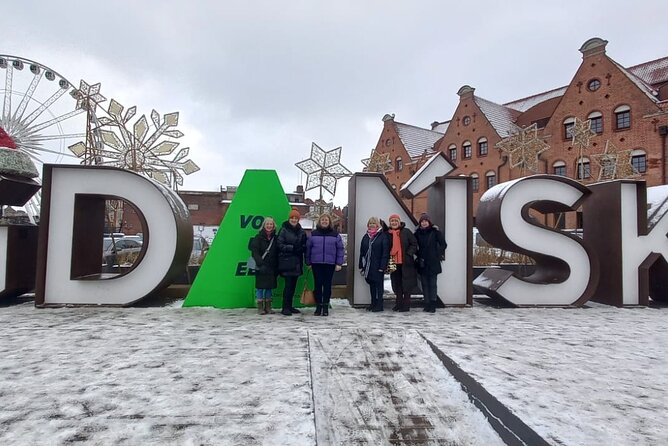
The tour is offered in English with a live guide. The quality depends partly on who leads your buggy, but the strongest guide comments are consistent: Michael is praised for personal stories and historical detail, Maciej for his friendly explanations, Mariana for finding less obvious places, and Noris for an energetic presentation and fun facts.
I would tell you to ask questions. The guide may have more information than you can absorb in two hours, and one person found the detail level heavy. Another visitor had difficulty following a guide who spoke quickly with a strong accent. That is not a reason to reject the tour, but it is a reason to politely ask for slower speech or clarification if needed.
The route is lively and packed. You will not have much time to study every facade or wander inside each building. Think of it as a moving orientation with selected stops, not a slow architectural walk.
Price, comfort, and practical value

At $51.97 per person, the price is higher than a basic self-guided walk, but the comparison is not quite fair. You are paying for transport between separated districts, a live guide, a drink, taxes, and entry to the amber altar visit at St. Bridget’s Church.
I see the best value for people with only one morning or afternoon in Gdansk, cruise passengers who can reach the center independently, older visitors, and anyone who finds long walks tiring. It is also useful at the start of a longer stay because it helps you decide where to return for more time.
Pickup and drop-off are available at a hotel or lodging within two kilometers of Neptune’s Fountain. You must provide the exact address and wait 10 minutes before departure. Pickup is not provided at the ports, and port visitors need to make their own way to central Gdansk. Gdynia is a different city, about 25 kilometers from the center, so allow plenty of time if you are coming from there.
The buggy can be chilly in autumn. A blanket or extra layer is sensible, especially if the vehicle is open. The tour requires good weather, and an alternate date or full refund is offered if poor conditions force a cancellation.
Free cancellation is available up to 24 hours before the start time. During the Saint Dominic’s Fair, from July 27 to August 25, 2025, some streets may be restricted and the route can change while keeping its normal schedule and length.
Who should book this Gdansk tour?
Book it if you want a fast, guided introduction that reaches both the medieval center and the Solidarity shipyard. It is a particularly good choice for a first morning, a short city break, or a day when walking several miles is not appealing.
Skip it if you want long museum visits, quiet time in churches, or complete control over the schedule. A private walking guide would give you more time at fewer sights.
For most first-time visitors, I would book this early in the stay, then return on foot to St. Mary’s, the European Solidarity Centre, the Museum of the Second World War, or the amber museum. The buggy gives you the map in your head. Your own later walks give the city time to speak.
FAQ
How long does the Gdansk buggy tour last?
The tour lasts approximately two hours to two hours and 15 minutes.
Where does the tour begin and end?
It begins at Neptune’s Fountain on Długi Targ in Gdansk’s historic center. It normally ends there as well, though drop-off can be arranged at another point within two kilometers of the fountain.
Is pickup available from my hotel?
Pickup is available from hotels, lodging, or another chosen point within a two-kilometer radius of Neptune’s Fountain. Pickup is not offered at the ports.
What drink is included?
Each participant can receive a drink, which may be water, coffee, or beer.
Is the tour conducted in English?
Yes. The experience is offered in English with a live guide.
Is entry to any attraction included?
Entry to St. Bridget’s Church to see the amber altar is included. The other listed stops are described as free exterior or orientation stops.
What happens if the weather is poor?
The tour requires good weather. If it is canceled because of poor conditions, you will be offered another date or a full refund.
Just added in Gdansk
- Wolf’s Lair private tour from Gdansk★ 5.0 · 1 review
- Whisky Tasting in Gdańsk★ 5.0 · 3 reviews
- Transfer from Gdańsk or Airport Gdańsk (GDN) to Kościerzyna★ 5.0 · 1 review
- Westerplatte private tour led by Expert-Guide (door to door)★ 5.0 · 5 reviews
- Westerplatte – 2h private trip by luxury car|★ 5.0 · 4 reviews
- Gdansk EVERYDAY Vodka Tasting Tour★ 5.0 · 6 reviews
- Undercover City Games: Gdynia★ 5.0 · 34 reviews
- VIP transfer from airport Gdansk (GDN) to Hotel in Gdansk / Sopot★ 5.0 · 2 reviews
Golf Cart Tours, compared.

City Sightseeing Tour Eco Electric Buggy Golf Cart
Read our review →
Extended City Sightseeing Tour – Eco Buggy Golf Cart
Read our review →
City Sightseeing Tour by Golf Cart/Buggy Guided Tour
Read our review →City Sightseeing Tour Eco Electric Buggy Golf Cart
Read our review →
Krakow Grand City Tour by golf cart – All 3 districts
Read our review →

Shared or Private City Tour Sightseeing By Golf Cart
Read our review →Browse the lists this tour appears in