
REVIEW · AUSCHWITZ-BIRKENAU MEMORIAL TOURS
Krakow to Auschwitz Birkenau Guided Tour with Transfer and Ticket
Some places demand your full attention. This Krakow to Auschwitz-Birkenau tour combines licensed guiding with return transport from Krakow, making a difficult but important day easier to manage. I like the clear organisation, the headsets at Auschwitz I, and the chance to visit both camp sites without arranging trains or museum entry yourself. The main drawback is the firm pace: you follow the guide and may not have much time to pause over every exhibit.
The tour costs about $36.28 per person and lasts roughly seven hours, including the drive each way. That is strong value if you want a structured visit with tickets, transport, insurance, and museum guiding included. You should also know that much of the day is outdoors, the ground can be uneven, and there is no proper meal break unless you arrange a packed lunch.
In This Review
- Key points to know before booking
- Why this Auschwitz tour is worth considering
- The Krakow pickup and 65-kilometre journey
- Arrival at Auschwitz I and the first two-hour visit
- Birkenau: scale, silence, and open sky
- A moving day with a fixed pace
- Food, breaks, and what to pack
- Group size, transport, and overall value
- Who should book this Auschwitz-Birkenau tour?
- Should you book it?
- FAQ
- How long does the Krakow to Auschwitz-Birkenau tour last?
- Does the tour include entry to Auschwitz I and Birkenau?
- Is transport from Krakow included?
- Is the tour conducted in English?
- How large is the tour group?
- Do I need to bring a passport or ID?
- Is lunch included?
- Are headsets provided during the tour?
- Can I cancel the tour for a refund?
Key points to know before booking
- About 7 hours door to door: Allow around 1 hour 15 minutes each way between Krakow and Oswiecim, plus the two museum visits.
- Both Auschwitz sites included: You visit Auschwitz I and the much larger Birkenau camp, also called Auschwitz II.
- Museum guide and headsets: The licensed guide leads the Auschwitz I visit, with headsets to keep the commentary clear.
- Groups can reach 30 people: A smaller option for up to 15 people is available and may feel more personal.
- Bring your passport or ID: Every person must show valid identification, and names must match the booking.
- Pack for the weather: Up to 70 percent of the visit is outdoors, with very little shelter at Birkenau.
Why this Auschwitz tour is worth considering
Auschwitz-Birkenau is not a casual sightseeing stop. It is a memorial and museum built around the crimes of Nazi Germany and the murder of millions of people, including approximately one million Jews. The scale, surviving buildings, personal belongings, and empty spaces make the visit difficult to absorb.
For that reason, I see real value in having a guide. You are not left to work out the meaning of each barrack, photograph, or display on your own. The guide provides historical context, explains how the camps operated, and helps connect the evidence to the people who were imprisoned and killed there.
The organisation also matters. You do not need to figure out the regional bus or train, reserve the museum separately, or find your way between Auschwitz I and Birkenau. A driver and group leader handle the road journey, while a museum-approved guide leads the memorial visit.
Still, this is a group tour, not an open-ended museum day. The official schedule and museum rules dictate the pace. If you want to stop for a long time at each display, read every information panel, or sit quietly in one place, you may find the experience too brisk.
More Private Transfers in Kraków
- From Krakow: Auschwitz Birkenau Tour with Transfer
★ 4.0 · 6,134 reviews - Krakow: Auschwitz-Birkenau Guided Tour with Ticket and Transfer
★ 4.5 · 3,784 reviews - Krakow to Wieliczka: Salt Mine Guided Tour with Ticket & Transfer
★ 4.5 · 3,193 reviews
The Krakow pickup and 65-kilometre journey
Pickup arrangements depend on the option you choose. Hotel pickup is available with the limited group option for up to 15 people. Lower-priced options use a meeting point, or a nearby accessible point if your accommodation is in a restricted traffic zone.
People staying near Krakow’s Main Square are assigned the closest practical pickup location. Those staying farther from the centre may need to walk or use local transport to a designated point. Roadworks in western Krakow currently prevent pickup in that area, and the meeting point at Floriana Straszewskiego 19 by the Philharmonic is temporarily closed.
The exact departure time depends on the museum’s available entry slot and is confirmed the day before. This means you should not build a tightly fixed morning or afternoon plan around the advertised start time. Traffic can also affect the schedule.
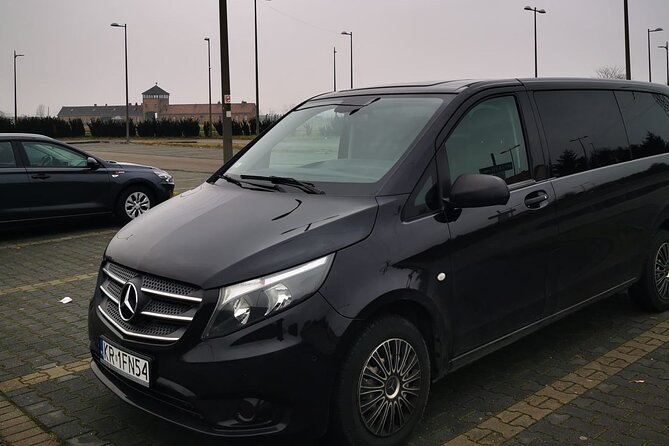
The drive to Oswiecim takes about 1 hour 15 minutes over roughly 65 kilometres. The included vehicle is air-conditioned and may be a van or minibus. The road journey is not the glamorous part of the day, but it removes a major piece of planning.
Communication is one of this tour’s strongest points. You receive pickup information and a welcome message, and the tour team may contact you if you are late or need help finding the vehicle. One person even received a phone call when running behind at the meeting point. That kind of support is useful when several vehicles and tour groups gather in the same part of central Krakow.
Arrival at Auschwitz I and the first two-hour visit
After arriving in Oswiecim, you normally have a short break. You can get a coffee, use the time to gather yourself, or look at outdoor displays before meeting the museum guide.
Security checks are required before entry, similar to an airport-style screening. Bring only what is permitted, and allow time for the process. Most importantly, carry your passport or national ID. The museum requires valid identification for every participant, and the name must match the booking. No ID means no entry.
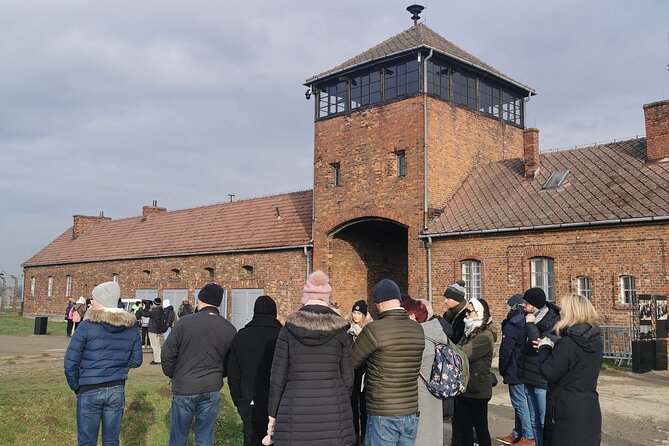
The first camp, Auschwitz I, was originally established by Nazi Germany as a concentration camp, initially holding many Polish prisoners arrested after the German occupation of Poland in 1939. You enter through the familiar gate marked Arbeit Macht Frei, a phrase that falsely promised freedom through work.
This part of the visit usually lasts about two hours. You walk among the original brick buildings, prison blocks, walls, fences, and guard structures. Many buildings now contain carefully prepared exhibitions, with photographs, documents, and belongings taken from people arriving at the camp.
The displays of shoes, glasses, suitcases, hair, and household objects are especially painful because they show the victims as ordinary people with homes, families, work, and plans. These are not abstract statistics. A pile of luggage or a child’s shoe gives the crimes a human scale that no textbook can match.
The guide also explains the gas chambers, crematoria, medical experiments, and the camp’s system of imprisonment and murder. Headsets are supplied at Auschwitz I, which is a real help when the group is spread through a building or gathered around a display. You can hear the commentary without forcing the guide to raise their voice in a place that calls for quiet.
The standard group may contain up to 30 people. That is not enormous, but it is large enough that you need to stay alert and keep up. The route includes walking and some stairs in certain buildings. The ground is generally manageable, but you should wear shoes that are comfortable and that you do not mind getting dirty.
Birkenau: scale, silence, and open sky
After Auschwitz I, there is a break of up to 15 minutes. You then travel the short distance to Brzezinka, the village containing Birkenau, or Auschwitz II. The transfer takes about three minutes.
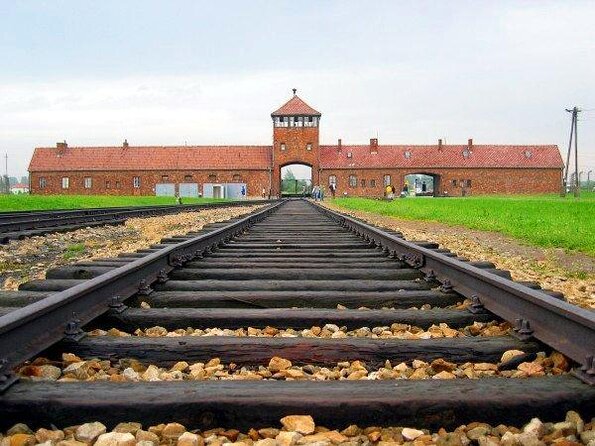
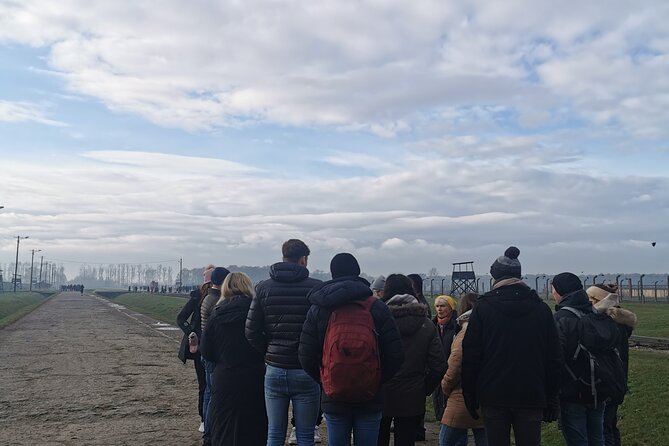
Birkenau is physically much larger than Auschwitz I. The broad open site, long rows of barracks, railway approach, watchtowers, fences, and distant buildings make the scale of the camp far easier to grasp. This was the principal killing centre in the Auschwitz complex, built by the Nazis for the mass murder of European Jews and the imprisonment of other targeted groups.
The guide continues the historical account here, covering the terrible living conditions, selections made on arrival, forced labour, and pseudo-medical experiments carried out by Nazi doctors, including Josef Mengele. The story ends with the liberation of Auschwitz on January 27, 1945, by soldiers of the 60th Army of the First Ukrainian Front.
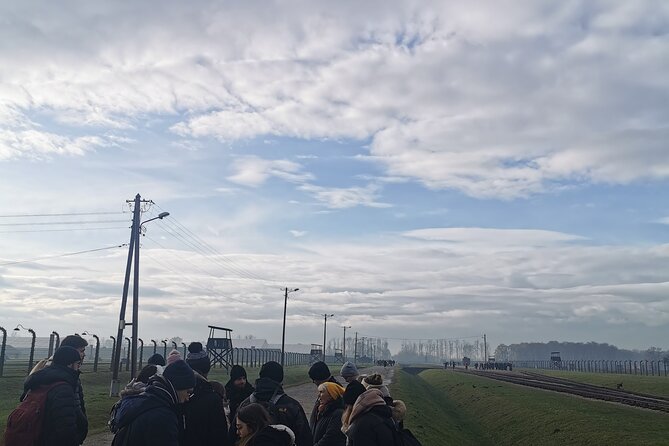
Birkenau is not mainly an indoor museum visit. You spend much of the time outside, and the site offers limited shelter. In winter, cold wind can make the visit especially hard. One person reported temperatures between minus 10 and minus 25 degrees Celsius, so warm layers, a hat, gloves, and solid shoes are not optional in severe weather.
Unlike the Auschwitz I section, headsets are not always available at Birkenau. That can make it harder to hear if the group spreads out or wind picks up. Stay close to the guide and avoid drifting behind to take photographs.
Photography is allowed in marked areas, but flash is not permitted inside buildings. Keep your camera use restrained. This is a memorial, and the setting calls for quiet, respectful behaviour. Eating, smoking, and loud conversation are not allowed during the museum visit.
More Auschwitz-Birkenau memorial tours:
- From Krakow: Auschwitz-Birkenau Guided Tour & Hotel Pickup
★ 4.5 · 33,358 reviews - From Krakow: Auschwitz-Birkenau Guided Tour & Hotel Pickup
★ 4.5 · 29,340 reviews - Krakow: Auschwitz Guided Tour with Optional Hotel Pickup
★ 4.5 · 15,280 reviews - Krakow: Auschwitz-Birkenau Guided Tour with Pickup & Lunch
★ 4.5 · 9,800 reviews
A moving day with a fixed pace
The emotional weight of this visit is the main reason to go, and also the main reason to prepare. You may feel sorrow, anger, numbness, or simply exhaustion. There is no correct reaction, and you should not expect the day to feel like an ordinary excursion.
The guide’s manner matters greatly. Past departures have included guides such as Marta, praised for empathetic explanations, and Miso, remembered for passion and strong historical detail. Norbert and Daniel were also singled out for careful coordination and looking after people during the transport. Names and guides can change, but these examples show the kind of service the company aims to provide.
The best guides do not treat the site as a stage for dramatic performance. They explain what happened, identify the evidence, and leave room for the facts to speak. The strongest feedback about this experience focuses on respectful delivery, clear English, and careful historical detail.
There is one important tradeoff. Some people feel rushed while reading the storyboards and studying the exhibitions. The guide must keep to the museum’s assigned time slot and move a group through a busy site. Cold weather, crowds, and security arrangements can also reduce the time available for quiet reflection.
If you want maximum independence, this is not the ideal format. If you want a reliable introduction to Auschwitz-Birkenau and prefer someone else to handle the complex timing, it works well.
Food, breaks, and what to pack
Food and drinks are not included in the basic tour. There is no proper restaurant stop between the two camps, and the museum sites do not provide a normal lunch setting during the visit.
Eat breakfast before an early departure. Bring water and a snack that can be consumed at the permitted break area. Packed lunch boxes may be available as an option, and some people found them useful and fresh. Others preferred buying their own food in advance.
Your clothing matters more than you might expect. The visit can involve several hours of walking, much of it outdoors. Pack for rain, wind, heat, or snow depending on the forecast. On warm days, bring water. In cold weather, layer properly rather than relying on one heavy coat.
Comfortable shoes are essential. The route is not a mountain hike, but you will walk across a large site and may encounter uneven or muddy ground. A small bag is easier to manage than bulky luggage, especially during security checks.
Group size, transport, and overall value
At $36.28 per person, this is a low-cost way to arrange a major day trip from Krakow. The price includes return transport, museum entry to both sites, a licensed local guide, headsets at Auschwitz I, insurance, and taxes.
Buying these parts separately could take more time and create more opportunities for mistakes. The price is especially fair for anyone who values convenience and wants to return to Krakow the same day without arranging intercity transport.
The standard group can reach 30 people. That keeps the price down, but it also means you may wait for others and have less contact with the guide. The small-group option for up to 15 people costs more, yet it may be worth the extra money if you want easier communication and a less crowded feel.
The return journey includes at least a 20-minute break after the visit. You can rest, visit a shop or bookstore, and gather yourself before the drive back to Krakow. Return times vary, but an early departure can get you back around lunchtime or early afternoon, leaving part of the day for Krakow.
The tour is recommended by 95 percent of people who have rated it, with an overall score of 4.8 from more than 8,000 ratings. The strongest praise centres on punctual transport, clear messages, helpful drivers, smooth ticket handling, and respectful guides. The most useful criticism concerns the brisk pace, occasional pickup confusion, the lack of headsets at Birkenau, and limited time to study displays.
Who should book this Auschwitz-Birkenau tour?
I would choose this tour if you are staying in Krakow and want the simplest practical route to the memorial. It suits first-time visitors, people who prefer a guide, and anyone who does not want to manage separate transport and museum reservations.
It is also a good fit if your Krakow schedule is tight. The early option can return you to the city around early afternoon, although the final departure time is controlled by museum availability and confirmed only the day before.
I would think twice if you dislike group schedules or need long, quiet periods at exhibits. The tour is also demanding for anyone who struggles with long outdoor walks, extreme cold, or uneven ground. The supplied information says most people can participate, but the day is not designed around individual pacing.
Should you book it?
Yes, if you want a well-priced, guided introduction to Auschwitz and Birkenau with the difficult logistics handled for you. The transport, tickets, clear communication, and respectful guiding give this tour a strong practical advantage.
Choose the small-group version if the budget allows. Book with your full legal name, carry your passport or ID, eat before departure, and bring water, snacks, and clothing suited to the forecast. Most of all, arrive ready for a serious memorial visit, not a standard day out. The history deserves your attention, and this tour gives you a clear way to encounter it.
FAQ
How long does the Krakow to Auschwitz-Birkenau tour last?
The experience lasts approximately seven hours. The drive from Krakow to Oswiecim takes about 1 hour 15 minutes each way, with visits to Auschwitz I and Birkenau in between.
Does the tour include entry to Auschwitz I and Birkenau?
Yes. Entry fees for both Auschwitz I and Auschwitz II Birkenau are included.
Is transport from Krakow included?
Yes. Round-trip transport in an air-conditioned van or minibus is included. Hotel pickup is available only with the limited group option for up to 15 people. Other options use a meeting point or designated pickup location.
Is the tour conducted in English?
Yes. The tour is offered in English.
How large is the tour group?
The group may include up to 30 people. A separate option is limited to 15 people.
Do I need to bring a passport or ID?
Yes. Every participant must carry a valid passport or national ID. The name must match the full name provided during booking, and the document will be checked before entry.
Is lunch included?
No. Food and drinks are not included. There is no time for a full meal between the visits, so bring a snack and water. A packed lunch may be available as an additional option.
Are headsets provided during the tour?
Headsets are provided for the Auschwitz I section so you can hear the guide clearly. They are not always available during the Birkenau section.
Can I cancel the tour for a refund?
You can cancel up to 24 hours before the start time for a full refund. Cancellations or changes made less than 24 hours before the experience are not accepted or refunded.
Just added in Krakow
- Auschwitz-Birkenau – Skip the Line Tickets★ 3.5 · 29 reviews
- Auschwitz-Birkenau: Fast-Track Ticket & Guided Tour No Transfers★ 3.5 · 17 reviews
- Zakopane & Sleigh Ride with Bonfire – Group Tour from Kraków★ 5.0 · 2 reviews
- Sleigh Ride & Bonfire in Zakopane with Funicular – Private Trip★ 5.0 · 48 reviews
- Thermal Baths & Zakopane – Private Trip from Krakow★ 5.0 · 1 review
- Zakopane & Gubalowka Funicular – Private Winter Tour from Krakow★ 5.0 · 10 reviews
- stag dog chase Krakow prank★ 5.0 · 4 reviews
- Divine Mercy Sanctuary – Private Tour from Krakow★ 5.0 · 4 reviews