
REVIEW · AUSCHWITZ-BIRKENAU MEMORIAL TOURS
Krakow: Plaszow Concentration Camp Guided Walking Tour
Plaszow is not easy sightseeing. It is important sightseeing. This two-hour guided walk connects Kraków’s Ghetto Heroes Square with the former Plaszow camp, where memorials, cemetery fragments, and surviving buildings help you understand a place that can be difficult to picture alone. I like the small-group limit of 25, and I like the way the tour links the ghetto to Plaszow instead of treating the camp as an isolated site.
The guides are the strongest part of the experience. Bartholomew, Barbara, and Phil have each been praised for clear explanations, careful answers, and the use of old photographs to show what has disappeared. The main consideration is that Plaszow has relatively few intact structures, so this is not a conventional museum visit. You need comfortable shoes, a moderate level of fitness, and the patience to reconstruct much of the camp from fragments.
In This Review
- Key points to know before you book
- Why Plaszow requires a guide
- Starting at Ghetto Heroes Square
- The tram ride from the square to Plaszow
- What you see at the former Plaszow camp
- Memorials, execution sites, and the Monument of Torn-Out Hearts
- Plaszow and Oskar Schindler
- The guides make the difference
- Is two hours enough?
- Is $30.04 good value?
- Practical details that affect your day
- Who should book the Plaszow walking tour?
- FAQ
- How long does the Plaszow concentration camp tour last?
- Where does the tour begin?
- Where does the tour end?
- Is transportation between Ghetto Heroes Square and Plaszow included?
- What language is the tour offered in?
- How large can the group be?
- What level of fitness is needed?
- Can I cancel for a full refund?
Key points to know before you book
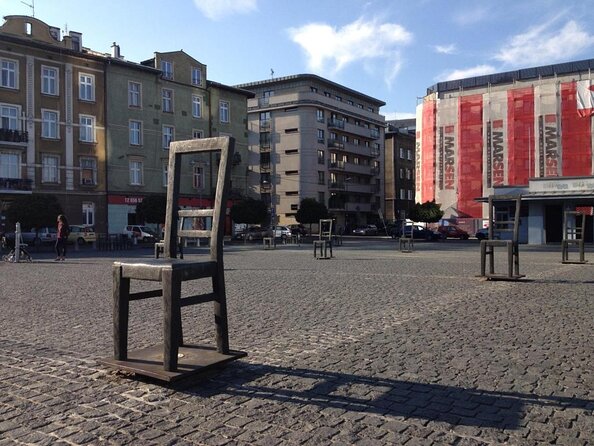
- The route begins at Ghetto Heroes Square, the former Plac Zgody and the departure point for transports from the Kraków ghetto.
- You travel from the square to Plaszow by tram, according to the tour details shared by past participants.
- The camp site is spread out and emotionally demanding, with walking between memorials, cemetery traces, and surviving structures.
- Old photographs make the vanished camp easier to understand, especially when paired with the guide’s explanation.
- Schindler’s connection is part of the story, including the work permits and factory transfer that saved more than 1,000 Jewish lives.
- The tour costs $30.04 per person, a fair price for a guided two-hour visit to a place that is hard to interpret without help.
Why Plaszow requires a guide
Plaszow does not offer the clear visual drama of a preserved camp museum. Much of the original camp has gone. You will see open ground, memorials, traces of former cemeteries, and a few surviving buildings rather than rows of barracks that explain themselves.
That is precisely why a guide matters here. Without context, you could pass the Grey House, the roll-call square, or a cemetery fragment without understanding its purpose. A good guide shows you photographs of the site as it once looked, then connects those images to what remains underfoot.
I appreciate that this tour treats Plaszow as a place to understand, not simply a film location. Schindler’s List brought the camp to worldwide attention, but the real story is larger and more painful than the movie. The guide explains how the camp operated, who was imprisoned there, and how forced labor, deportation, and murder were tied together.
The tone is serious and direct. That suits the subject. You should not expect entertainment, theatrical storytelling, or a light afternoon outing.
More Walking Tours in Kraków
- Old Town Krakow & Wawel Castle Walking Tour
★ 5.0 · 1,508 reviews - Creepy Krakow: 2-Hour City Walking Tour
★ 4.7 · 1,131 reviews - Krakow: The Old Town Walking Tour
★ 4.8 · 794 reviews
Starting at Ghetto Heroes Square
The tour begins outside Apteka pod Orłem at Plac Bohaterów Getta 18. This is Ghetto Heroes Square, known during the German occupation as Plac Zgody.
The square served as the logistical center of the Kraków ghetto. It was used for control and registration, and it became the place from which people were sent away on transports. The site was renamed after the war to honor those who resisted and suffered under Nazi German occupation.
The opening stop lasts about 15 minutes. That may sound brief, but it gives the tour an important starting point. Plaszow was not separate from Kraków’s ghetto story. The camp first held Jewish people forced out of the liquidated ghetto, so the walk begins at the point where many lives were disrupted before continuing to the camp itself.
This first stop also helps you get your bearings. The meeting point is near public transportation, and the route then continues toward Plaszow. Arrive at least 10 minutes early. The group cannot wait for late arrivals once it has left, and the ticket cannot be refunded in that situation.
The tram ride from the square to Plaszow
The transfer to Plaszow is part of the practical flow of the experience. One account describes taking a tram from Ghetto Heroes Square to the camp, which makes sense of the geography and keeps the visit connected to the city around it.
That movement matters. You are not simply being dropped at a remote memorial and handed a block of facts. You begin in the former ghetto, then follow the route toward the forced-labor camp. The change from urban square to a more open former camp site helps you understand how these places were related within the Nazi system.
The provided information does not specify the tram line, travel time, or whether public transport costs are included. Plan around the stated two-hour duration, but allow extra time before and after if your schedule is tight. The tour ends at the bus stop at 57 Kamieńskiego Street, not back at the starting point.
That one-way format is useful if you are continuing elsewhere in Kraków. It is less convenient if you expect to finish where you began, so check the route before booking.
What you see at the former Plaszow camp
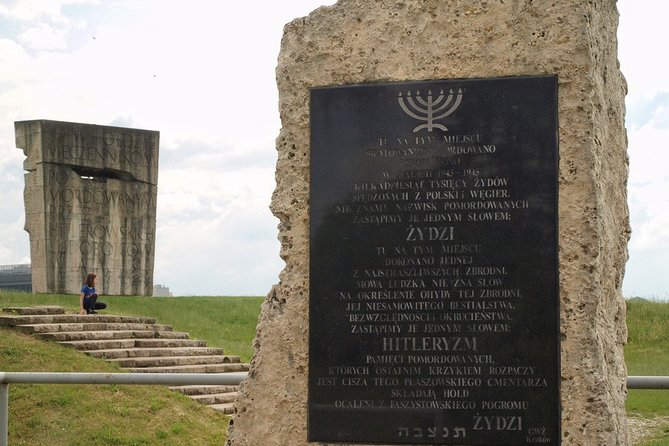
Plaszow was created in October 1942 on the grounds of two Jewish cemeteries. It began as a forced-labor camp for Jewish prisoners from the Kraków ghetto. In July 1943, a penal-labor section for Polish prisoners was added.
In January 1944, the site became a concentration camp. Later that year, it also served as a transit camp for Hungarian Jews being sent onward to Auschwitz. More than 35,000 people were imprisoned at Plaszow during its existence, and about 6,000 were murdered.
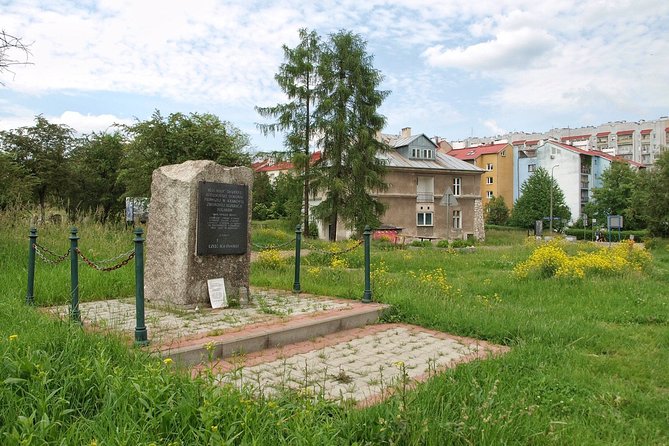
The guide uses the remaining evidence to make this large and complex story understandable. You may see the Grey House, ruins of the pre-burial hall, traces of the Jewish cemeteries, and the former roll-call square. The tour also addresses the disturbing use of fragments of gravestones to pave roads within the camp.
Those details can be hard to take in, but they explain why the site should be approached with care. The ground is not simply empty. It contains evidence of a destroyed community and a system built to strip people of identity, freedom, and dignity.
More Auschwitz-Birkenau memorial tours:
- From Krakow: Auschwitz-Birkenau Guided Tour & Hotel Pickup
★ 4.5 · 33,358 reviews - From Krakow: Auschwitz-Birkenau Guided Tour & Hotel Pickup
★ 4.5 · 29,340 reviews - Krakow: Auschwitz Guided Tour with Optional Hotel Pickup
★ 4.5 · 15,280 reviews - Krakow: Auschwitz-Birkenau Guided Tour with Pickup & Lunch
★ 4.5 · 9,800 reviews
Memorials, execution sites, and the Monument of Torn-Out Hearts
Several execution sites existed within the camp. Today, mass graves and memorials mark parts of the former camp area.
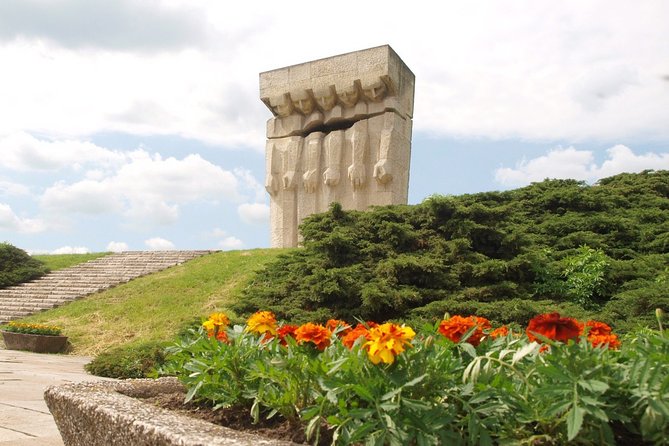
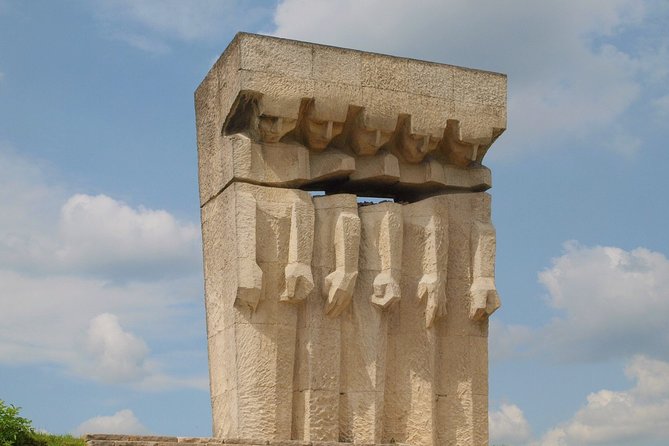
A major point of reflection is the Monument of Torn-Out Hearts. The monument is not just a place for a quick photograph. The guide explains how it relates to the people imprisoned and murdered here, giving the memorial meaning that can be missed when seen without context.
The camp’s organization is another key part of the walk. You learn how the living quarters, hospital, administrative areas, and industrial sections were arranged. That structure helps you picture daily life under imprisonment, forced labor, disease, punishment, and constant fear.
Some visitors may find the site less visually immediate than expected. There are no intact camp streets to follow from one building to the next. I see that as a reason to choose the guided walk, not a reason to skip it. The guide supplies the missing framework through maps, stories, and historical photographs.
Plaszow and Oskar Schindler
Oskar Schindler is inseparable from the way many people first encounter Plaszow. His enamelware business employed Jewish prisoners registered through the camp. By seeking work permits for them, he helped protect them from further transports.
Later, Schindler arranged for the workers to be transferred to his plant in Brunnlitz. More than 1,000 lives were saved through these efforts.
The tour uses Schindler’s story as part of the larger account, rather than allowing one famous individual to overshadow everyone else. That balance is important. Schindler’s List can help you recognize places and events, but a visit to Plaszow should also leave you thinking about the thousands of people who had no protector and whose names are less widely known.
A guide can also explain where the film follows the historical record and where a movie simplifies events. One particularly useful part of the experience is seeing old photographs alongside the present-day remains. This connection helped one participant understand how the film’s locations related to the real camp.
The guides make the difference
The strongest praise for this tour centers on the guides. Bartholomew has been described as informative and highly prepared. Barbara guided the group from Heroes Square to the former labor camp while answering questions and showing photographs along the way. Phil was praised for taking time at the main sites and explaining what happened in detail.
The operator provides the tour in English, and group tours use only one language at a time. Choose English when you book if that is the language you want.
A guide’s skill is especially important at Plaszow because the site asks you to imagine much of what no longer exists. The best approach is not to rush. Listen for how the camp changed over time, how different prisoner groups were treated, and how each section functioned.
The group can include up to 25 people. That is not an intimate private tour, but it is still a manageable size for a walking explanation. If you want a fully private experience or long personal conversations at every memorial, this format may feel too limited. For most people, the maximum group size offers a reasonable balance between price and personal guidance.
Is two hours enough?
Two hours is enough for a focused introduction, not a complete study of Plaszow.
The planned time includes roughly 15 minutes at Ghetto Heroes Square, about an hour at the main Plaszow site, and another 45 minutes examining the camp’s remaining features and memorials. The schedule gives you a clear route without turning the visit into an exhausting full-day program.
I like this length for a first visit. The subject is emotionally heavy, and two hours provides time to listen without overloading you. Still, do not expect to inspect every corner or spend long periods alone at each memorial. The tour moves at a purposeful pace.
Wear comfortable shoes. The walk includes the transfer between the square and Plaszow, movement around a broad former camp area, and time on foot at several locations. A moderate fitness level is requested, so this is not the right choice if you need a short, seated visit.
Is $30.04 good value?
At $30.04 per person, the tour offers solid value if you want the site explained rather than simply located.
There is no separate admission charge at the listed stops, so much of what you are paying for is the guide’s preparation, the route, the interpretation, and the use of historical images. At Plaszow, that guidance is not an optional extra. The remaining evidence is scattered, and the meaning of the site is not always clear from a casual walk.
The value is strongest for first-time visitors, people interested in the Kraków ghetto and Holocaust history, and anyone who has seen Schindler’s List and wants to place the film within the real setting. It is less compelling if you only want a quick photo stop or prefer to explore memorial sites without a fixed group schedule.
The tour is often reserved well ahead of time, with an average booking lead of about 39 days. That does not guarantee every date will sell out, but it is a useful sign that you should not leave it until the last minute if your Kraków plans are fixed.
Practical details that affect your day
The meeting point is Apteka pod Orłem, Plac Bohaterów Getta 18, Kraków. The end point is the bus stop at 57 Kamieńskiego Street. Since the walk finishes in a different part of the city, check how you will continue from there.
You receive confirmation when booking, and the experience is near public transportation. Arrive 10 minutes early. The no-latecomer rule is strict because the group leaves the meeting point together.
The experience is offered in English, with one language used per group. The maximum group size is 25 people. Free cancellation is available up to 24 hours before the start time. Cancellations or changes made less than 24 hours ahead are not accepted for a refund.
Bring practical footwear and be ready for a serious visit. The tour does not present Plaszow as a polished attraction. Its value comes from helping you read a difficult place with care.
Who should book the Plaszow walking tour?
I would choose this tour if you want historical context, clear guiding, and a direct connection between Ghetto Heroes Square and Plaszow. It is especially suitable if you have already seen Schindler’s List, want to understand the real locations, or feel you would miss important details exploring alone.
You should think twice if you want a museum with extensive indoor displays, a short stroll, or a relaxed sightseeing activity. Plaszow can be harrowing, and the walk requires attention and a moderate level of fitness.
For me, the strongest reason to book is the combination of a difficult site and an experienced guide. Bartholomew, Barbara, and Phil are each singled out for making the visit clear, thoughtful, and memorable. At Plaszow, that kind of explanation is worth far more than a simple map pin.
FAQ
How long does the Plaszow concentration camp tour last?
The tour lasts approximately two hours.
Where does the tour begin?
It begins at Apteka pod Orłem, Plac Bohaterów Getta 18, Kraków.
Where does the tour end?
It ends at the bus stop at 57 Kamieńskiego Street in Kraków.
Is transportation between Ghetto Heroes Square and Plaszow included?
The route includes the transfer from Ghetto Heroes Square to Plaszow, and one account describes making this journey by tram. The provided details do not specify whether a public transport fare is included.
What language is the tour offered in?
The tour is offered in English. Group tours use only one language, so select your preferred language when booking.
How large can the group be?
The maximum group size is 25 people.
What level of fitness is needed?
A moderate level of physical fitness is recommended. Comfortable shoes are also advised because the experience involves walking between the square, the former camp area, and its memorials.
Can I cancel for a full refund?
Yes. You can cancel at least 24 hours before the experience start time for a full refund. Cancellations or changes made less than 24 hours before the start time are not accepted for a refund.
Just added in Krakow
- Auschwitz-Birkenau – Skip the Line Tickets★ 3.5 · 29 reviews
- Auschwitz-Birkenau: Fast-Track Ticket & Guided Tour No Transfers★ 3.5 · 17 reviews
- Zakopane & Sleigh Ride with Bonfire – Group Tour from Kraków★ 5.0 · 2 reviews
- Sleigh Ride & Bonfire in Zakopane with Funicular – Private Trip★ 5.0 · 48 reviews
- Thermal Baths & Zakopane – Private Trip from Krakow★ 5.0 · 1 review
- Zakopane & Gubalowka Funicular – Private Winter Tour from Krakow★ 5.0 · 10 reviews
- Divine Mercy Sanctuary – Private Tour from Krakow★ 5.0 · 4 reviews
- stag dog chase Krakow prank★ 5.0 · 4 reviews